

Description
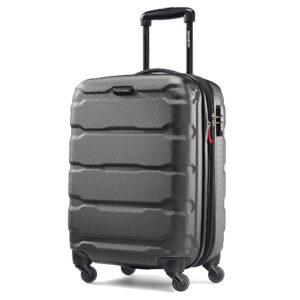
The Samsonite Freeform is a 21 inch expandable hard shell aimed at travelers who want a rigid case without the weight of an aluminum frame, and at 6.5 pounds it lands close to softside territory. The manufacturer’s own product title includes the words airline approved, and that phrase is doing more work than the published dimensions support. Read the numbers rather than the name, because the exterior figure this listing gives is over the common United States domestic allowance on two of three axes.
The traveler and the trip
This is a case for the regular flyer who checks nothing and wants the contents protected. A hard shell keeps a laptop, a camera or a bottle safe from the crush of an overfilled overhead bin in a way a fabric case does not, and the Freeform’s low weight removes the usual penalty for that protection. The trip profile is three to five days for one adult, or a weekend for two if the packing is disciplined.
It is a poor choice for anyone who needs to reach a passport or a laptop without opening the case, because hard shells have no exterior pockets. It is also a poor choice for rough ground travel. If pocket access is what you need, the Travelpro Maxlite 5 softside makes the opposite trade, and other fabric cases sit alongside it in carry on luggage.
Dimensions, and what the airline approved claim rests on
Samsonite publishes both figures, which is to its credit. The exterior is 21.25 by 15.25 by 10.0 inches with wheels. The interior packing space is 19.5 by 14.5 by 10.0 inches. The gap between the two is the shell wall, the wheel housings and the handle mechanism, and on this case it is about one and three quarter inches on the width, which is a large share.
Against the common allowance
The commonly cited United States domestic carry on allowance is around 22 by 14 by 9 inches. At 21.25 by 15.25 by 10.0 inches this case is comfortably under on height, over by one and a quarter inches on width, and over by a full inch on depth. Samsonite’s bullet says the case meets the cabin size restrictions of most airlines, which is a scoped claim. The product title’s airline approved wording is not scoped and is not something a manufacturer can grant, and we are not going to repeat it in our own voice.
A rigid shell has no give in a sizer. Where a softside compresses and passes, a hard shell over on two axes will not. That does not mean this case is refused everywhere; plenty of carriers police the total footprint loosely and plenty of gate agents never measure. It does mean that on a carrier with a rigid sizer at the gate, this case is the wrong side of the line on the numbers Samsonite itself publishes. Check the 21.25 by 15.25 by 10.0 figure against your specific airline and fare before you buy.
The case also expands, and expansion adds depth to a bag already at 10 inches. Do not plan to use it on a flight where you intend to carry the bag aboard.
Shell, wheels, handle and lock
The exterior is described as textured and scratch resistant. Samsonite does not name the polymer in the bullets we can read, which is worth flagging on a brand that usually does. The Freeform line has historically used a polypropylene shell rather than polycarbonate, and the two behave differently: polypropylene is lighter and more flexible but takes a permanent dent where polycarbonate springs back. Since the listing is silent, ask before assuming. The texture is genuine practical value, because it hides the scuffing that a gloss shell shows within a single trip.
Four oversized multidirectional spinner wheels handle the rolling. Oversized castors roll better over expansion joints and thresholds than small ones and are more stable under a full load, which partly offsets the usual spinner weaknesses. The weaknesses remain: exposed castors are the first thing to break, they are poor on cobble and gravel, and they are part of why the exterior depth reaches 10 inches.
The closure is a zipper with a built in combination lock that Samsonite describes as TSA approved, and one bullet says it ensures belongings stay safe and sound. That overstates it. A TSA recognized lock opens to a universal key held by screeners. It deters an opportunist and keeps the case from falling open. It is not security, and valuables should not travel in a checked bag behind one. The same caution applies to the lock on the Samsonite Omni 2 carry on and every other case with the feature.
Capacity, packing behavior and the weight
Samsonite publishes an interior dimension rather than a liter capacity, which is unusual and arguably more useful. At 19.5 by 14.5 by 10.0 inches the packing space works out to roughly 46 liters of raw volume, though a hard shell never delivers all of that because the retracted handle housing intrudes into one half. Expect the handle side to be noticeably shallower than the other, and pack the bulky items on the free side.
Interior organization is elastic straps, a divider and a pouch. That is the standard hard shell layout and it works, because the divider stops the loose half migrating in transit. At 6.5 pounds empty the case is light for its construction, roughly a pound heavier than the lightest softsides and two pounds lighter than a comparable aluminum framed case. On carriers that enforce a cabin weight limit, that gap is real packing capacity.
Warranty and the alternatives
Samsonite states a ten year warranty backed by testing. Ten years is at the long end of published luggage terms and it is stated plainly, which is worth something in a category where warranty language is usually vague. It is also a defects warranty. Airline handling damage is the standard exclusion across the whole category, and a warranty that does not explicitly cover carrier damage does not cover the damage that actually happens. Read the exclusions rather than the headline number.
Worth noting is that Travelpro’s Maxlite line publishes a limited lifetime term that explicitly covers carrier damage for one year, which is a narrower promise but a more specific one. Within Samsonite’s own range, the Omni PC hardside and the Winfield 3 DLX are the closest hard shell comparisons, and larger cases in the same construction sit under suitcases.
Who should buy it and who should not
Buy it if you want rigid protection at 6.5 pounds, you value a published interior dimension and a ten year defects warranty, and your carrier is relaxed about the footprint of a cabin bag. The oversized castors and the textured shell are well judged.
Skip it if you fly airlines with rigid gate sizers, because at 21.25 by 15.25 by 10.0 inches this case is over the common 22 by 14 by 9 allowance on both width and depth by Samsonite’s own numbers, and a hard shell cannot be squeezed. Skip it too if you need exterior pockets. And treat the airline approved wording in the product name as marketing, not as a compliance statement.