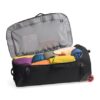

Description
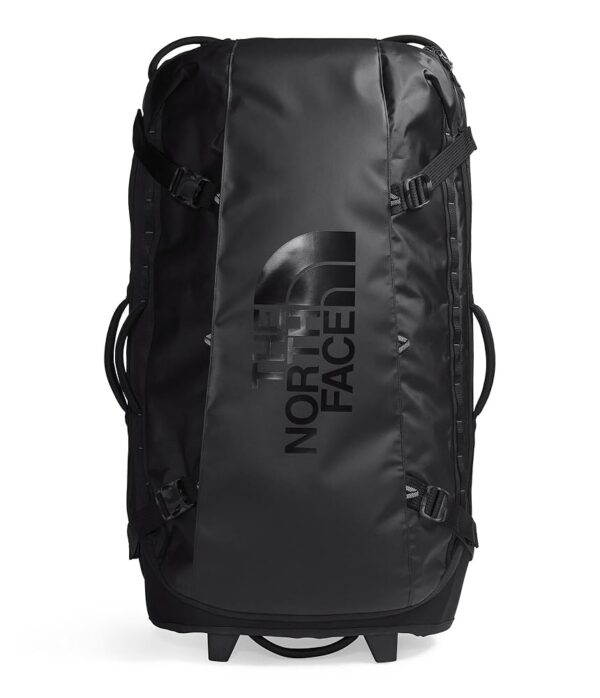
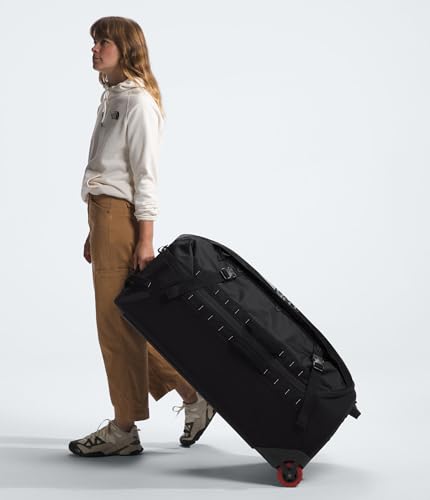
The North Face Base Camp Rolling Thunder 36 is a wheeled expedition duffel with a hard shell chassis. Its feature bullets carry a full and coherent technical specification. Its specification block carries a dimension figure of 0.39 inches on every axis and a capacity of one liter. Both of those need dealing with before anything useful can be said.
The traveler and the trip this is for
This is an expedition bag rather than a suitcase. The North Face pitches it at people who move gear: climbing and ski kit, camera equipment, field supplies, the loads that a rigid suitcase wastes space on because it has corners the contents cannot fill.
At 160 liters it is the largest bag in this catalog by capacity, and it is checked luggage under every reading. Readers comparing wheeled gear haulers should read the Osprey Sojourn Shuttle 100L and the Dakine Split Roller 110L.
The size, and the fee it will attract
The tech specs bullet gives dimensions of 36.2 by 19.7 by 15.7 inches, or 92 by 50 by 40 centimeters, with a volume of 160 liters. The two unit systems convert to each other correctly, so the figures are internally consistent.
Against the checked allowance
Most United States carriers apply a checked bag limit of 62 linear inches, meaning length plus width plus height added together. At 36.2 by 19.7 by 15.7 inches the linear total is 71.6 inches.
That is 9.6 inches over the limit, which is not marginal and is not something a busy counter will overlook on a bag this size. Oversize fees apply per leg and they are substantial. Anyone flying with this bag should assume an oversize charge, price it into the trip, and check whether their carrier has an upper size limit beyond which a bag is refused entirely rather than surcharged. Many do.
That is not a criticism of the bag. Expedition duffels are built to a use case where a fee is the cost of moving equipment, and a bag this size is often driven, shipped or flown as excess baggage by arrangement. It is a criticism of buying one without knowing.
The capacity of 160 liters cross checks credibly: the outer envelope of 36.2 by 19.7 by 15.7 inches is about 11,196 cubic inches, or roughly 183 liters, so a stated 160 liters sits sensibly below it and reads as a genuine usable figure.
Two weights and two impossible fields
The specification block gives an Item Weight of 17.61 pounds, repeated in a second field. The tech specs bullet gives an average weight of 11 pounds 11 ounces, which is 11.69 pounds.
Those differ by nearly six pounds, which is more than a third of the lower figure. On a bag already facing an oversize fee, six pounds of uncertainty also matters against a weight allowance. There is no way to resolve it from the listing. Plan on the heavier figure.
Two specification fields are simply wrong and should be disregarded entirely. Product Dimensions reads 0.39 by 0.39 by 0.39 inches, which is a one centimeter cube and cannot describe any bag. Capacity Total reads 1 Liters, against a stated volume of 160. Both are flagged here rather than quietly dropped, because a shopper skimming the specification block will meet them before the bullets.
A third field reads Language: Polish, which is a template field that has no application to a suitcase.
Materials, chassis and the sustainability badge
The shell is 100 percent recycled Base Camp fabric with a durable water repellent finish. Base Camp fabric is the maker’s name for the coated laminate used across that line, and while no denier is published, the DWR finish is a real specification: it makes water bead and run off rather than soak in, and it fades with use rather than lasting the life of the bag.
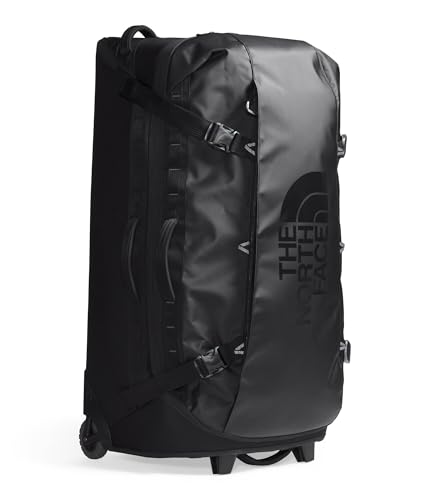
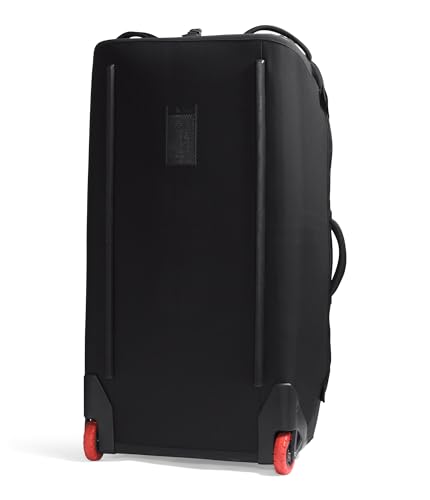
The chassis is described as a new hard shell design with custom molded wheels. A rigid chassis on a soft duffel is the right engineering: it gives the bag a base that takes the abrasion and a structure the wheels can mount to, without making the whole bag rigid.
The sustainability claim is unusually specific and deserves credit for it. The maker states that to carry its badge, a product must be made with 75 percent or greater recycled, regenerative or responsibly sourced renewable materials by weight. That is a stated threshold with a stated measurement basis, which is far more than the eco conscious adjectives elsewhere in this catalog. It is the maker’s own program rather than a third party standard.
Organization, security and the age restriction
The outer zipper is lockable with ergonomic U pulls, which are easier to grip than flat tabs and usable with gloves. Lockable means the pulls accept a padlock; no lock is stated as included.
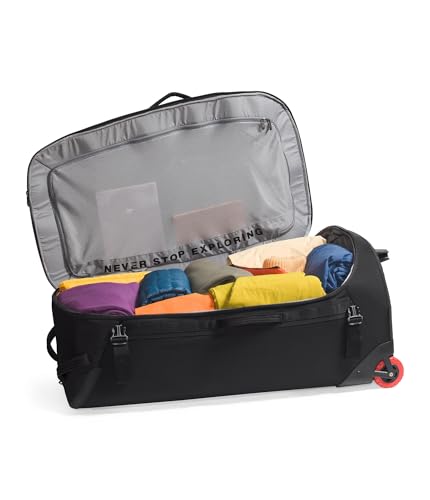
Inside there is a compression panel that cinches down clothing, with two secure zip mesh pockets. A compression panel on a 160 liter bag is doing real work, because that much loose volume consolidates into a shifting mass that makes the bag hard to lift and unstable to tow.
A Sherpa strap carries a second bag, which is the feature that makes a bag this size manageable through a terminal when you are also carrying something else.
One line in the tech specs is worth repeating: this item is not intended for use by children 12 and under, and the Age Range Description field reads adult. That is a stated restriction rather than marketing, and on a 160 liter bag weighing at least 11.7 pounds empty it is a sensible one.
The Department field reads Men’s, which is a categorization artifact rather than a description, since nothing about the bag is gendered. Readers wanting a rigid alternative at large capacity should read the OGIO Rig 9800 or the Traveler’s Choice Maxporter II 30 inch spinner.
Warranty and the demand picture
No warranty term is published anywhere in this listing. No period, no scope, no exclusions. Where luggage warranties are published, lifetime and limited lifetime terms commonly exclude damage caused by airline handling, which is the damage a checked duffel actually takes.
The listing shows a 5.0 star average across 3 ratings. Three ratings is not a sample and no conclusion should be drawn from that average in either direction. It ranks 499th in Suitcases and 558,791st in Clothing, Shoes and Jewelry. More options sit across the suitcases category and the travel duffels category.
Who should buy it, and who should not
Buy it if you move large volumes of equipment, you want a hard shell chassis under a recycled fabric body with a compression panel and a lockable zipper, and an oversize fee is a cost you have already accepted.
Skip it if you are flying and expect to pay standard checked rates, because 71.6 linear inches is far outside the common allowance. And disregard the specification block’s dimension and capacity fields entirely, since they read 0.39 inches and one liter.