Description
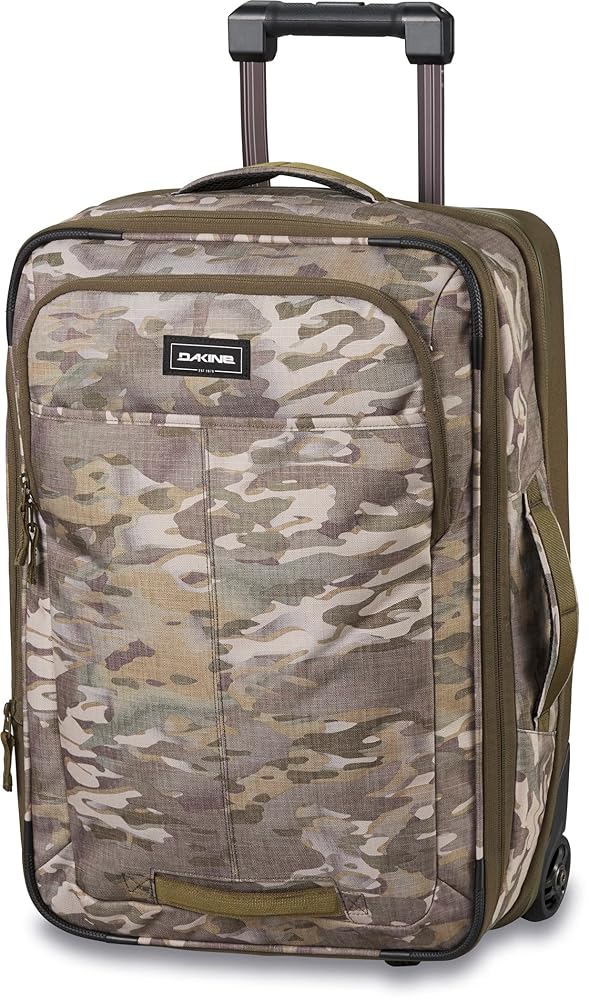
The Dakine Status Roller 42L in vintage camo, model 10002940, is a soft sided cabin case with a large expansion panel and a laptop sleeve sized well above the class average. Its first feature bullet claims legal carry-on size for most airlines, and that phrasing needs correcting before the rest of the listing means much.
The traveler and the trip this suits
This is a three to five day cabin bag for someone carrying a large laptop. The exterior pocket with a padded 17 inch laptop sleeve is the standout specification: most cabin cases stop at 15 or 16 inches, and a 17 inch machine is awkward to carry any other way.
At 5.94 pounds empty it is light for a cabin case with a laptop sleeve and an expander. Readers comparing at this size should read the Travelpro Platinum Elite carry-on, and the same maker’s larger bags are covered in the Dakine Split Roller 110L review and the Dakine Split Roller review.
Legal carry-on size, and why that is the wrong word
The first feature bullet reads legal carry-on size, with most airlines in parentheses.
Nothing about cabin bag size is a legal matter
In the United States the Federal Aviation Administration regulates what may be carried and how it must be stowed for safety. It does not set a cabin bag size in inches, and no other regulator does either. Each airline publishes its own cabin allowance as a commercial policy. There is no legal carry-on size to comply with, and a bag cannot be legal or illegal by its dimensions.
The parenthetical qualifier, most airlines, is the maker acknowledging the real position while the word legal undercuts it. This is the maker’s claim and it is repeated here only as the maker’s claim.
What the numbers say: the specification block gives Product Dimensions of 13.77 by 9.05 by 21.5 inches. Against the commonly cited United States domestic figure of roughly 22 by 14 by 9 inches, this bag is half an inch inside on height, about a quarter inch inside on width, and five hundredths of an inch over on depth. In practice it sits level with the common convention rather than outside it, which is a good result and is not the same as being legal anywhere.
Budget and regional carriers publish smaller figures, and international carriers frequently enforce a cabin weight limit as well. Check the airline you are flying. The listing also does not state whether the quoted dimensions include the wheels and the retracted handle.
The expander, and what using it costs
The expansion panel adds 15 liters, stated as 900 cubic inches. That takes the bag from 42 liters to 57, which is a 36 percent increase and one of the largest expanders in this catalog.
It is also the largest compliance hazard here. Nine hundred cubic inches spread across the footprint of this bag adds roughly three inches of depth, taking it from 9.05 inches to somewhere around 12. That is a third over the common cabin figure. An expanded Status Roller is a checked bag, and the listing does not say so anywhere.
Use the expander on the return leg of a trip where the bag is going in the hold, and not on a flight where you intend to board with it.
Capacity of 42 liters cross checks well. The outer envelope of 21.5 by 13.77 by 9.05 inches is about 2,679 cubic inches, or roughly 43.9 liters, so a stated 42 liters sits just below it. On a soft bag with no rigid shell to subtract, that is exactly what a credible usable figure looks like.
The molded cup rest, and other details
A molded cup rest is specified, which is unusual enough to explain. It is a recess formed into the top of the bag that holds a cup or bottle steady while the bag is standing, so a drink can be set down without a separate holder. On a bag towed through a terminal that is a small, genuinely useful piece of design, and it is the sort of feature that comes from a maker whose customers stand around in airports and lift areas rather than from a luggage house.
Buyers who want a bag of this kind with a published fabric specification rather than none should compare the Dakine Verge weekender tote, which states a denier for its shell. It is a different format, a soft tote rather than a wheeled case, and it shows what this listing could have included.
Beyond that, the listing is thin. Four feature bullets is all there is.
No shell material is named. Not a fiber, not a denier, not a weave, not a coating. On soft luggage the fabric weight determines whether the bag lasts five years or five trips, and abrasion at the bottom corners is the failure that arrives first. Nothing here helps.
No wheel specification appears either: no count, no type, no diameter, no statement of whether they are recessed inline wheels or exposed spinner castors. That is a fundamental difference in how the bag behaves and it is missing.
No interior organization is published at all beyond the exterior laptop pocket. No pocket count, no compression straps, no divider, no lining description.
That silence on the interior matters more than it might on a checked bag. A cabin case is opened and repacked repeatedly across a trip, in overhead bins, on hotel luggage racks and on beds, and whether the contents stay put when it is opened flat depends entirely on straps and dividers this listing does not mention. Assume there are none until the seller confirms otherwise.
Warranty and the demand picture
No warranty term is published anywhere in this listing. No period, no scope, no exclusions. That is worth noting because the maker’s Split Roller listing in this catalog does state a limited lifetime warranty, so its absence here is a gap in this record rather than a statement about the brand. Where luggage warranties are published, lifetime and limited lifetime terms commonly exclude damage caused by airline handling.
The listing shows a 5.0 star average across 2 ratings. Two ratings is not a sample and no conclusion should be drawn from that average in either direction. It ranks 539th in Carry-On Luggage and 455,187th in Clothing, Shoes and Jewelry. The product name also carries a stray plus sign after the capacity, reading Status Roller 42L plus, which is a data artifact. More cabin options sit across the carry-ons category and the carry-on luggage category.
Who should buy it, and who should not
Buy it if you carry a 17 inch laptop and want a cabin bag with a padded sleeve that actually fits one, you want a light bag that sits level with the common cabin figure, and the molded cup rest appeals.
Skip it if you need to know what the bag is made of or how many wheels it has, because neither is published. Skip the expander entirely on any flight you intend to board with, since it adds roughly three inches of depth.