

Description
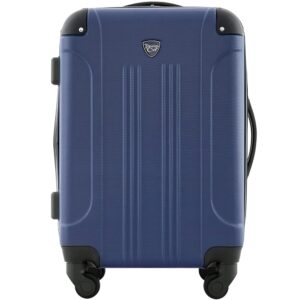
The Wrangler Astral is a 20 inch hard shell with a three in one fitting on the back: a cup holder, a phone holder and a USB port in a single molded unit. That is the reason to consider it and it is also the reason to read the boarding rules before you fly with it. The listing publishes a dimension set, two capacity figures that correctly differ before and after expansion, and no shell material at all.
The traveler and the trip
Around 44 liters closed and just under 50 liters expanded, at roughly 7 pounds, is a four to five day bag for one adult. The cup and phone holder aim it at someone who spends time standing in terminals with no free hands, which is a genuine and under served problem. The USB port aims it at the same person.
It suits domestic leisure and business travel on carriers that do not measure cabin bags closely. It does not suit anyone whose binding constraint is weight, and it does not suit travelers who want a case with nothing to go wrong, because a molded fitting on the back panel is a protrusion and a mechanism. Simpler cases at the same size sit in carry on luggage.
Dimensions, and the expansion claim to ignore
The attribute block gives 14.5 by 9.5 by 22 inches. Reordered, that is 22 inches on the longest side, 14.5 wide and 9.5 deep. The manufacturer bullets publish no dimensions at all, so this single figure is the whole disclosure, and it does not state whether the castors, the retracted handle or the rear cup holder unit are included.
Against a sizer
The commonly cited United States domestic carry on allowance is around 22 by 14 by 9 inches, measured with the castors on. This case matches the height exactly, is half an inch over on width, and is half an inch over on depth. A rigid shell has no give, so unlike a fabric case it cannot be pressed into a gauge it does not fit. If the rear cup holder unit stands proud of the 9.5 inch depth figure, which the listing does not address, the effective depth is greater still.
Wrangler makes no explicit compliance claim in the bullets we can read, and we are not going to make one on their behalf. Budget and regional carriers publish tighter allowances than the mainstream figure and enforce them with rigid gauges, and international carriers frequently add a cabin bag weight limit that a 7 pound case eats into before you pack.
The short description previously carried on this page claimed the expansion provides extra space without compromising overhead compartment compatibility. That is not how expansion works. A gusset adds material to one axis, and a case already half an inch over on two axes is further over once it is used. Every expandable cabin bag is a cabin bag with a checked bag setting, and this one is no exception. Treat the gusset as a feature for a return leg you are prepared to check.
The USB port, the cup holder and the battery rule
The three in one fitting is genuinely uncommon. A cup holder that folds out of the back panel takes a coffee while you handle a phone and a boarding pass, and a phone holder above it keeps a screen visible while you walk. Both are useful and both add protrusions to a shell that a gauge will measure.
The USB port needs the standard caution. Most airlines require lithium batteries and power banks to be carried in the cabin rather than in the hold, and they require any battery inside a piece of luggage to be removable. Bags with batteries built permanently into the shell have been refused at check in and at the gate by multiple carriers, which is a boarding risk rather than an inconvenience.
This listing does not say whether a power bank is included, whether one is required, or whether it is removable. That is an important omission on a case with an electrical fitting. Confirm it with the seller before you buy, and if the port runs off your own power bank, take it out before the case is checked and carry it on your person. Cases such as the Traveler’s Choice Pagosa state plainly that the power bank is not included, which is the disclosure to look for.
A practical note on the port itself: it is a passthrough connecting an external socket to a cable inside. It stores nothing. Without a power bank it does nothing at all.
Shell, wheels and handles
The listing calls this a sturdy hardside shell and a durable hardside shell, and never names the polymer. That is the most consequential omission on a hard shell, because ABS cracks under impact where polycarbonate flexes and springs back, and polypropylene dents permanently rather than doing either. Without the material you cannot predict how the case fails, and how it fails is the whole question on luggage. The maker’s own Wrangler hardside spinner does name its shell as ABS, so the omission here is a choice rather than a house style. Ask before buying.
The wheels are a 360 degree four wheel system, meaning four spinner castors. The listing does not say whether the castors are single or dual wheeled. Dual castors roll more smoothly under a full load and are more stable on a sloped floor, so the omission matters. Castors are the most common failure point on wheeled luggage, they are poor on cobble and gravel, and their exposed profile adds to the depth a gauge measures.
There are top and side carry handles, which is the right arrangement for lifting a case into an overhead bin from different angles. The telescoping handle is not described at all: no material, no number of stop heights.
One note on the source record. The manufacturer field reads Travelers Club Luggage rather than Wrangler. That is a licensing arrangement rather than an error, and it explains why this case shares a specification pattern with the Wrangler smart luggage set and other Travelers Club products. The brand on the shell and the company building it are different things.
Capacity, packing and weight
The capacity fields are among the better ones in this catalog because they actually differ: 2687.34 cubic inches closed and 3030.5 cubic inches total. Converted, that is about 44 liters closed and about 49.7 liters expanded, a gain of roughly 5.7 liters. Publishing distinct figures before and after expansion is what an expandable listing should do and most in this catalog do not.
Forty four liters is generous for a 20 inch case, and the reason is visible in the exterior: a 9.5 inch depth is deep, which is also what puts the case over the cabin allowance. Capacity and compliance are a straight trade in this category and this case has chosen capacity.
Weight is given as 3.2 kilograms, which is about 7.05 pounds. Publishing a luggage weight in kilograms on a listing aimed at a United States audience is an import artifact rather than a manufacturer decision. Seven pounds is toward the heavy end for a 20 inch case, and the three in one fitting and its wiring are part of the reason. For comparison the polycarbonate Samsonite Omni PC weighs 6.81 pounds with no electrical fittings at all.
The interior is not described anywhere in the bullets. No divider, no compression straps, no pockets are named, which is a real gap on an otherwise talkative listing.
Warranty and the comparison set
No warranty term appears anywhere in the source data. On a case with electrical fittings that is a larger gap than usual, because a USB port and its wiring are a failure mode a plain suitcase does not have and it is not obvious whether a luggage warranty would cover it. Get the term and the exclusion list in writing before ordering, and ask specifically about the port and the cup holder mechanism.
Expect airline handling damage to be excluded whatever term you are quoted, as it is across essentially this entire category. If a published warranty is what decides the purchase, Samsonite states ten years against defects and Travelpro states a limited lifetime term with one year of carrier damage cover. Larger cases in the same construction sit under suitcases.
Who should buy it and who should not
Buy it if the cup holder and phone holder solve a problem you actually have, you want 44 liters closed with a properly published 49.7 liter expanded figure, and your carrier is relaxed about cabin bag footprint. The capacity disclosure on this listing is better than most.
Skip it if you need to know what the shell is made of, because the polymer is never named. Skip it too if your airline uses a rigid gauge, since at 22 by 14.5 by 9.5 inches the case is over the common allowance on two axes before the rear fitting is counted. And establish whether the USB port runs off a removable power bank before you check the bag anywhere.