
Description
Who this London Fog Newcastle spinner suits
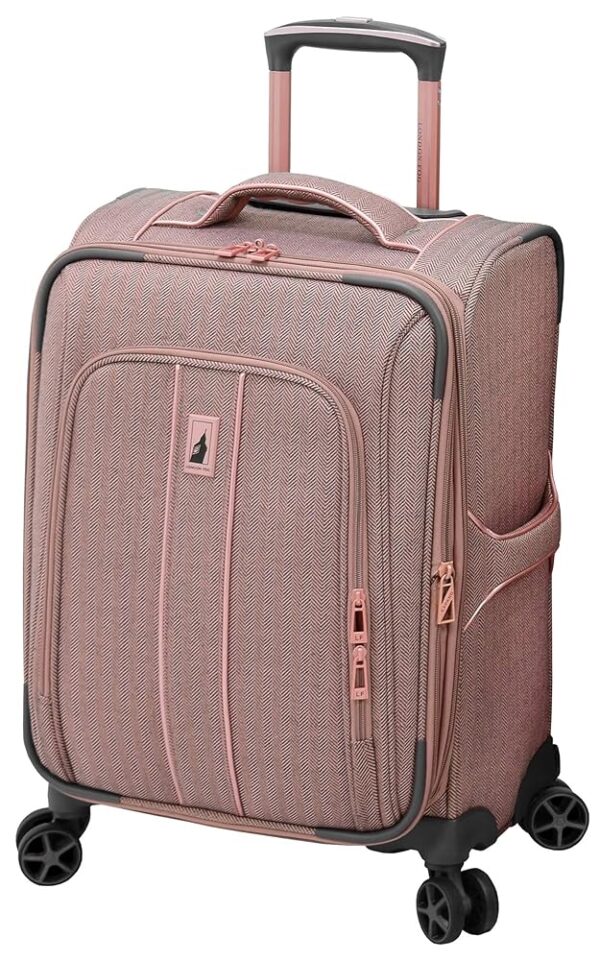
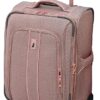
This is a softside cabin spinner in a woven herringbone fabric, aimed at the traveler who wants a bag that looks like luggage rather than sports equipment. The styling is the pitch, and there is no shame in that: a herringbone weave with contrasting signature lining is a deliberate alternative to the black nylon and gloss polycarbonate that fills the rest of this category.
Underneath the styling the specification is more serious than it first looks. Honeycomb internal structure, a reinforced back panel, corner guards, self repairing zippers and eight low profile wheels are all durability features rather than decoration. The trip is three to five nights. If you want the same softside format with a published airline damage clause, the Travelpro Crew Classic spinner is the comparison to make.
Dimensions and where they land
The specification block gives 14 by 9 by 19.5 inches. Against the size guideline most commonly cited for United States domestic cabin baggage, roughly 22 by 14 by 9 inches, that is inside on every axis, with two and a half inches of margin on the longest one. For a bag sold as a 20 inch spinner, 19.5 inches is a credible body height.
What the listing does not say
Whether the wheels and the retracted handle are included. On a spinner the casters sit under the body and add to the height, and eight low profile wheels means four dual casters, so the measured height is very likely above 19.5 inches. Low profile is the useful word there: shallower casters add less than tall ones, which is presumably why the maker chose them. Even so, assume the object measures more than the published figure and confirm it yourself.
We will not write that this bag is airline approved and the listing does not claim it. Check the allowance published by the carrier and fare you booked, note that budget and regional carriers are frequently stricter than the majors, and remember that many international carriers enforce a cabin weight limit as well, which matters here because 7.7 pounds empty is not light.
The bag expands two inches for additional packing capacity. That expansion adds to the depth, taking a bag published at 9 inches to roughly 11 and pushing it outside the commonly cited guideline. A bag that fits closed will not necessarily fit expanded. Use the expansion on the return leg only where a gate check is acceptable.
Fabric, structure, wheels and handle
The face fabric is a woven herringbone. The listing does not publish a denier rating, so the weave weight is unstated, which is the usual gap. What it does describe is the structure underneath, and that is where the interesting engineering is. A honeycomb internal structure is a cellular panel that resists crushing at a given weight far better than a flat sheet, and a separately reinforced back panel adds stiffness where a spinner needs it most, because the back panel is what the handle assembly mounts to and what takes the load when the bag is pulled.
Heavy duty corner guards protect the four points a bag lands on. On a softside bag the corners are where the fabric abrades through first, so armoring them is the right allocation of weight.
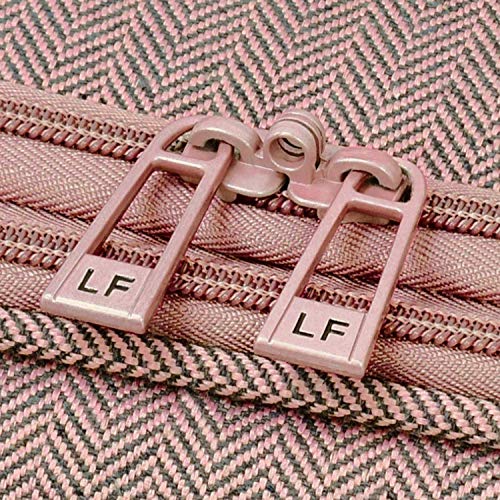
The zippers are described as self repairing with ergonomic pulls. Self repairing means a coil design where the teeth remesh if the slider is run back over a split, which is a genuine feature rather than marketing and addresses the second most common luggage failure after the wheels. It is still a coil zipper, which can be split with a ballpoint pen and closed again, so it is not a security feature.
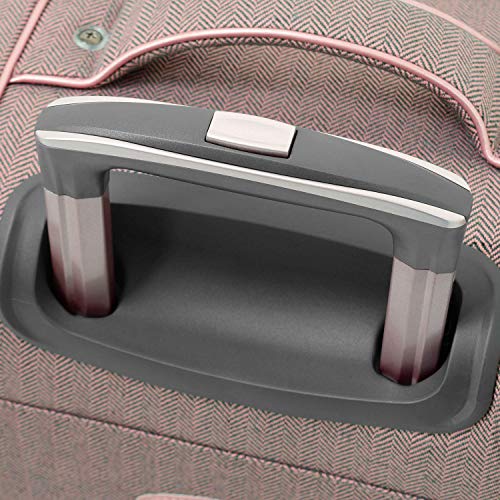
The handle is an aluminum locking push button system with channels for added strength. Channels means the tubes run in guided tracks rather than free in the body, which reduces the twisting play that makes cheap handles wobble. Locking rather than floating is what stops stress concentrating at the mounts.
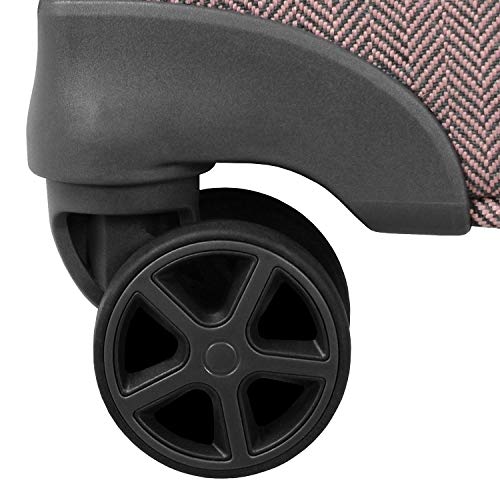
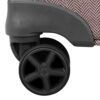
Eight low profile 360 degree wheels means four dual casters. Spinners roll sideways easily on smooth terminal floors and catch and tip on curbs and rough pavement, and exposed casters are the most common failure point on any wheeled bag. Low profile casters are shallower and therefore add less to the measured envelope, at the cost of clearance over uneven ground.
Capacity, weight and a number that is only arithmetic
Capacity is published as 2,457 cubic inches, which is an unusual unit and works out to roughly 40 liters. Run the arithmetic on the published exterior of 14 by 9 by 19.5 inches and you get 2,457 cubic inches exactly. The two numbers are identical because the capacity figure is the multiplication of the three exterior dimensions, not a measurement of what fits inside.
That distinction matters. A softside bag loses less of its envelope to structure than a hard shell does, but it still loses the handle channel, the wheel wells, the honeycomb panel and the lining. Realistic usable volume will be meaningfully under 40 liters. Plan from the linear dimensions and the interior layout rather than from the cubic inch figure, and note that anyone comparing this bag against a rival quoting real usable liters is not comparing like with like.
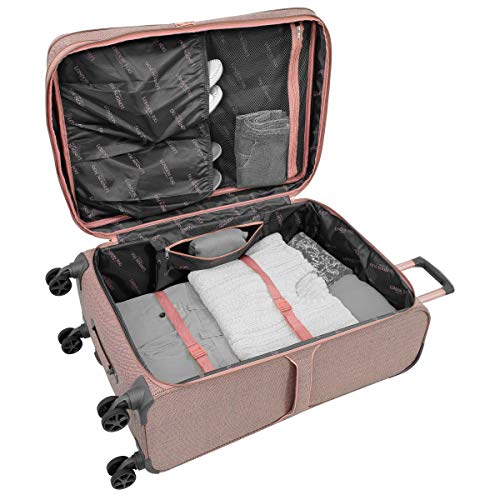
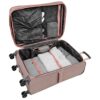
The interior is better specified than most: two shoe pockets, a zippered mesh pocket, a zippered accessory pocket and EVA foam padded fronts. Two dedicated shoe pockets is unusual and genuinely useful, because shoes are the single thing most likely to ruin clothes in a shared cavity. A front exterior pocket takes last minute items, and there are carry handles on the top, side and bottom, which is what you want when lifting the bag into an overhead bin from an awkward angle.
Weight is 7.7 pounds empty. That is on the heavy side for a softside cabin bag and it is where the honeycomb structure, the corner guards and the eight wheels have gone. On United States domestic routes cabin bags are not weighed. On budget European and many Asian carriers, where the allowance is 7 or 8 kilograms and enforced, 7.7 empty pounds takes about half of it.
Warranty, branding and the alternatives
No warranty term appears on this listing. No period, no coverage description, no exclusions, and nothing about airline handling damage, which is the damage luggage actually suffers. There is also no lock and no lock provision described anywhere. The locking push button handle is a handle that locks in position, not a lock on the bag, and buyers should not read it as one.
One point about branding worth knowing. The manufacturer field on this listing reads Leisure Merchandising Corp rather than London Fog. London Fog is a licensed name across several product categories, and luggage carrying it is made and sold by a licensee. That is not a defect and it is not unusual, but it does mean the brand on the bag is not a guide to who stands behind it, which matters more than usual when no warranty is published.
The review base is 4.3 from over 1,150 ratings with a rank of 198th in its Amazon category. That is a solid pool for reading failure reports, and with no warranty published it is the research that matters. Within the same brand, the London Fog Newcastle carry on is a sibling listing worth comparing directly, and the London Fog Queensbury set covers the multi piece option. Wider choices sit in our carry-on luggage and luggage sets sections.
Who should buy it and who should not
Buy it if you want a softside cabin bag that looks like luggage, with genuine structural reinforcement, self repairing zippers, corner guards and two shoe pockets, and your published dimensions leave room for wheels that are not in the stated figure. Skip it if you fly carriers that weigh cabin baggage, because 7.7 pounds is heavy, and skip it if you need a lock, because there is none. Do not plan around 40 liters: that figure is the outside of the bag multiplied out, not the space inside it.