Description
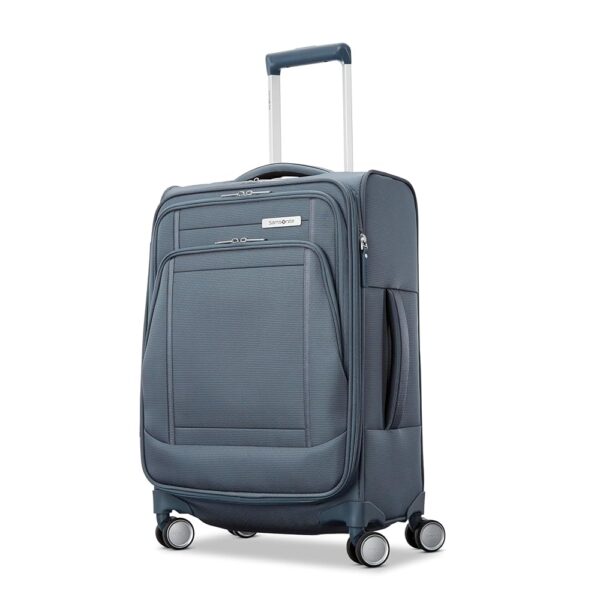
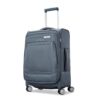
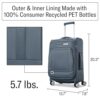
The Samsonite UpLIFT softside carry-on, model 152024-A382 in Elemental Blue, is a 20 inch spinner built from recycled polyester with a published empty weight of 5.7 pounds and a ten year limited warranty behind it. Among the cabin bags on this site it is one of the few whose listing publishes the numbers a buyer actually needs, and that alone changes how it should be read.
The trip and the traveler this suits
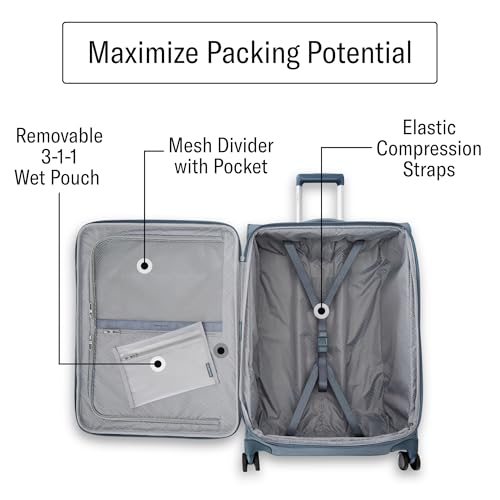
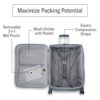
This is a bag for the traveler who flies often enough to care about weight and who wants exterior pockets. Softside cases give you something a hard shell cannot, which is an outer face you can reach into while the bag is still standing at your feet. The UpLIFT design uses that with a mesh dual access pocket reachable from inside the main compartment and from the exterior face panel, which is the arrangement that suits a laptop bag on the same trip or a document you need at the desk.
It suits a traveler less well who wants crush protection. A polyester shell will not stop a bag above it in an overhead bin from pressing on what you packed, and it will not shrug off rain the way a sealed hard shell does. Anyone carrying something rigid and fragile should be looking at the hardside UpLIFT carry-on instead, which is the same line with a rigid shell.
Dimensions and what an airline will measure
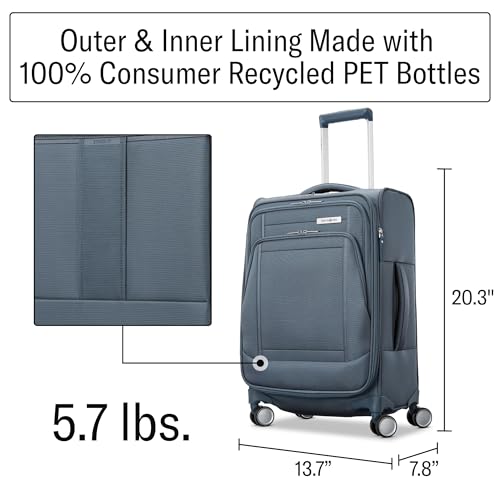
The specification block gives 13.7 by 7.8 by 20.2 inches. That is comfortably inside the roughly 22 by 14 by 9 inch convention most United States domestic travelers have in mind, with more than an inch and a half of headroom on height and an inch of headroom on depth. On the face of it this is a conservatively sized cabin bag rather than one built right up to the limit.
There is a caveat and it is the usual one. The listing does not state whether 20.2 inches includes the spinner wheels and the retracted handle housing, or whether it describes the shell alone. On a four wheel spinner the wheels typically add between one and two inches to the height, and that is exactly the gap between a bag that clears a sizer and a bag that does not. If the 20.2 inch figure excludes the wheels, the measured height is closer to 22 inches and the headroom disappears. The honest position is that the listing does not say, so measure the assembled bag from the floor to the top of the retracted handle before you rely on it.
The expansion is the part that will catch you out
The maker states that the expansion zipper adds 0.75 inches of packing capacity. That is a useful amount of room and it is a straightforward liability at the gate. Expanded depth is measured depth. If the listing’s 7.8 inch depth is accurate and you expand, you are presenting a bag around 8.55 inches deep, which is still inside the 9 inch convention but has lost most of its margin, and on a carrier with a tighter allowance it will not be inside anything. Expansion on a carry-on is a feature for the flight home when you have checked the bag, not a feature for the flight out when you have not.
Samsonite’s own product title uses the words airline approved. That claim is Samsonite’s. We are not repeating it in our own voice, because there is no such thing as general airline approval. Allowances are set airline by airline, budget and regional carriers are commonly stricter, and international carriers frequently enforce a cabin weight limit alongside the size limit. The published dimensions are the useful thing here. Take them, and check them against the carrier you are actually flying.
Fabric, wheels, handle and zippers
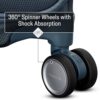
The shell is polyester made from recycled PET. Polyester in this role abrades before it tears, which means the way it ages is scuffing and eventual thinning at the corners rather than a sudden failure. That is a gentler failure mode than a cracked polycarbonate corner, but it is not a durable one against a determined baggage system. Fabric also absorbs water. A softside case left on wet tarmac will wick, and what is packed against the outer wall gets damp.
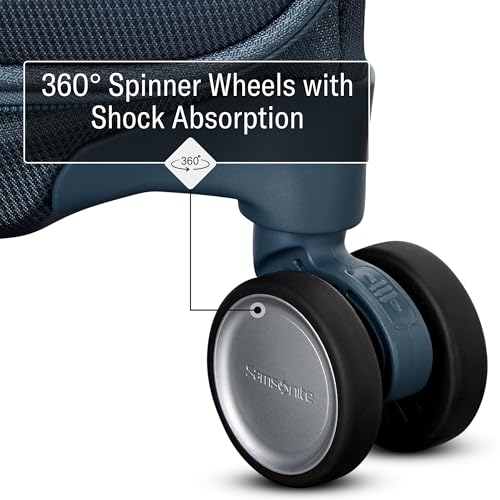
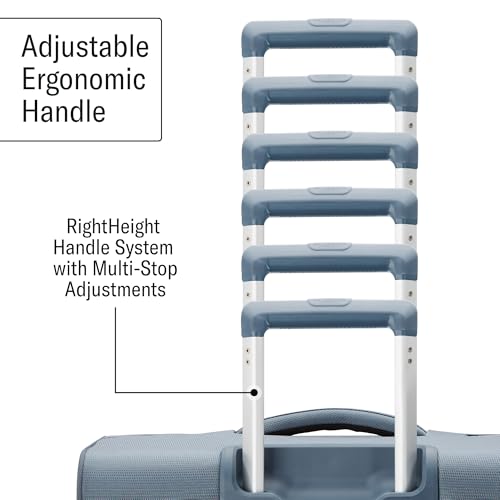
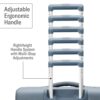
Samsonite calls the handle a RightHeight system with multi stop adjustment, meaning it locks at more than the usual two extended positions. That is a real ergonomic benefit for anyone unusually tall or short, since a handle set wrong makes you clip the case with your heel. Inside there are seatbelt webbing cross straps, a removable 3-1-1 liquids pouch and a retractable identification tag. The listing publishes nothing about the zippers, which on a softside case is the omission that matters most.
Weight and capacity, and one gap
Weight is published consistently. The specification field says 5.7 pounds and the maker’s own bullet says 5.7 pounds, with no contradiction between them. On a catalog where weights are routinely wrong by a factor of several, that consistency is worth stating. Empty weight counts twice on a cabin bag. It eats the airline’s weight allowance where one is enforced, and it is the weight you personally lift into the bin.
Capacity is the gap. No liter figure is published anywhere on this listing, so there is no volume number to compare against the bags you might be cross shopping. The dimensions imply a gross external box in the region of 2,150 cubic inches, but interior volume is always meaningfully less once you subtract the wheel wells, the handle housing and the lining, and turning that into a liter figure would be inventing a number. If capacity is your deciding criterion, the Travelpro Tourlite softside and the Travelpro Platinum Elite 21 inch sit in the same softside bracket and are worth reading alongside this one.
The warranty, and how to read it
Samsonite publishes a ten year limited warranty against defects in materials and workmanship, and states that its products are tested to internal standards. Ten years with a named scope is a real term and it is unusual in this catalog, where most listings publish nothing at all. It is worth being precise about what it is, though. Defects in materials and workmanship means the bag was made wrong. It does not, on its face, mean the bag was damaged in transit. Airline handling damage is the damage luggage overwhelmingly suffers, and it is the exclusion to look for in the written terms of any luggage warranty, including a long one. Read the document before you assume a wheel torn off by a belt is covered.
For the rest of the comparison set, the larger UpLIFT case takes the same design up to a checked size, and the wider carry-on luggage category and suitcases category hold the alternatives. Buyer feedback here runs to 109 ratings at an average of 4.3 out of 5, and the bag sits ranked 21st in Carry-On Luggage and 15,054th in Clothing, Shoes and Jewelry. The listing gives Thailand as the country of origin.
Who should buy it, and who should not
Buy it if you want a light softside cabin bag with usable exterior access, you value a published warranty term and a published weight you can trust, and you are tall or short enough that a multi stop handle is worth something. Do not buy it if you need crush resistance or weather sealing, if you need a stated capacity in liters to plan against, or if you intend to fly with the expansion open, because that expansion adds three quarters of an inch to the exact dimension a gate sizer measures. Measure the assembled bag yourself, since the listing does not say whether the wheels are counted.