

Description
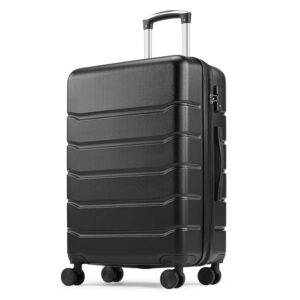
The Krute carry-on is a 20 inch hard shell case built on an aluminum frame with latch closures instead of zippers. The design idea is sound and the execution reads well on paper. The listing around it is another matter: it publishes a width that is well over the common cabin convention, a capacity field rendered in scientific notation, a country of origin that is difficult to credit, and a model number field containing the brand name.
The trip and the traveler this suits
A frame case with latches suits the traveler who has had a zipper fail and does not want to think about the closure again. There is no expansion gusset on a latched frame case, so the bag is the same size on every trip, which removes the most common way a compliant cabin bag quietly becomes a non compliant one. Short trips and business travel are the stated use and the honest one.
Dimensions, and why the width is the problem
The specification block gives 15.35 by 9.45 by 21.85 inches. The maker’s second bullet gives 15.6 by 9.5 by 21.9 inches. Those two disagree by around a quarter of an inch on width and small fractions elsewhere, which is a minor inconsistency rather than a serious one, and neither set is labeled as including or excluding the wheels. On a latched frame case with recessed hardware the difference is usually modest, but the listing does not say, so measure the assembled bag when it arrives.
The serious point is what both sets show. The convention most United States domestic carriers apply is roughly 22 by 14 by 9 inches. On the smaller of the two published sets this bag is inside on height by about an inch and a half, over on width by 1.35 inches, and over on depth by nearly half an inch. On the larger set it is over on width by 1.6 inches. Either way it exceeds the common convention on two of three axes.
The approval language in the title
The product title includes the words TSA Airline Approved and the second bullet says the case meets airline standards. Both are the maker’s claims and we are attributing them rather than repeating them. There is no general airline approval for luggage. Every carrier publishes its own cabin allowance, budget and regional operators are frequently stricter than the mainline convention, and international carriers commonly enforce a cabin bag weight limit as well. Given the published width, this is a bag to measure and to check against your own carrier before you count on carrying it on. Note also that TSA approved describes the lock rather than the size, and the two things are being run together in that title.
Shell, frame, wheels and the closure
The shell is described in the title as metal hardshell PC plus ABS, with the third bullet adding reinforced aluminum corners. A polycarbonate and ABS blend sits between the two mainstream hard shell plastics: more impact tolerant than straight ABS, which cracks rather than flexing, and less resilient than pure polycarbonate, which flexes and returns. Aluminum corner reinforcement is the right answer to the failure that actually happens on a hard shell, since aluminum dents where plastic splits.
The closure is the reason to look at this case. Latches on an aluminum frame remove the zipper, which is both the component most likely to end a trip and the quiet weak point of a zippered case, since any zipper can be split with a ballpoint pen and pressed closed again. The maker makes exactly this argument in its fifth bullet and it is a fair one. What latches cost you is expansion and a little weight from the frame.
The lock is a TSA combination lock with no keys. Krute describes the zipperless design as safeguarding belongings from unauthorized access. That overstates it. Removing the zipper does close off the pen trick, which is a genuine improvement, but a TSA lock still opens to a universal key held by a great many people, so the case is protected against opportunism rather than secured. Nothing you would mind losing belongs in a bag you may be forced to gate check.
Mobility is 360 degree spinner wheels. Spinners are effortless on terminal flooring and poor on cobbles, gravel and curbs, where the caster catches and takes a side load it was not built for, and exposed casters remain the most common physical failure on any wheeled bag. No stage count or load rating is published for the telescoping handle.
Capacity, weight and three fields that do not read properly
Capacity is published in the capacity field as 4E+1 Liters. That is a spreadsheet artifact: scientific notation for 40, which has been passed through as text rather than converted. The maker’s own bullet gives 40 liters, so the intended figure is clear, but a buyer should know that the structured field is corrupted rather than meaningful. Forty liters for a 20 inch frame case is a normal working volume, good for three or four days packed to a list.
Weight is published as 7.24 pounds in one field and 3.29 kilograms in another, which is 7.25 pounds. Those agree, and for an aluminum frame case with a blended shell that is a reasonable figure. Empty weight counts twice on a cabin bag, once against any enforced allowance and once against your own arms.
Two further fields do not survive scrutiny. The country of origin is given as USA, which is difficult to credit for a case of this construction and price and is not supported by anything else on the listing. And the item model number field contains the text Krute’s luggage, which is the manufacturer name rather than a model number, so this product has no identifiable model code at all. We are flagging both rather than working around them.
The assurance, the record, and the alternatives
The first bullet offers what Krute calls a ten year quality assurance, inviting the buyer to contact its after sales team at any time. Read the wording carefully. It is an assurance and an invitation to make contact, not a warranty document: there is no statement of what is covered, no exclusion list, and no repair or replacement commitment. Ten years is a long period to attach to a promise with no defined scope. The point that matters on luggage is airline handling damage, which is the damage that actually happens and the exclusion that survives even inside written warranties, and this assurance says nothing about it either way.
Within the brand, the other Krute carry-on is the close relative. For the same zipperless idea elsewhere, the HotWay 1866 aluminum frame case and the Nobl zipperless carry-on are worth reading, and the CAARANY aluminum carry-on takes the metal further into the body itself. The wider field sits in the carry-on luggage category and the carry-ons category.
Who should buy it, and who should not
Buy it if the zipper is the part you do not trust, you want a fixed size case with no expansion, and you have confirmed that your airline will accept a bag over 15 inches wide. Do not buy it if your carrier enforces the 14 inch width, because both published dimension sets exceed it by more than an inch, and do not treat the ten year assurance as a warranty, because no coverage is described. Treat the USA country of origin, the 4E+1 capacity field and the model number field as unreliable data rather than product facts.