Description
Who this TPRC under seat case is for
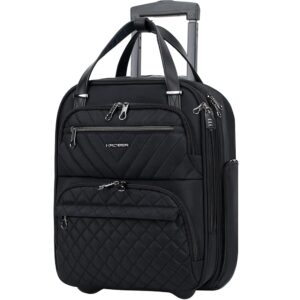
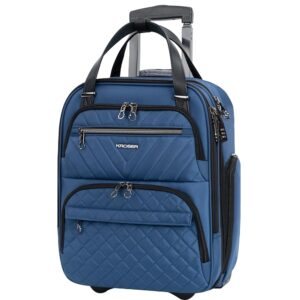
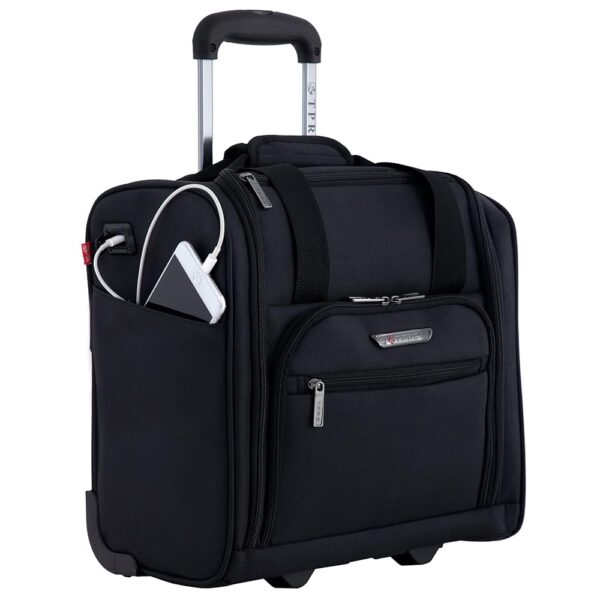
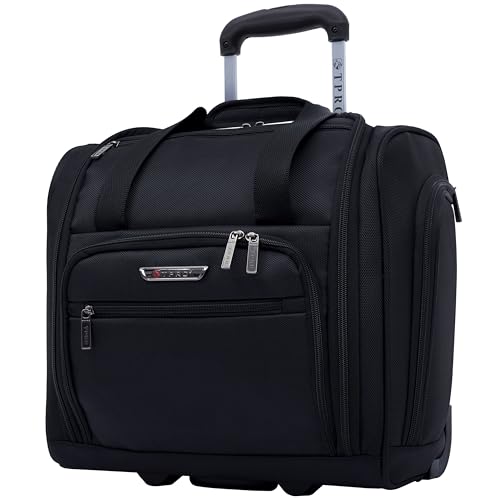
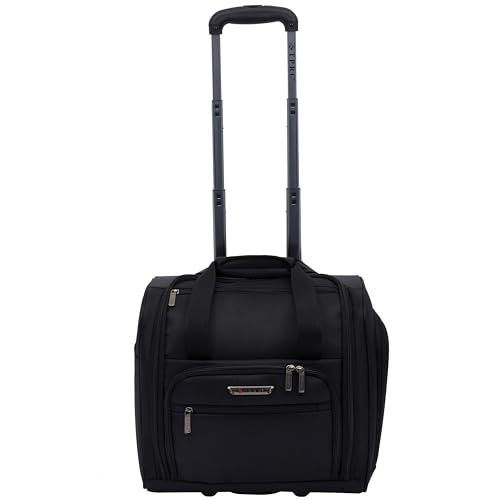
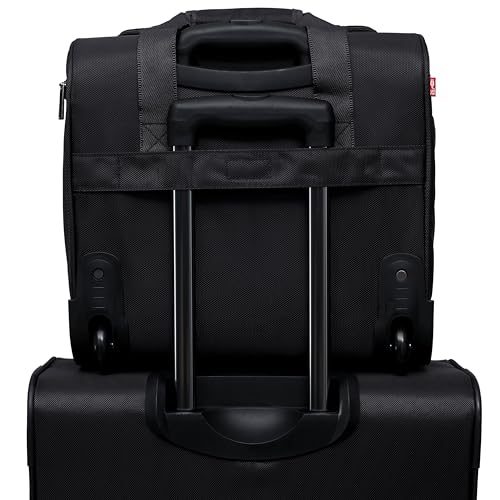
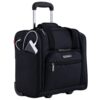
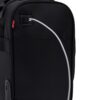
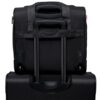
This is a 15 inch wheeled bag built to go under the seat in front of you rather than into an overhead bin, with a USB port on the side for charging a phone in flight. The traveler it suits is someone flying a fare that includes a personal item but not a cabin bag, a commuter who wants two days of clothes and a charger on wheels, or anyone who has decided the overhead bin lottery is not worth playing. It has been on sale a long time and has accumulated more than ten thousand ratings, which for a bag in this class is a substantial track record.
What it is not is a general purpose cabin bag. Fifteen inches is far smaller than a 22 inch upright, and if you are packing for more than two or three nights you will run out of room quickly. The trade is certainty at the gate against capacity in the bag.
Dimensions and the under seat question
The specification table gives 14 by 8.5 by 15 inches. A feature bullet gives 14 inches long by 15 high by 8.5 wide, which is the same case in a different axis order, so on this point the listing agrees with itself. That is worth crediting. What it does not say is whether the wheels and the retracted handle are inside that measurement, and on an under seat bag that gap is more consequential than usual, because the clearance you are fitting into is measured in inches and the tolerances are small.
Under seat space is not standardized
Under seat clearance varies by aircraft type, by seat row, and by whether you are in a window, middle or aisle seat, because the entertainment box and the seat leg structure eat into the space on some rows and not others. Bulkhead and exit rows frequently have no under seat storage at all. Many airlines publish a personal item allowance in the region of 18 by 14 by 8 inches, while the cabin bag figure of roughly 22 by 14 by 9 inches is a different allowance entirely and the two are often confused. This bag at 8.5 inches wide is slightly over the common 8 inch personal item depth, which is exactly the kind of half inch that matters when you are pushing a bag into a fixed space. We never write that a bag is airline approved. Compare it against your own carrier’s published personal item dimensions.
Fabric, wheels, handle and pockets
The fabric is named as 1680 denier polyester, and that is the single most useful specification on this listing. Denier is the number that tells you the weight of the yarn, and 1680 denier is genuinely heavy duty: it is roughly three times the yarn weight of the 600 denier polyester used on cheap luggage, it resists abrasion well, and it is the grade normally found on business and tactical bags rather than on budget travel gear. On a bag that will be dragged across terminal floors and shoved under seats every week, that is where you want the material budget spent. The maker’s phrasing that it is the very best fabric to withstand time and travel is marketing rather than fact, but the underlying number is real and verifiable.
The wheels are stated as inline skate wheels, which is the right choice for a bag this size and better than casters would be. Two inline wheels tolerate curbs, gravel, grass and being lifted into a car far better than four exposed casters, they cannot snap off sideways, and they add nothing to the measured depth of the bag. The cost is that it must be tilted and towed rather than pushed upright beside you, which on a 15 inch bag is barely a cost at all.
An open side pocket is listed for quick access items. No lock of any kind is described anywhere, and no zipper brand is named. On a bag that stays within arm’s reach in the cabin, the missing lock is a smaller issue than it would be on a checked case, but it should be stated rather than assumed.
The USB port, the battery, and the rule that matters
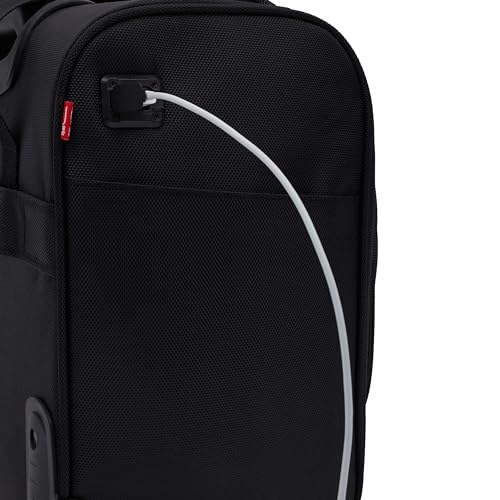
The side USB port is the feature the product is named for, and the listing is explicit that neither a power bank nor a USB cord is included. That is the important detail and it is good news. The port is a pass through: you supply your own power bank, put it in the bag, connect it internally, and charge a phone from the outside without opening the bag.
Because the battery is a separate item you supply and can remove at any time, this bag avoids the boarding problem that sealed smart luggage has. Airlines require lithium batteries and power banks to travel in the cabin rather than in the hold, they must be removable, and bags with non removable batteries have been refused at the gate. Two practical rules follow from that. If this bag is ever gate checked, take the power bank out and keep it with you. And do not expect the port to do anything without a battery inside, because on its own it is only a cable.
Capacity, weight and two fields with the wrong units
The capacity fields contradict each other in kind. One reads 2.7 kilograms, which is a weight and not a volume, and cannot be used. The other reads 23.85 liters, which is plausible and useful: roughly a laptop, a change of clothes, toiletries and a book, and not much more.
Weight is published twice with two values. The specification table gives 5 pounds, restated as 2.27 kilograms. A feature bullet gives 6 lbs. Plan around the higher figure. Either way, this is a heavy personal item. Five or six pounds empty consumes a meaningful share of a 7 kilogram cabin allowance before you pack anything, and the wheels and handle mechanism are what cost you that weight. A plain backpack of the same 24 liter volume weighs perhaps a third as much. That is the honest price of putting a small bag on wheels, and it is worth deciding consciously rather than by default.
Warranty, standing and the alternatives
No warranty term appears anywhere in the source data. The product description is a company history going back to 1986 and a statement of intent about customer service, which is not a warranty. On a bag that will be rolled several times a week, the components under most stress are the handle, the wheel mounts and the USB wiring, and those are exactly what a warranty would need to cover. Ask before ordering.
The listing shows 4.5 stars from 10,363 ratings and a position of 14th in the carry-on luggage chart. Ten thousand ratings at 4.5 is one of the more convincing signals in this catalog. Among alternatives, the Amazon 17 inch under seat roller and the Amazon Basics 15 inch under seat bag cover the same job without a USB port, while the EMPSIGN 16 inch under seat roller and the KROSER under seat case add laptop compartments. For a powered option in a full set, see the Wrangler smart luggage set. Browse carry-ons and carry-on luggage for the field.
Who should buy it and who should not
Buy it if you fly fares that only include a personal item, you want genuinely heavy duty 1680 denier fabric, and you like that the battery is separate and stays in your control. Do not buy it if your carrier enforces an 8 inch personal item depth, since this measures 8.5; if five or six pounds of empty bag is too much of your weight allowance; or if you need a written warranty, because none is stated.