

Description
The trip this U.S. Traveler Anzio is built for
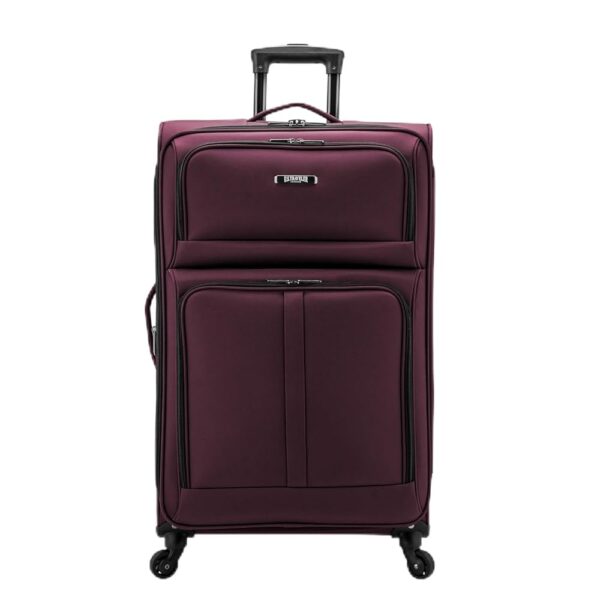
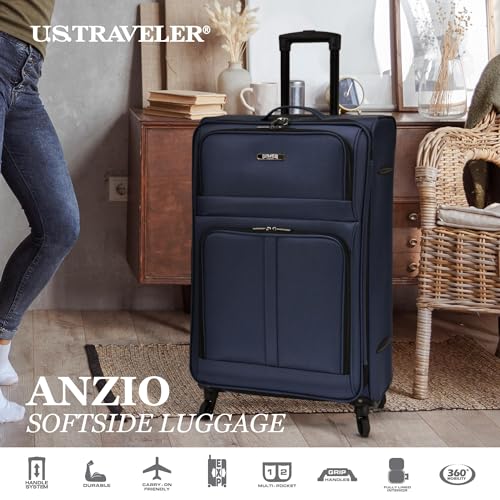
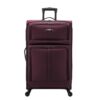
This is a 30 inch softside expandable spinner in micro ballistic nylon, and the fabric is the reason to look at it. Most bags at this price are polyester. Ballistic nylon is a denser, harder wearing weave developed for abrasion resistance, and on a checked bag that gets dragged across concrete and thrown into container holds, abrasion is the main wear mechanism. Naming it is a real specification rather than a slogan.
The trip it suits is a long one: a relocation, a family holiday, or any journey where the constraint is bulk. Softside at this size is a defensible choice, because a fabric bag absorbs a crushing load by deforming and springing back, while a hard shell transmits it to the corners. The cost is that fabric absorbs water and gives less protection to anything fragile.
The two dimension sets, and the depth is the difference
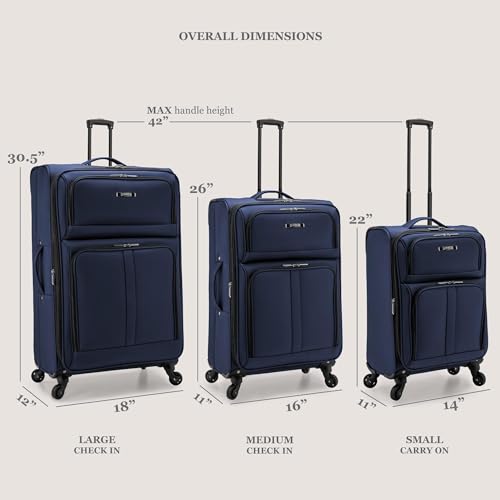
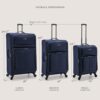
The specification table gives 18 by 14 by 30.5 inches. A feature bullet gives 30.5 inches high by 18 wide by 12 deep, with a further 2 inches when expanded, and separately gives an interior of 27 by 17.5 by 11.5 inches plus the same 2 inch expansion.
The height and the width agree. The depth does not: 14 inches in the specification table against 12 inches in the bullet. That two inch gap changes the answer to the only question that matters on a checked bag.
The linear total lands on both sides of the limit
Most airlines cap a checked bag at around 62 linear inches, meaning length plus width plus depth added together, and charge an oversize fee above it. On the bullet’s 30.5 by 18 by 12 figure this bag totals 60.5 linear inches, comfortably inside. On the specification table’s 30.5 by 18 by 14 figure it totals 62.5, over the cap. The same listing therefore puts the same bag on both sides of the line.
The expansion resolves the ambiguity in the wrong direction. A 2 inch gusset takes the bullet figure from 60.5 to 62.5 linear inches, which is over. So even on the more favorable reading, this bag is inside the common cap collapsed and outside it expanded. We never write that a bag meets airline requirements, because those requirements belong to the airline and differ. Measure it on arrival, collapsed and expanded, and check your carrier’s linear limit and oversize fee before you use the gusset.
Fabric, wheels, handle and pockets
The fabric is described as ultra durable micro ballistic nylon. No denier figure is published, which is the number that would let you compare it against a specific polyester, but ballistic nylon as a class is the better material for this job: at a given weight it resists abrasion and tearing better than polyester, which is why it is standard on bags built for heavy use. The trade is cost and a slightly stiffer hand. It also absorbs water rather than shedding it, and no coating is described.
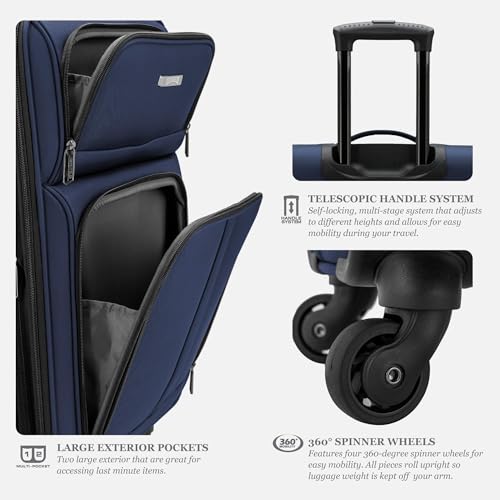
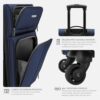
The wheels are four 360 degree spinner casters. On a bag this large the spinner arrangement is more defensible than it is on a cabin case, since a packed 30 inch bag is heavy and pushing it upright beside you beats towing it tilted. The trade is unchanged: casters handle cobbles, gravel and curbs badly, they are exposed, and on a fully loaded checked bag they carry more load than any other component. On a softside bag the casters mount to a base plate rather than to a molded shell, so a caught wheel transfers load into fabric and stitching.
The handle is a push button multi stage telescoping system. Inside there is full lining, compression straps and a mesh zippered pocket, and the compression straps matter on a bag this size because 100 litres of loose clothing shifts in transit and shifting is what creases it. Outside there are two large zippered pockets, which is the standard advantage of soft construction over a rigid clamshell: you can reach a jacket or documents without opening the whole bag. No lock of any kind is described anywhere on this listing.
Capacity, weight and one field with the wrong unit
The capacity fields give 2.89 litres in one and 6,588 cubic inches in the other. The 2.89 litre entry is nonsense for a 30 inch case and is the same erroneous figure that appears on other U.S. Traveler entries in this catalog, so it looks like a systematic import fault rather than a one off. The 6,588 cubic inch figure is plausible and works out at roughly 108 litres, which is consistent with the published interior dimensions. Work from that, and note that cubic inches is an unusual unit in a category where most competitors publish litres, so comparing this bag against others requires arithmetic the maker should have done.
The empty weight is 9.47 pounds, restated as 9.5, and the bullet repeats 9.47. That is genuinely light for a 30 inch bag, where eleven pounds and above is common, and it is a real advantage of soft construction. The arithmetic still deserves attention: on a typical 50 pound domestic checked allowance a 9.47 pound empty bag consumes 19 percent of your budget, and a 108 litre bag will let you pack past 50 pounds long before you run out of room. Weigh it before you leave.
Warranty, standing and the alternatives
No warranty term appears anywhere in the source data. No length, no coverage description, no exclusion list. On a checked bag that is the gap that matters most, because handling damage is what checked luggage actually suffers and it is the exclusion luggage warranties most commonly carry. Ask for the written terms and look for that clause specifically.
The listing shows 4.1 stars from 2,512 ratings and a position of 35th in the suitcases chart. That is a moderate score on a good base, and a consistent minority of unhappy buyers on a bag this size usually means caster failures under load. Among alternatives, the U.S. Traveler Boren 30 inch is the hardside equivalent from the same brand at 60.75 linear inches, the SwissGear Sion 29 inch is the softside benchmark, the Samsonite Omni 2 in 28 inch is the better known hardside and the Travelers Choice 30 inch hardside spinner is another. For a cabin bag from the same maker, see the U.S. Traveler Rio set. Browse suitcases and luggage and travel gear.
Who should buy it and who should not
Buy it if you want ballistic nylon rather than polyester at checked size, you value external pockets and a light 9.47 pound empty weight, and you will keep the expansion closed. Do not buy it if your airline enforces 62 linear inches, since the bag is over on the specification figure and goes over when expanded on either; if you need a capacity in litres, because one field is nonsense and the other is in cubic inches; or if you need a lock or a warranty.