

Description
The Case and the Traveler
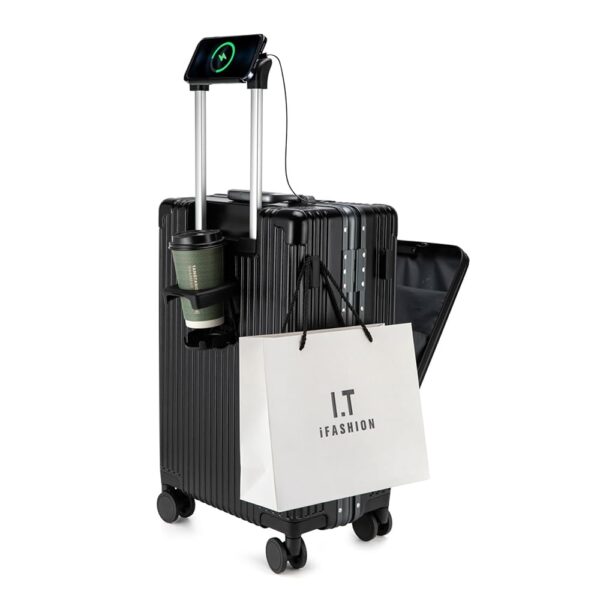
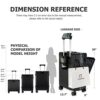
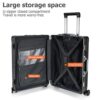
This is a 20 inch aluminum frame cabin case loaded with gadgets: a built in TSA lock, a cup holder and phone holder molded into the top, a handle hook, a USB and Type C charging port, and a front opening panel for a laptop or tablet that can be reached while the case stands upright. The shell is an ABS and polycarbonate blend held by an aluminum frame rather than a zipper.
The traveler it targets is someone who spends a lot of time standing in terminals and wants the case to act as a table: a drink held, a phone propped, a laptop reachable without putting the bag on a wet floor. That is a real convenience and it is why front opening cases have grown popular. It also comes at a cost that dominates everything else on this listing, covered under weight below.
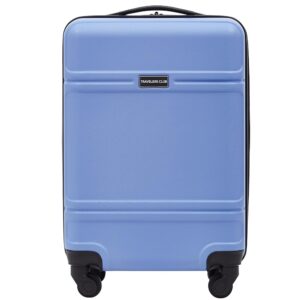
For a plainer 20 inch hardside without the accessories, the Travelers Club Cosmo hardside spinner is the direct comparison at half the weight, and the LEVEL8 20 inch carry-on covers the design led end.
The Dimensions Are Good, With One Caveat
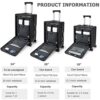
The specification block gives 13.66 by 8.98 by 20 inches, and that is the only dimension set on the listing. Against the commonly cited United States domestic cabin allowance of roughly 22 by 14 by 9 inches, this case is two inches inside on height, a third of an inch inside on width and two hundredths inside on depth. It fits on all three axes.
That is a genuinely good result and it is unusual in this catalog, where nominal 20 inch cases routinely measure 22 or 23 inches once the wheels are counted. The caveat is that the listing never says whether the published figures include the four spinner casters and the handle housing. If they describe the shell only, the real measured height will be higher, and the 8.98 inch depth has almost no margin against a nine inch limit. Nothing here is described as expandable, so at least the figure does not move.
No airline approval is claimed anywhere on this listing, which is to its credit. We are not claiming it either: every carrier writes its own rule, budget and regional airlines are stricter, and international carriers commonly add a cabin weight limit that this case is poorly placed to meet. Check your carrier’s published dimensions and its weight allowance.
The Frame, the Shell and the Lock Contradiction
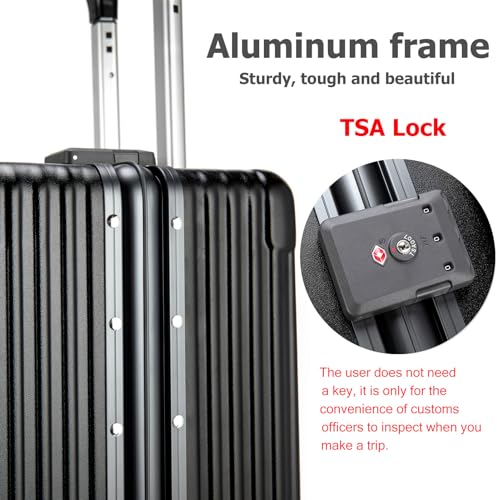
The shell is an ABS and polycarbonate blend, described as extremely scratch resistant. A blend lands between the two common hardside plastics: polycarbonate flexes under impact and returns to shape, ABS is cheaper, lighter and stiffer but more brittle. The aluminum frame is the more significant structural choice. A frame case clamps the two halves shut along a rigid perimeter instead of joining them with a zipper, which removes the single most common covert entry method on luggage, since a coil zipper can be split with a ballpoint pen and closed again with no visible sign. It also adds rigidity and a great deal of weight.
The Lock Bullets Contradict Each Other
The first feature bullet gives an unusually honest explanation of what a TSA lock is: a globally universal lock whose keyhole exists so customs and security personnel can open the case with their master key, with the buyer setting only a combination and receiving no key.
The fifth bullet then says the mounted TSA locks extremely improve safety, ensuring that only you can easily access your belongings. Those two statements cannot both be true, and the first one is correct. A TSA compatible lock is openable by anyone holding a universal key, and those keys are not confined to airport security. Treat it as a deterrent that keeps the case shut on a belt and lets an inspection happen without the lock being cut off. It is not security, and valuables should not travel in a checked bag on the strength of it.
The wheels are four multi directional spinner casters, described as noise reducing. On smooth terminal flooring that is the right choice for a heavy case, and on gravel or a curb they catch where inline wheels would not. Exposed casters are the most common failure point on any wheeled case, and that risk rises with weight. The telescoping handle is not described at all: no stage count, no material, no extended height.
The Weight Problem
Empty weight is 11.31 pounds. That figure needs to be the centre of any decision about this case, because it is exceptional for a 20 inch cabin bag.
For comparison within this catalog: the Travelers Club Cosmo 20 inch hardside is 6 pounds, the Travelpro Maxlite 5 is 5.4 pounds with considerably more volume, and even the heavy Delsey Chatelet Air 2.0 is 7.7 pounds. This case is roughly double the lightest options and nearly four pounds heavier than a typical hardside of the same size. The aluminum frame, the lock, the cup and phone holders and the charging hardware are where that weight goes.
The consequence is concrete. Many international and budget carriers enforce a cabin weight limit, commonly in the region of 15 to 22 pounds. At 11.31 pounds empty, this case can consume more than half of a strict allowance before a single item is packed. On United States domestic flights, where cabin weight is generally not weighed, it matters less, but you still lift it into the bin.
Capacity is published as 2,775.5 cubic inches in two fields, agreeing with itself, which works out to roughly 45.5 liters. That is a reasonable volume for the size, and it means you are carrying eleven pounds of case for 45 liters of space.
The USB Port, the Battery Question and What Is Missing
There is a built in USB port and a Type C port. Unlike several comparable listings in this catalog, this one never states whether a power bank is included or whether any battery is removable. That gap matters. Airlines require lithium batteries and power banks to travel in the cabin rather than in checked baggage, and where a bag has a battery built into it, most carriers require that battery to be removable. Bags with fixed batteries have been refused at the gate.
Most cases of this type ship as a pass through with no cell inside, as the Samsonite Solyte DLX states outright, but this listing does not confirm it. Ask the seller directly whether a battery is included and whether it can be removed before you fly with this case.
The front opening panel is described as suitable for a laptop or iPad, with no dimension given and a note telling buyers to refer to the pictures. That is not a specification. Measure your machine and ask for the panel dimension. No warranty is published either: no term, no exclusions, no coverage period.
The feedback record is modest: 4.0 across 308 ratings, ranked 165th in Carry-On Luggage and 103,901st in Clothing, Shoes and Jewelry. The carry-ons category holds better established alternatives.
Who Should Buy It and Who Should Not
Buy it if you want the cup holder, phone holder and front laptop access, you fly domestically where cabin bags are not weighed, and you value an aluminum frame closure over a zipper. The measured 20 by 13.66 by 8.98 inches genuinely fits the common cabin reference on all three axes, which is rare here. Do not buy it if any carrier on your route enforces a cabin weight limit, because 11.31 pounds empty is roughly double the lightest cases of the same size. Do not read the fifth bullet’s claim that only you can access the case, because the first bullet on the same listing explains why that is not so. And confirm with the seller whether the USB system includes a battery.