

Description
The Traveler This Case Is Aimed At
Pelican built its name on hard protective cases for cameras, instruments and equipment, and the Aegis luggage line applies that thinking to a softside cabin bag. The construction is unusual for the category: a molded EVA front shell that Pelican calls Pelican Shield, bonded to a weather resistant 500 denier Cordura body, with oversized wheels, a multi stage extension handle, external compression straps and grab handles placed throughout.
That combination is aimed at someone who treats luggage as equipment rather than as an accessory: field work, expedition travel, or simply a traveler who has broken enough conventional cases to want a molded panel between the outside world and their contents. There is also a modular accessory system, ModPak, sold separately and compatible across the Aegis range.
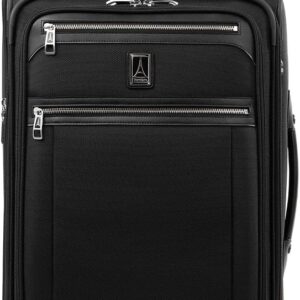
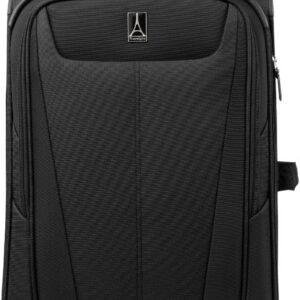
What it is not is a light bag or a cheap one, and the front shell means it will not compress into a bin the way a fully soft case does. For a conventional softside cabin bag at lower weight, the Travelpro Maxlite 5 is the comparison, and for a full hardside the Samsonite Winfield 3 DLX takes the other approach.
Two Sizes, Two Weights, and What a Sizer Would Read
The listing publishes its dimensions twice and the figures disagree. The third feature bullet gives an exterior of 14.4 by 10.6 by 22 inches at 7.32 pounds. The specification block gives 14.4 by 10.6 by 23.6 inches at 7.98 pounds. The first two axes match; the height differs by 1.6 inches and the weight by two thirds of a pound.
Take the more favorable bullet figure and compare it against the commonly cited United States domestic cabin allowance of roughly 22 by 14 by 9 inches. The height of 22 inches is exactly at the line. The width of 14.4 inches is four tenths over. The depth of 10.6 inches is 1.6 inches over. On the specification figure the height is 1.6 inches over as well, putting it outside on all three axes.
Either way the depth is the problem, and a molded EVA front panel is not something a gate agent can compress. Pelican makes no airline approval claim on this listing, which is to its credit, and we are not making one either. Every carrier writes its own rule, budget and regional airlines publish smaller figures, and international carriers commonly add a cabin weight limit. Check your specific airline’s published dimensions, and ask the seller which height is correct, because 22 and 23.6 inches are meaningfully different bags.
Neither figure states whether the wheels and handle housing are included, which on a case with oversized wheels could add further. Nothing here is described as expandable, so at least the measurement does not move once you know it.
EVA Shell, 500 Denier Cordura and Oversized Wheels
The material specification is the strongest part of this listing. Cordura is a branded high tenacity nylon known for abrasion resistance, and 500 denier is a mid weight version of it: lighter than the 1000 denier used on military gear, considerably tougher than the plain polyester on most cabin bags. Pelican describes it as weather resistant, which is the honest word. Expect it to shed rain and to wet through eventually, with the seams and zipper track going first.
The molded EVA front shell is the differentiator. EVA is a closed cell foam that can be heat formed into a rigid panel, and on the front face of a soft bag it does two things: it stops the front collapsing inward and crushing whatever is packed against it, and it gives the bag a defined shape when half empty. It is not the same as a polycarbonate shell, which resists crushing across the whole case, but it protects the face that takes most of the impacts in a bin and on a belt.
The wheels are described as heavy duty and oversized, with no count given and no indication of whether they are inline or spinner casters. On a case built for rough use, oversized wheels are the right specification because larger diameter rolls over broken pavement and gaps that stop small casters dead. The wheel type is a real omission though, since inline and spinner behave completely differently. The handle is a multi stage extension system with no stage count or extended height published.
External compression straps, an external quick access zipper, an internal quick access compartment, easy grab handles throughout and a Pelican Patch identification tag system complete the specification. No lock of any kind is described, unlike the LEVEL8 20 inch carry-on, which fits two.
The Capacity Nobody Published, and a Collection Description
No capacity figure appears anywhere on this listing, in liters or cubic inches. For a cabin bag sold on the strength of what it protects, that is a significant omission, and the two conflicting height figures make even a rough calculation from the exterior unreliable. Ask the seller.
The product description is also worth flagging. It does not describe this case at all. It describes the Aegis collection in general, listing duffel bags, backpacks, sling packs, packing cubes and organizational bags, and explaining the range’s inspiration and philosophy. Not one sentence in it concerns the 22 inch carry-on being sold. It also uses language such as unparalleled strength and uncompromised durability, which is marketing rather than specification and is not something we will restate.
Weight, taking the heavier published figure of 7.98 pounds, is mid range for a cabin case: heavier than a 5.4 pound softside rollaboard, lighter than the ten pound plus frame cases in this catalog. The molded front panel is where the extra goes.
A Stated Five Year Warranty, and a Very Small Sample
The fifth feature bullet states a 5 year warranty. A specific finite term is worth more than the vague lifetime language common in this category, because a number is something you can hold a maker to, and Pelican has a long track record of honoring case warranties. The exclusions are not published anywhere in this data, and that is what to check: across luggage generally, coverage commonly excludes damage caused by airlines and other carriers, which is the damage that actually happens. Ask for the written terms.
The feedback record is the weakness. The rating is 4.3, which is fine, but it rests on only 17 ratings, and the sales rank is 175,683rd in Clothing, Shoes and Jewelry and 357th in Carry-On Luggage. Seventeen ratings is far too small a sample to draw any conclusion from, and the score could move substantially either way. This is a recent listing from a brand new to soft luggage, so a thin record is expected rather than alarming, but it means the specification is all you have to go on. Country of origin is Vietnam. The carry-ons category holds better established alternatives, including the Travelpro Platinum Elite with its lifetime carrier damage clause.
Who Should Buy It and Who Should Not
Buy it if you want equipment grade materials on a cabin bag, value a 500 denier Cordura body with a molded EVA front shell and oversized wheels, and a stated five year warranty matters to you. Those are real specifications rather than marketing. Do not count on it clearing a sizer, since the depth of 10.6 inches is 1.6 inches over the common nine inch reference on either published reading. Do not buy on the strength of the 4.3 rating, because 17 ratings is not a sample. And ask the seller three things this listing does not settle: the true height, the capacity, and the wheel count and type.