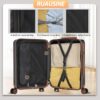
Description
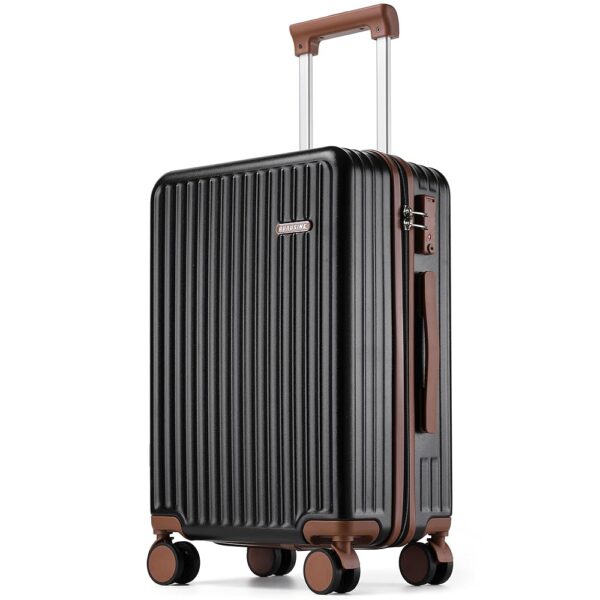
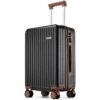
This listing has no brand name anywhere. The product name is a string of keywords, the manufacturer field is empty, and the only identifier is a model code, RX002. It is a 20 inch hard shell carry on with spinner wheels and a TSA lock, and the source record is one of the thinnest in this catalog. It also contains a claim that needs correcting outright: the listing says the TSA lock means the case is approved by airlines. A lock has nothing to do with size compliance.
The traveler and the trip
A 20 inch hard shell at 6 pounds is a three to four day bag for one adult. Beyond that, the listing gives you very little to go on. There is no capacity figure, no packing dimension, no material name, no wheel count and no warranty term. What you are buying is a shape and a weight.
The buyer for an unbranded case is someone who wants a rigid shell and a lock at the lowest price available and accepts that there is no company standing behind it. That is a legitimate choice for a bag that flies twice a year. It is not a choice for anyone who flies regularly, and it is not a choice for anyone who needs a replacement part or a warranty claim later, because there is no brand to contact. Named alternatives at a similar price sit in carry on luggage.
Dimensions, and the number in the name
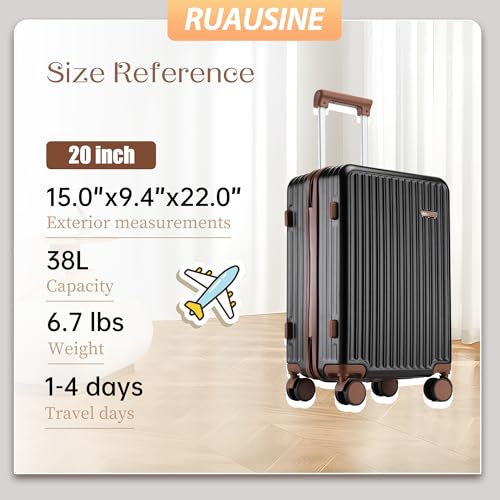
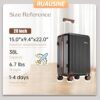
The attribute block gives 14 by 9 by 22 inches. Reordered, that is 22 inches on the longest side, 14 wide and 9 deep. A manufacturer bullet says the case measures 22 by 14 by 9 inches and describes that as perfectly sized to meet carry on requirements. For once the two sources agree, which is worth noting.
Why matching the allowance exactly is not the same as fitting
The commonly cited United States domestic carry on allowance is around 22 by 14 by 9 inches, and an airport sizer measures the case standing on its castors. This case is quoted at exactly that figure on all three axes, which means it has no margin whatsoever. A rigid shell has no give, so a gauge that is fractionally tight, a lock housing that stands proud by a few millimetres, or a castor that protrudes further than the quoted figure allows, is enough to fail.
The listing also does not say whether the 22 inches includes the wheels. A published dimension that matches an airline allowance precisely, on a listing that names no brand and gives no other measurements, is more likely to have been copied from the allowance than measured off the case. That is a pattern across this catalog and it deserves scepticism here.
We are not going to write that this bag is airline approved. Approval is a property of the airline, every carrier publishes its own allowance, budget and regional airlines are consistently tighter, and international carriers frequently add a cabin bag weight limit. Measure the case yourself on arrival.
The lock claim, which is simply wrong
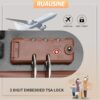
One manufacturer bullet is headed TSA Lock Approved and reads that the case is approved by airlines and will pass through airport security checks smoothly. Those two ideas are unrelated and putting them in one sentence is misleading.
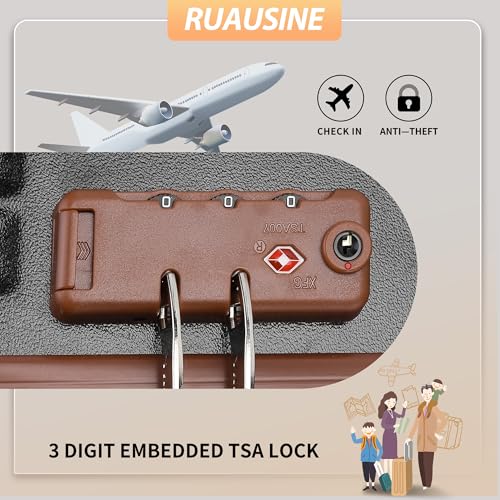
A TSA recognized lock is a lock that screeners can open with a universal key so they do not have to cut it during a bag inspection. It concerns what happens to your padlock in a screening room. It has nothing whatsoever to do with whether the case fits in an overhead bin or passes a gate sizer, which is a question of dimensions. A bag with a TSA lock and the wrong dimensions gets gate checked exactly like a bag without one.
The lock is also not security. A universal key opens it and those keys are widely available outside the agency. It deters an opportunist and it stops the zipper being pulled open in transit. Nothing you would mind losing should travel in a checked bag behind one, here or on the Hulsin HXXB02 or any other case with the feature.
Shell, wheels and handle
The listing calls the material high quality hardside material and hard shell, and never names the polymer. That is the most consequential omission on a hard shell, because the difference between ABS and polycarbonate is the difference between a shell that shatters under impact and one that flexes and returns to shape. ABS is cheaper, lighter and the most brittle of the common shell polymers; polycarbonate deforms and springs back and does not go brittle in a cold hold. At 6 pounds for a 20 inch case on an unbranded listing, ABS is the likely answer, and the listing does not say so. Cases that do name their material, such as the Travelpro Maxlite Air with its stated 100 percent polycarbonate shell, let you predict how they fail.
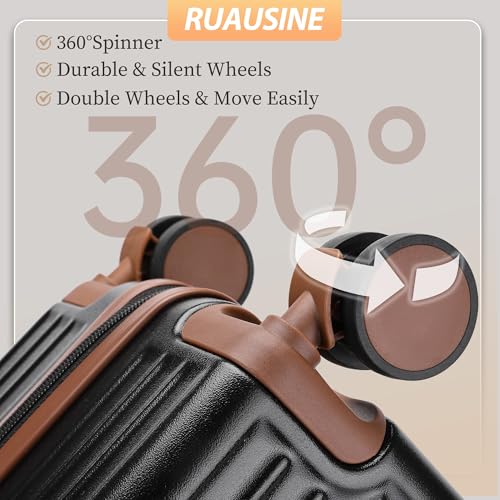
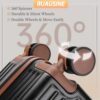
The wheels are described only as smooth spinner wheels offering 360 degree rotation. No count, no statement of single or dual castors, no bearing type. Dual castors roll better under load and are more stable on a sloped floor, so the omission matters. Castors remain the most common failure point on any wheeled bag, they are poor on cobble and gravel, and their exposed profile adds to the depth a gauge measures, which on a case quoted at exactly 9 inches is a real concern.
The telescoping handle is not mentioned at all. No material, no stop heights, no lock mechanism. Handle failure at full extension is a common way inexpensive cases die.
Capacity, packing and what a thin listing costs you
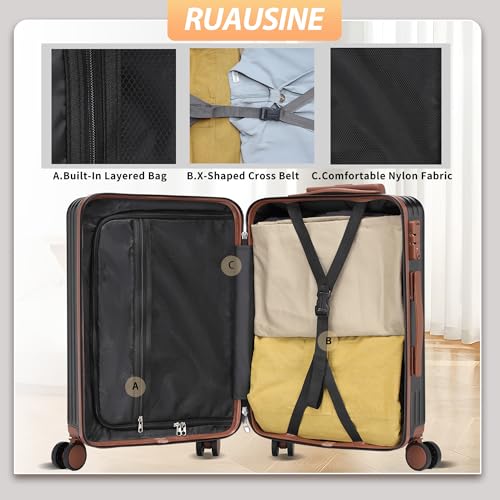
No capacity figure appears anywhere, in liters or cubic inches. No packing dimension is published. No interior layout is described, so there is no way to know whether there is a divider, compression straps, a mesh pocket or anything else.
Working from a bounding box of 22 by 14 by 9 inches, the enclosed volume is roughly 45 liters before shell wall, handle housing and wheel wells take their share, so something in the high thirties is a reasonable expectation. That is an estimate and not a published number, and we are not going to present it as one.
Empty weight is 6 pounds, which is the only substantive specification on the page besides the dimensions. It is competitive for the size, and it counts twice on carriers that enforce a cabin bag weight limit, because the case eats your allowance before you pack. Larger cases in the same construction sit under suitcases.
Warranty, and the problem with an unbranded case
No warranty term appears anywhere, and there is no manufacturer name in the source record to ask. That combination is the real issue with this listing. A warranty is a promise from a company, and a listing with no company behind it has nobody to make the promise or honor it. If the shell cracks or a castor shears in the second month, your recourse is the seller’s return window rather than a warranty.
Even where a term exists, expect airline handling damage to be excluded, as it is across essentially this entire category. If a published warranty is what decides the purchase, Samsonite states ten years on defects and Travelpro states a limited lifetime term with one year of carrier damage cover, both openly on the listing. The TILYMOL TLM100-6308 is another unbranded style listing worth comparing, and it at least names its shell material.
Who should buy it and who should not
Buy it only if price is the sole consideration, you fly rarely, and you understand that you are buying a shape with a lock on it. Six pounds and a 22 by 14 by 9 inch quoted footprint are the two facts you have.
Skip it otherwise. There is no brand, no shell material, no capacity, no wheel count, no handle specification and no warranty on this page. The quoted dimensions match the airline allowance exactly, which leaves no margin at a gauge and looks copied rather than measured. And ignore the bullet that says the TSA lock makes the case approved by airlines, because a lock has no bearing on whether a bag fits.