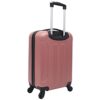
Description
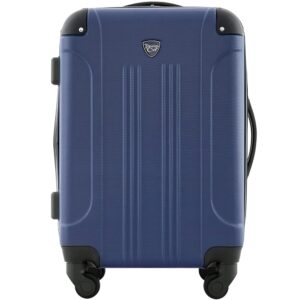
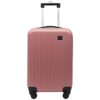
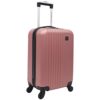
The Travelers Club Cosmo is a 20 inch ABS hardside spinner in rose gold, and its listing does something almost no other listing in this catalog does: it states plainly that the dimensions it publishes are the body without the wheels. That single piece of honesty makes this an easier bag to advise on than most, because it tells you exactly which number you cannot use at a gate and forces the right question before you buy.
The traveler and the trip
Thirty seven liters at 6 pounds is a three to four day bag for one adult, or two nights if the trip needs a jacket and a second pair of shoes. The interior specification is better than the price suggests, with pockets, compression straps and dividers, so this suits someone who packs formal or semi formal clothing and wants it to arrive flat.
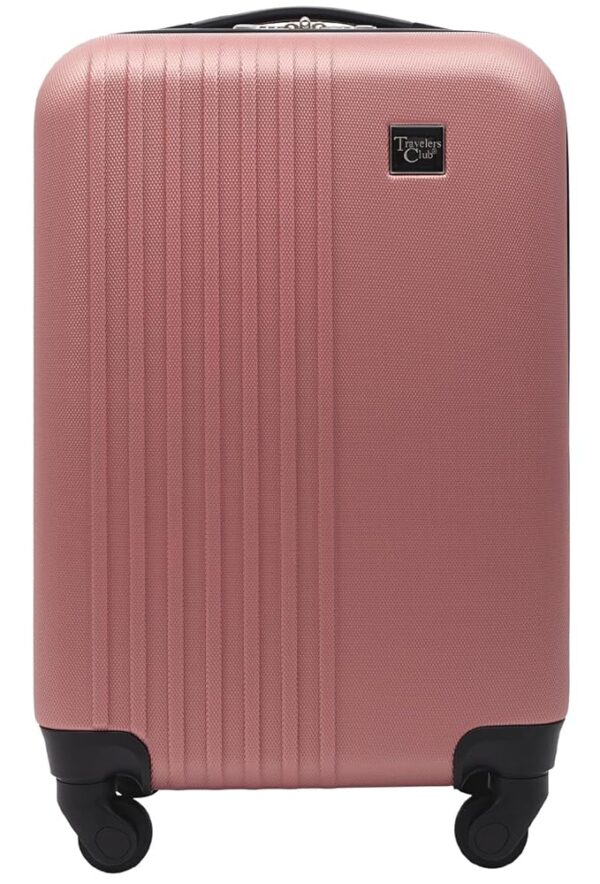
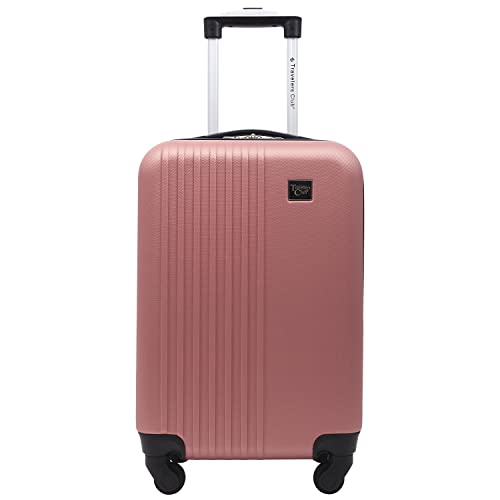
The rose gold finish is doing real work at a carousel, where identifying your case quickly is worth more than most people credit. It suits leisure travel, short business trips and anyone replacing a failed budget case. It does not suit weekly flying, because ABS has a limited number of hard handling cycles in it. Frequent travelers should be looking at polycarbonate, which is what the Samsonite Omni PC uses at a similar size, and the wider field sits in carry on luggage.
Dimensions, and the disclosure that matters
The manufacturer bullet gives the body dimensions, explicitly without the wheels, as 19.5 inches high by 13.5 inches long by 8.5 inches wide, at 6 pounds. The attribute block gives 13.5 by 8.5 by 19.5 inches, which is the same measurement in a different order. For once the two sources agree.
What the missing wheel height costs you
An airport sizer measures the case standing on its castors, so the number that matters is the 19.5 inch body plus the wheels. Spinner castors on a 20 inch case typically add between one and a half and two and a half inches, which puts the real standing height somewhere between 21 and 22 inches. The commonly cited United States domestic allowance is around 22 by 14 by 9 inches. At 13.5 inches wide and 8.5 inches deep the case has margin on both of those axes, so height is the only variable, and it is likely to land close to the line rather than comfortably under it.
Travelers Club makes no airline compliance claim in the bullets we can read, which is more restrained than several competitors, and we are not going to make one on their behalf. Every carrier publishes its own allowance, budget and regional airlines are tighter, and many international carriers add a cabin bag weight limit. The right move is to measure the case standing on its wheels when it arrives and compare that figure to your specific airline, aircraft and fare.
There is no expansion gusset on this case, and that is a genuine advantage on a cabin bag. An expandable carry on is a carry on with a setting that makes it non compliant, and a fixed volume case cannot be talked into that mistake at a gate.
Shell, wheels and the ground contact
The material is named as ABS, described by the maker as a durable and lightweight hard shell. Half of that is accurate. ABS is genuinely light, which is how a 20 inch case with four castors and a telescoping handle reaches 6 pounds. It is also the most brittle of the common hard shell polymers, and under a hard impact, particularly in a cold cargo hold, it cracks rather than flexing and springing back the way polycarbonate does. A cracked ABS shell ends the case. That is the trade at this price, and it is a reasonable one for a bag that flies a few times a year.
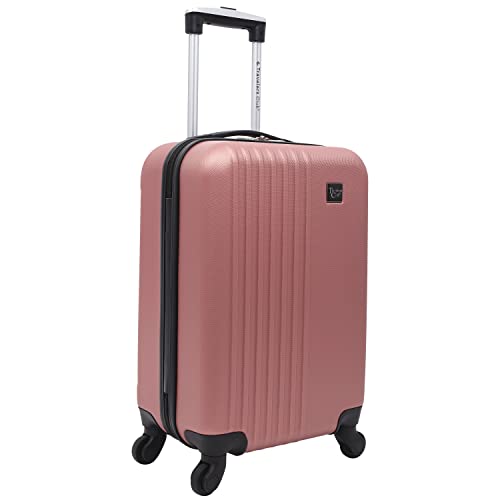
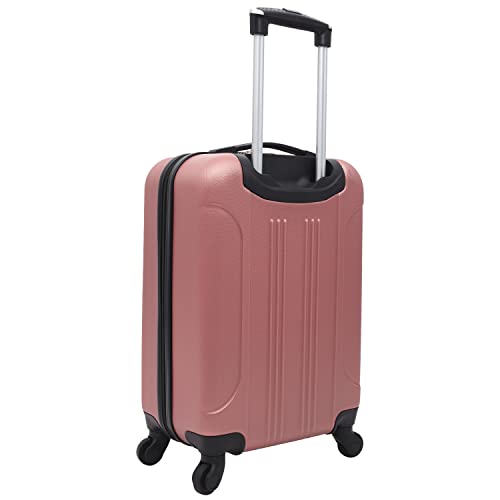
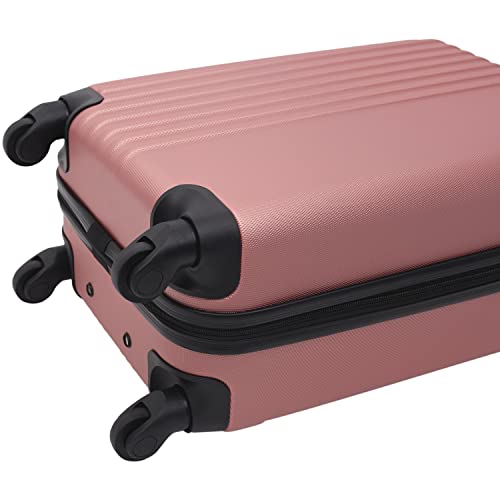
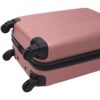
Four spinning wheels do the rolling, described by the maker as easy on the wrist, which is a fair account of what a spinner does when you push a case beside you rather than dragging it. The standard weaknesses apply: castors are the most common breakage point on wheeled luggage, they are poor on cobble and gravel, and they add to the height and depth a sizer measures. The listing does not say whether the castors are single or dual wheeled, and dual castors roll better under load.
The detail worth praising is four side rubber studs for laying the case on the ground. That sounds trivial and is not. Hard shell cases spend a lot of time flat on floors that are wet, gritty or both, and studs keep the shell off the surface and take the abrasion instead. Combined with the top carry handle, it is a sensible set of small decisions.
Capacity, packing and a unit error
Capacity is reported twice and only one of the two figures is usable. The total capacity field gives 37 liters, which is a plausible number for a body of 19.5 by 13.5 by 8.5 inches once the shell wall and the handle housing are subtracted. The capacity field gives 6 pounds, which is not a unit of volume at all and is simply the item weight repeated into the wrong field. Take 37 liters and disregard the other.
The interior is the best part of this case. Fully lined, with pockets, compression straps and dividers. Compression straps hold a packed half flat and are what keeps folded clothing from creasing across a flight. A divider closes the loose half so the case can be opened flat without spilling. That combination is more than the Travelers Club Richmond offers at a similar size and price, and it is the reason to choose this model over that one.
There is no lock mentioned anywhere. If that matters to you, understand what you would be getting: a TSA recognized lock opens to a universal screener key, so it deters an opportunist and stops a zipper being pulled open in transit, and it secures nothing of value.
Warranty, support and the comparison set
No warranty term appears anywhere in the source data. What the manufacturer offers instead is a statement asking buyers with any issue to contact them directly for immediate help. That is customer service language, not a warranty, and it commits to nothing in particular. Get a term and, more importantly, an exclusion list in writing before you buy. Airline handling damage is excluded across essentially this whole category, and handling damage is what actually breaks luggage.
If a published warranty is what decides the purchase, Samsonite states ten years on its hard shells and Travelpro states a limited lifetime term that explicitly covers carrier damage for the first year. Within the same size class the alternatives sit in carry-ons, and if a matched set is what you actually want rather than a single case, the Travelers Club Midtown hardside set is the same maker’s take on that format.
Who should buy it and who should not
Buy it if you want a light, well organized 20 inch hard shell with compression straps and dividers, you like the finish, and you accept ABS as a material with a finite trip count. The rubber ground studs and the fixed volume are both small decisions that go the buyer’s way.
Skip it if you need a lock, if you fly often enough to wear out a shell, or if a published warranty term is a requirement. And be clear about the height: the 19.5 inches on this listing is the body without the wheels, by the maker’s own statement, so the real standing height is one and a half to two and a half inches more than that.