Description
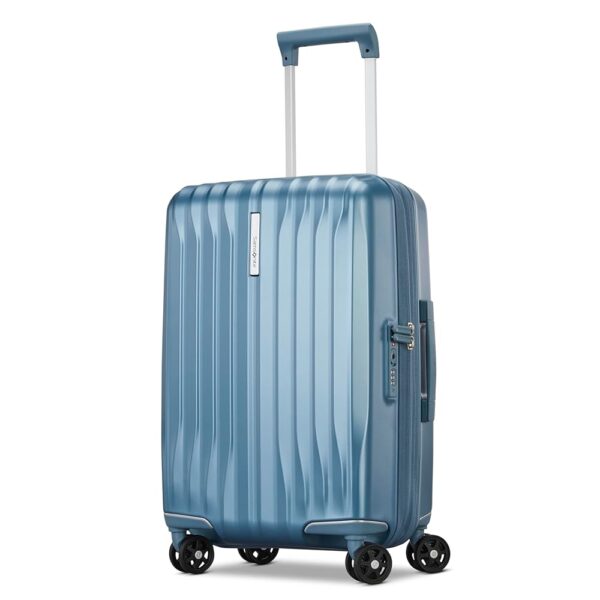
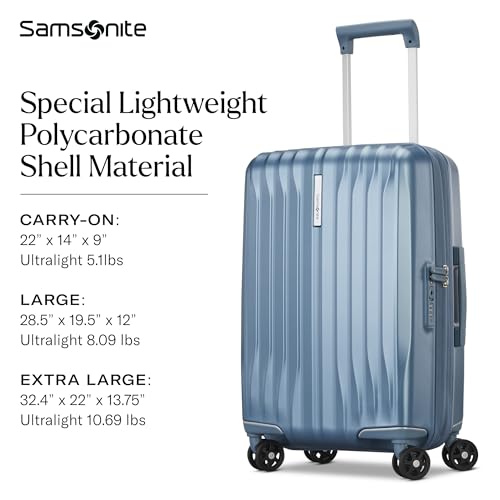
The Samsonite UpLIFT hardside is the lightest polycarbonate case in this batch by a clear margin, at 5.07 pounds. That is roughly a pound and three quarters under the class average and it is the whole reason the case exists. The manufacturer’s product name also contains the words airline approved, which is a claim we will attribute rather than repeat, and the listing calls the case 19 inch while publishing an exterior of 22 inches.
The traveler and the trip
A 20 to 22 inch polycarbonate hard shell at 5.07 pounds is a three to four day bag for one adult, and the weight is what makes it interesting. On international and budget carriers that enforce a cabin bag weight limit, often between fifteen and twenty two pounds, every pound of empty case comes out of your packing allowance. A 5.07 pound case leaves three more pounds of clothing than an eight pound one.
Polycarbonate is the material to want in a hard shell, because it deforms under a crush load and springs back rather than cracking, and it keeps rain out entirely. Getting that rigidity at softside weight is a genuine engineering achievement rather than a marketing line. It does not suit anyone who needs exterior pockets, because no hard shell has any. If pocket access matters, the maker’s own UpLIFT softside is the fabric alternative at a similar weight, and the wider field sits in carry on luggage.
Dimensions, and the size the listing cannot settle
The attribute block gives 9 by 14 by 22 inches. Reordered, that is 22 inches on the longest side, 14 wide and 9 deep. The manufacturer title calls this a 19 inch carry on. The manufacturer bullets publish no dimensions at all.
Nineteen inches is presumably the packing height rather than the case height, following the pattern on Samsonite’s other listings where a 19 or 20 inch label sits alongside a 22 inch exterior. The number a gauge measures is 22 inches.
Against the common allowance
The commonly cited United States domestic carry on allowance is around 22 by 14 by 9 inches, measured with the castors on. This case is quoted at exactly that figure on all three axes, which means it has no margin whatsoever. A rigid polycarbonate shell has no give, so a gauge that is fractionally tight, or a castor or lock housing that stands proud of the quoted figure, is enough to fail.
The listing also does not state whether the 22 inches includes the wheels, which on a case published at precisely the allowance figure is the question that decides everything. A published dimension matching an allowance exactly is a pattern that recurs throughout this catalog and it deserves scepticism.
The product name contains the words airline approved. That is not something a manufacturer can grant. Approval is a property of the airline, every carrier publishes its own allowance, budget and regional airlines are consistently tighter than the mainstream figure, and international carriers frequently add a weight limit. We are not going to repeat it. Measure the case standing on its wheels on arrival.
The case expands by 1 inch. That is a restrained figure by the standards of the category, where two inch gussets are normal, but on a case with zero margin any expansion takes it outside. Treat the gusset as a feature for a return leg you are prepared to check.
Shell, wheels, handle and lock
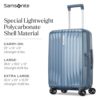
The shell is a specially engineered polycarbonate, which Samsonite says is formulated for strength without weight. The 5.07 pound result supports the claim. The trade with a thinner or differently formulated shell is usually stiffness, so expect more flex under a crush load than on a heavier polycarbonate case. That is not necessarily bad, since polycarbonate is meant to flex, but it does mean fragile contents get less absolute protection than the material’s reputation suggests.
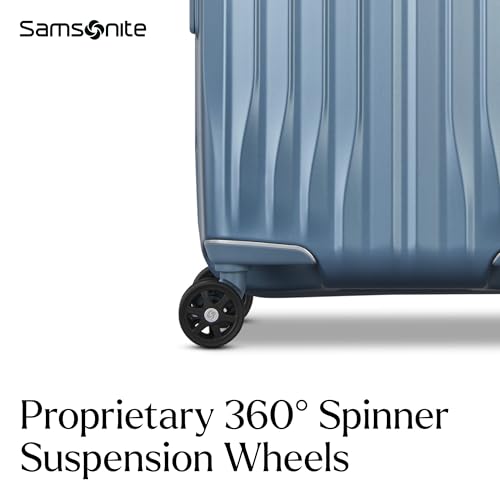
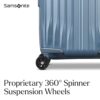
The wheels are described as proprietary 360 degree suspension wheels. Suspension on a castor is a real engineering answer to the standing weakness of small hard wheels, which transmit every seam and crack straight into the case and into your wrist. A sprung or damped castor absorbs some of that and reduces the shock loading on the mount, which is where castors tear out. This is one of the better wheel specifications in the batch, alongside the multi layer tires on the maker’s Stryde 2. The listing does not say whether the castors are single or dual wheeled.
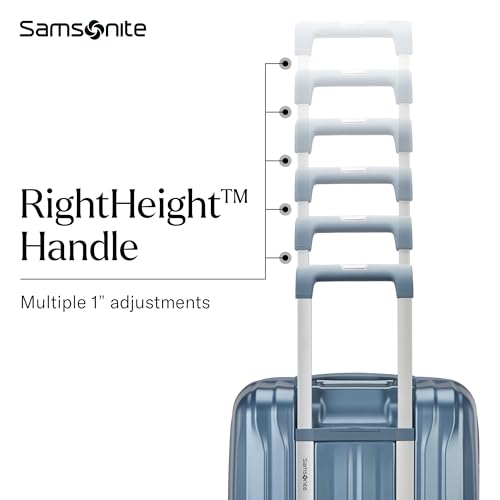
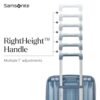
The handle is the RightHeight system with multiple one inch height adjustments and a wipe clean ergonomic grip. Continuous one inch stops is more useful than the two position handles common in the class, particularly for shorter and taller travelers who find fixed stops land in the wrong place.
The lock is a fully flush mounted TSA recognized mechanism, fitted on every size in the range. Flush mounting matters more than it sounds: a lock that sits inside the shell profile does not add to the measured depth and does not take the impact when the case is thrown flat onto a belt. On what the lock does, be precise. It opens to a universal key held by screeners, so it deters an opportunist and stops the case falling open in transit. It is not security, and nothing you would mind losing should travel in a checked bag behind one.
Capacity, packing and what is missing
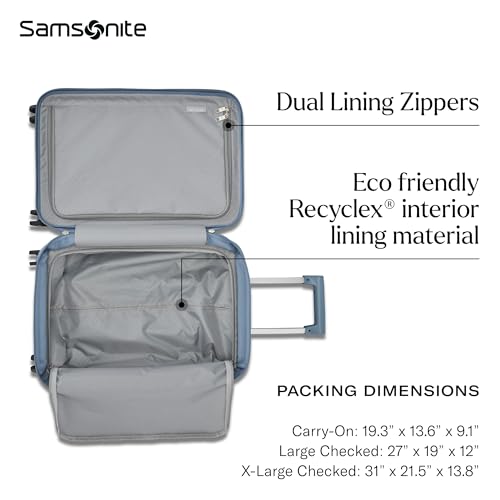
No capacity figure appears anywhere, in liters or cubic inches, and no packing dimension is published either. That is a real gap on a case whose main competitors publish theirs, and it means you cannot compare this bag against anything else in the size class on volume.
Working from a bounding box of 22 by 14 by 9 inches, the enclosed volume is roughly 45 liters before the shell wall, the handle housing and the wheel wells take their share, so something in the high thirties is a reasonable expectation. That is an estimate and not a published number, and we are not going to present it as one.
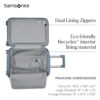
The interior is not described anywhere in the bullets. No divider, no compression straps, no pockets are named, which is unusual on a Samsonite listing where a full zip divider and cross straps are normally specified. Confirm the layout before ordering, particularly if you want both halves of the case to close.
Country of origin is given as Thailand, which differs from the Cambodia, Indonesia and Myanmar origins on other Samsonite listings in this catalog. That is normal for a brand with multiple contract factories and it is not a fault, but it does mean build consistency across the range is not guaranteed. Sibling listings include the UpLIFT in a larger size and the UpLIFT carry on under an adjacent model code.
Warranty and the comparison set
No warranty term appears anywhere in the source data for this listing, which is unusual for Samsonite, since the brand publishes a ten year limited warranty against defects on most of its hard shells and states it plainly there. Whether the same term applies to the UpLIFT hardside is not stated here and we are not going to transfer it across. Get the term and the exclusions in writing before ordering.
Expect airline handling damage to be excluded whatever term you are quoted, as it is across essentially this entire category. A defects warranty covers a shell cracked by a manufacturing fault, not one cracked by a baggage belt, and handling damage is the great majority of what happens to a checked bag. The Travelpro Maxlite Air is the closest competitor on weight at 6.3 pounds, and it publishes a limited lifetime term that explicitly covers carrier damage for one year after registration. Larger cases in the same construction sit under suitcases.
Who should buy it and who should not
Buy it if empty weight is your binding constraint. At 5.07 pounds this is the lightest polycarbonate hard shell in this batch, and the suspension wheels, the one inch adjustable handle and the flush mounted lock are three well judged decisions on top of that.
Skip it if your airline uses a rigid gate sizer, because the case is published at exactly 22 by 14 by 9 inches with no margin on any axis and the listing does not say whether that includes the wheels. Skip it too if you need a published capacity, an interior layout or a stated warranty term, none of which appear on this page. And treat the airline approved wording in the product name as marketing rather than a specification.