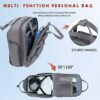
Description
Who buys a 16 inch underseat bag
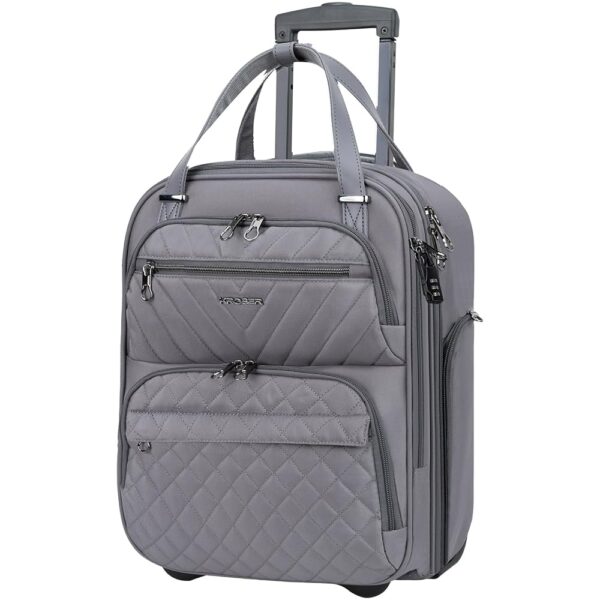
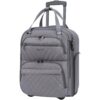
The KROSER underseater is aimed at a specific and growing traveler: the one flying a fare where the overhead bin costs extra, or the one who has decided that boarding early and fighting for bin space is not worth it. At a published 16 by 12 by 7 inches this is a personal item sized bag with a padded laptop wall, a front organizer and a back sleeve for stacking over a larger case. One or two nights of clothes plus a working laptop setup is the honest capacity.
The other buyer is the overnight business traveler who does not check anything and does not want to touch a bin. For that person the bag competes less with suitcases and more with a large backpack, and the deciding factor is whether you would rather roll weight or carry it. If you would rather carry it, the wheels and frame here are dead weight. If you would rather roll it, this is the format. Comparable options in the same class include the Verage underseat spinner and the Coolife underseat carry on.
Dimensions and the compliance question
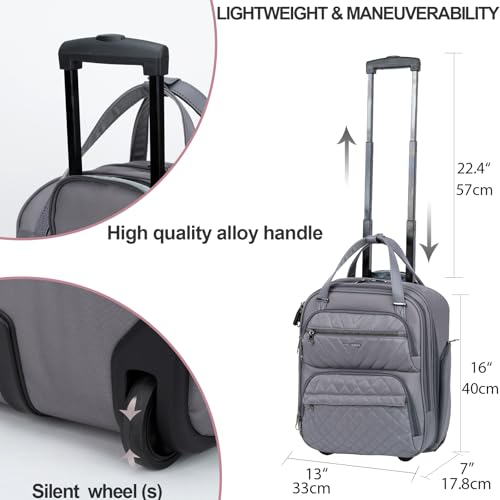
The specification block publishes 12 by 7 by 16 inches. That is a small bag by any measure, comfortably under the personal item allowances published by most United States major carriers, and small enough that the usual carry on argument barely applies.
What the listing does not say about the wheels
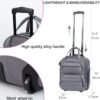
The listing never states whether the 16 inch figure includes the wheels. In fact the feature bullets never mention wheels at all, despite the product being sold as a rolling underseater. There is no wheel count, no description of caster versus inline, and no material. That is a strange omission on a wheeled bag, and it matters twice: once because wheel type determines how the bag behaves on rough ground, and once because wheel housings usually add to whichever dimension they are mounted on. Measure the bag on arrival before you assume 16 inches is the number a sizer will read.
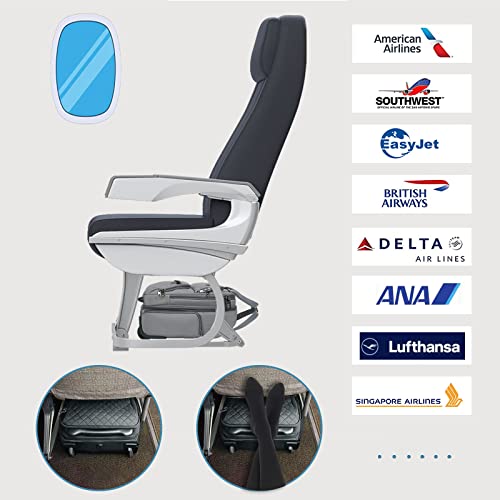
KROSER’s first bullet claims the bag fits in most airline overhead compartments and under the seat. That is the maker’s claim and we are attributing it as such rather than repeating it as fact. No airline certifies luggage, personal item allowances differ by carrier and fare, and underseat space in particular varies by aircraft type and by seat. Window seats with entertainment boxes and many regional jets give you less space than the published figure suggests. Check your specific carrier’s personal item dimensions, then measure this bag yourself.
Fabric, protection and the hardware KROSER does describe
The shell is polyester with a water resistant treatment and an anti scratch finish, with the listing specifically noting that the bottom is protected. Bottom reinforcement is a genuinely useful detail on an underseat bag, because the bottom is what drags across terminal floors, jet bridge grating and taxi curbs. No denier rating is published, so the fabric weight is unstated and the durability claim is unquantified.
Polyester behaves the way polyester behaves. It scuffs instead of cracking, it takes outer pockets that a hard shell cannot offer, and a water resistant coating buys you a rain dash rather than protection in a downpour. The zipper line is the point of entry for water on any softside bag, coated or not.
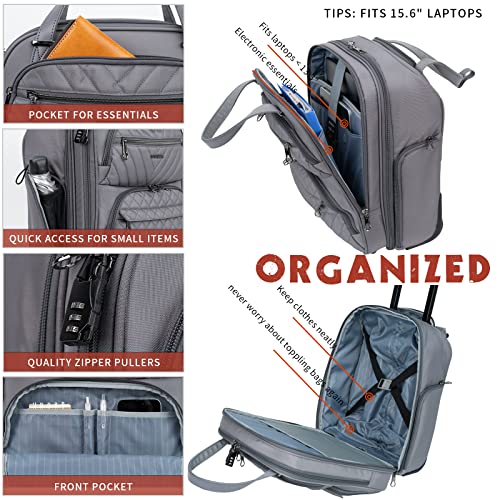
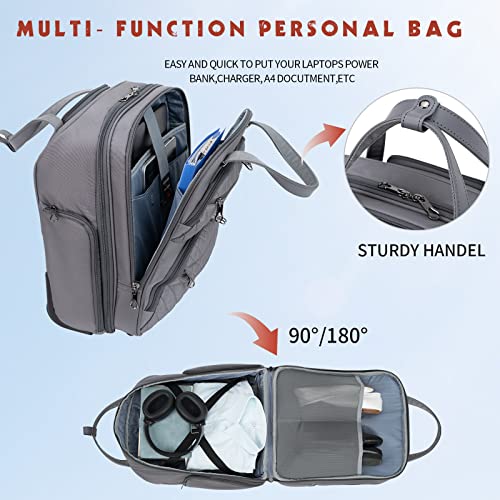
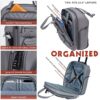
The layout is the strong part. A spacious main compartment for clothes and shoes, a padded compartment rated for laptops up to 15.6 inches, a front organizer for small items, and zippered pockets on both sides that KROSER describes as sized for a battery and a water bottle. That battery pocket is worth a note: this bag has no built in power system, so any power bank you carry is a loose item you can remove and keep with you. That is the arrangement airlines want. Lithium power banks must generally be carried in the cabin and not checked, and bags with sealed in, non removable batteries have been refused at the gate. Nothing here creates that risk.
A top carry handle and a back sleeve complete the picture. The sleeve is the feature that turns this into a second bag stacked over a full size upright, and it is the reason people buy underseaters in pairs with larger cases such as the KROSER softside expandable carry on.
Capacity, weight and the figures that are missing
KROSER publishes no capacity at all. There is no liter figure and no cubic inch figure anywhere on the listing, and no interior dimensions either. For a bag whose entire selling point is fitting a defined space, that is a real gap. What you can do is work from the exterior: 16 by 12 by 7 inches is roughly 1,344 cubic inches, or about 22 liters of total envelope before the laptop wall, the handle channel, the wheel housings and the shell thickness are subtracted. Usable space will be meaningfully less. Plan for one or two days of clothing alongside a laptop, not three.
The weight figure is the one that should give buyers pause. KROSER publishes 6.33 pounds empty. That is heavy for a bag this size. For scale, several 18 inch underseaters in the same category publish empty weights under five pounds, and this bag is smaller than those and heavier than them. Six and a third pounds of empty bag against a strict international cabin allowance is a large bite, and it is a large bite in your hand every time you lift the bag over a curb or into a bin.
To be fair to the product, some of that weight is the bottom reinforcement, the padded laptop wall and the frame that lets the bag stand up loaded. Rigidity costs weight. The point is that you are trading empty weight for structure, and you should make that trade knowingly rather than discovering it at a check in scale.
Security, warranty and the alternatives
The listing mentions an extra zipper lock to prevent theft. It does not describe it as TSA approved and does not say what type it is. Any zipper lock on a coil zipper is a deterrent against opportunistic opening rather than security, because a coil zipper can be forced open with a ballpoint pen and closed again by running the sliders over the split. Keep passports, cash and electronics on your person.
There is no warranty statement on this listing. No term, no coverage description, no exclusions, and nothing about airline handling damage. That silence is common on unbranded luggage and it is worth pricing in. If a published coverage commitment matters, the Briggs and Riley underseat cabin bag sits at the other end of the market with stated terms, and the broader range is in our carry-ons and carry-on luggage sections.
One data point in the bag’s favor: it carries a rating of 4.4 from a little over 3,000 ratings and sits ranked 13th in its Amazon carry on luggage category. A review base that size gives you a much larger pool of failure reports to read than a listing with a few dozen, and reading the one and two star reports is the most useful research you can do on any bag whose maker publishes no warranty.
Who should buy it and who should not
Buy it if you fly bin excluded fares on United States domestic routes, you carry a 15.6 inch or smaller laptop, and you want a reinforced, well organized rolling personal item. Skip it if empty weight is your constraint, because 6.33 pounds is heavy for the size, and skip it if you need to know the wheel type before ordering, because the listing never describes the wheels at all. Measure the bag, check your carrier’s personal item allowance, and do not read the overhead bin claim as a guarantee.