Description
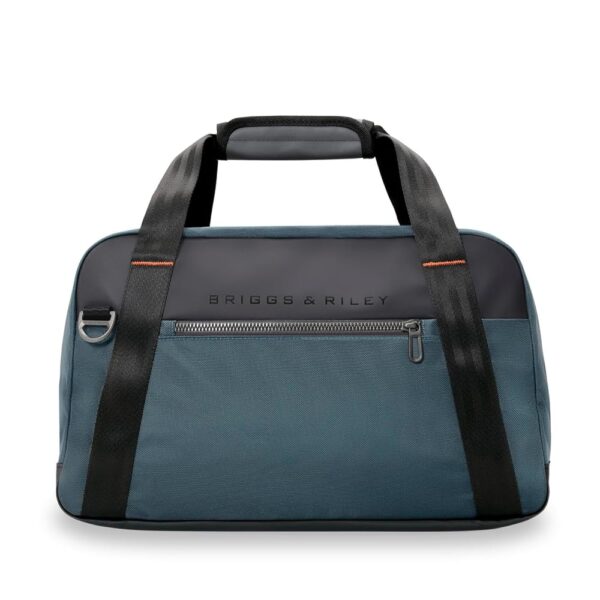
The Briggs and Riley ZDX underseat cabin bag in ocean, model ZX150-26, is a soft sided personal item built around a tech compartment. At a published 1.9 pounds it is among the lightest bags in this catalog, and its listing publishes a capacity slightly larger than the outside of the bag.
The traveler and the trip this suits
This is the second bag on a trip, or the only bag on an overnight. It goes under the seat while a cabin case goes overhead, or it slides onto a rolling case handle through the terminal. Briggs and Riley describes it as holding a change of clothes alongside tech accessories, which is an accurate account of what 25 liters does.
The buyer it is aimed at carries a laptop and its accessories daily. An independent tech compartment, a battery pouch and a cord pass describe a bag organized around a working setup rather than around clothing. Readers comparing personal items should read the Osprey Transporter boarding bag and the KROSER underseat carry-on.
Dimensions, and a capacity figure that does not fit inside them
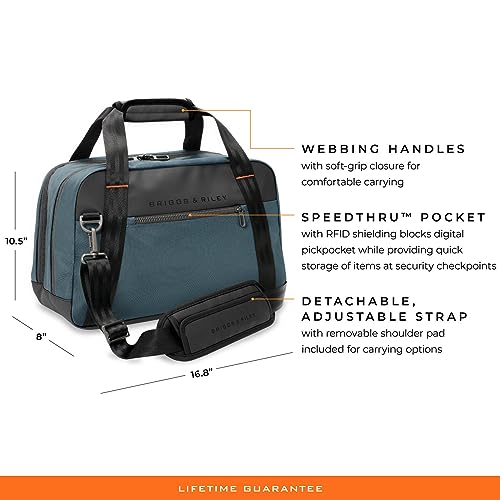
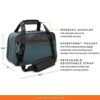
The specification block gives Product Dimensions of 16.8 by 8 by 10.5 inches, with a capacity of 25.5 liters repeated in a second field.
The cross check
The outer envelope of 16.8 by 10.5 by 8 inches is about 1,411 cubic inches, or roughly 23.1 liters. The published capacity of 25.5 liters is larger than the entire outside of the bag by about two and a half liters.
On a frameless soft bag that is not quite as absurd as it would be on a hard case, because a stuffed soft bag bulges past its nominal dimensions and the quoted figures presumably describe it unpacked. It is still a figure that cannot be reconciled with the dimensions as published, and a buyer planning a pack should work from the dimensions rather than the liters.
As a personal item
At 16.8 by 10.5 by 8 inches this sits comfortably inside the commonly cited United States domestic cabin figure of roughly 22 by 14 by 9 inches, which is the larger of the two standards that apply. Personal item allowances are separate and smaller, each airline publishes its own, and underseat space additionally varies by aircraft type and by seat row: a row with an entertainment box or a life vest housing has less of it, and bulkhead and exit rows frequently have none.
Nothing in the listing claims compliance with anything, which is to its credit, and we are not going to claim it either. Check the personal item dimensions your specific carrier publishes. A soft bag helps here in a way a rigid one cannot, because an underfilled bag compresses into a smaller space than its nominal size.
The listing does not state whether the figures describe the bag empty or packed, which on a frameless bag is the relevant distinction.
The tech compartment, and the battery pouch
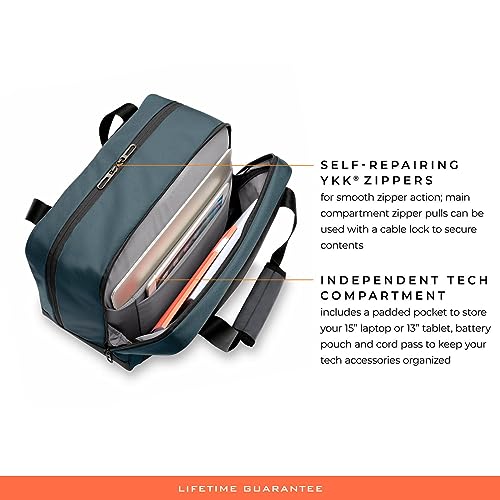
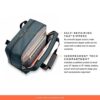
The tech compartment is independent of the main compartment, with a padded pocket stated to fit a 15 inch laptop or a 13 inch tablet, a battery pouch and a cord pass. Publishing a laptop size is worth crediting, since many listings mention a sleeve without saying what goes in it.
The battery pouch needs the standard treatment. It is a pouch, not an installed battery, and nothing in the listing says a power bank ships with the bag, so whatever goes in it is yours and is removable by definition. That is the right arrangement.
The rule still applies to what you put there. Most airlines require lithium batteries and power banks to travel in the cabin and to be removable, and bags with non removable batteries have been refused at the gate. If this bag is ever gate checked, the power bank has to come out and travel with you. A cord pass, which is a grommet letting a cable run from the pouch to a device, means a bank can charge a phone in place without the bag being opened.
The SpeedThru pocket and the RFID claim
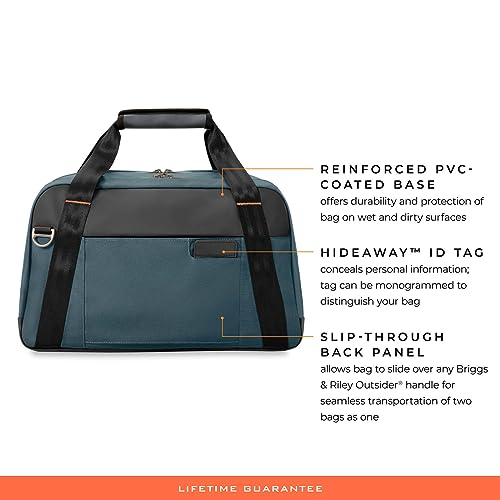
The SpeedThru pocket is an external quick access pocket for the items security asks you to present: phone, keys, coins, a boarding pass. Its genuinely useful detail is an orange lining that is visible when the pocket is left open, which is a simple solution to the most common way people lose things in an airport.
The pocket is also described as having RFID shielding that blocks digital pickpocketing. That is the maker’s claim and it should be read with some perspective. RFID shielding is a metallic layer that prevents a contactless card or passport chip being read at close range. It works as physical shielding. Whether it addresses a real risk is a separate question: contactless payment cards use one time tokens rather than transmitting reusable card details, and documented cases of contactless skimming in the wild are rare. Treat the shielding as reassurance rather than as protection against a common threat, and do not pay a premium for it alone.
Materials, carry options and what is missing
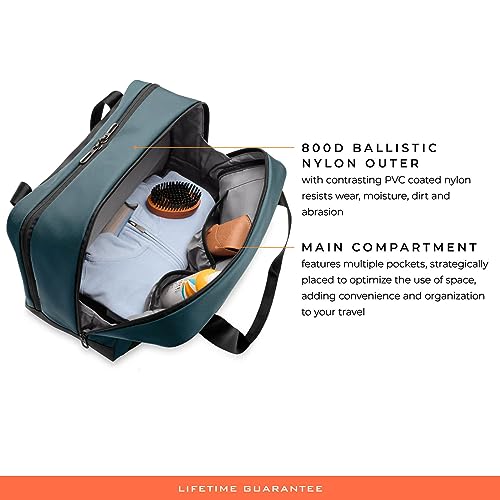
The description says the bags are crafted of rugged and resilient fabrics. That is the entirety of the material information: no fiber, no denier, no weave, no coating. On a soft bag the fabric weight is the number that tells you how it will wear, and it is missing from a listing at the premium end of this catalog.
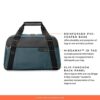
A detachable adjustable strap with a removable shoulder pad is included, giving hand carry and shoulder carry options. The slip through back panel slides over any Briggs and Riley Outsider handle, which is the maker’s externally mounted handle design, so the two bags travel as one. That works with the maker’s own cases specifically, such as the Briggs and Riley ZDX 22 inch carry-on, and is less certain on other brands’ handles.
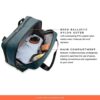
The main compartment is described as having multiple pockets strategically placed, without any being counted or located.
Warranty and the demand picture
No warranty term is published anywhere in this listing. That is worth flagging specifically, because the same maker’s Rhapsody listing in this catalog does state a lifetime repair commitment that explicitly names damage caused by an airline, which is unusual and is one of the strongest things about that product. Its absence here means a buyer working from this data has no published period, scope or exclusions. Confirm with the seller. The Rhapsody is covered in the Briggs and Riley Rhapsody underseat spinner review.
The listing shows a 4.7 star average across 18 ratings. Eighteen ratings is a very thin sample and no conclusion should be drawn from that average in either direction. It ranks 861st in Carry-On Luggage and 907,468th in Clothing, Shoes and Jewelry, both very low, which for a premium priced specialist bag is unsurprising rather than alarming. Country of origin is Indonesia. More options sit in the carry-ons category and the carry-on luggage category.
Who should buy it, and who should not
Buy it if you want a very light personal item with a separate tech compartment, a stated 15 inch laptop fit, a cord pass for charging in place and a quick access pocket with an open lining warning.
Skip it if you need to know what the bag is made of, or want a published warranty term. Plan from the dimensions rather than the 25.5 liter figure, which exceeds the bag’s own outer volume, and make sure any power bank in the battery pouch can come out.