

Description
This is a two piece set in white
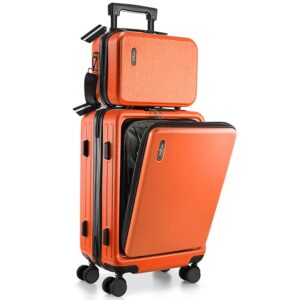
The listing sells a 20 inch hard shell cabin case together with a 14 inch cosmetic case, not a single suitcase. Both pieces have their own published dimensions, weights and capacities, and the specification block mixes figures from both, so reading this page correctly starts with knowing there are two objects in the box.
This is the white finish of a set that also appears in grey elsewhere in this catalog, sharing an identical review count and category rank because Amazon aggregates ratings across colorways. The grey version is the LUGGEX two piece set in grey. A white shell is worth one specific caution covered below. Sets are collected in our luggage sets section.
Dimensions, and which piece each figure describes
The feature bullet publishes both pieces separately, which is the useful source. The 14 inch cosmetic case is 10.5 by 13.6 by 6.9 inches at 2.1 pounds with 10 liters of capacity. The 20 inch case is 21.9 by 15.0 by 8.3 inches at 6.1 pounds with 40 liters. The specification block gives 21.9 by 15 by 8.3 inches, which is the larger piece, and 8.2 pounds, which is the two weights added together.
Where the cabin case lands
Against the size guideline most commonly cited for United States domestic cabin baggage, roughly 22 by 14 by 9 inches, the 20 inch case at 21.9 by 15.0 by 8.3 inches is just inside on height, comfortably inside on depth, and a full inch over on width. That last figure is the problem. A soft bag would compress an inch of width into a sizer. A rigid shell will not compress at all.
Nothing states whether the wheels and retracted handle are included in any of these figures. We will not write that either piece is airline approved, and the listing does not claim it. Check the allowance published by the carrier and fare you booked, note that budget and regional carriers are frequently stricter than the majors and that many international carriers add a cabin weight limit, and measure both pieces on arrival.
The case is also described as expandable, with no expansion figure published anywhere. Whatever it adds goes onto the depth, which has room, but a case already an inch over on width does not become compliant by growing. Treat the expansion as a feature for the hold.
The 14 inch piece at 13.6 inches on its longest side is small enough to work as a personal item under most published allowances, which makes the pairing sensible: one bag in the bin and one under the seat.
Polypropylene, and what white does to it
The shell is three layered polypropylene, which is an unusual choice in this category and the most interesting thing on the listing. The common luggage polymers are polycarbonate, which flexes under impact and returns to shape, and ABS, which is cheaper, lighter and cracks at a corner. Polypropylene sits differently again: lighter than both, very resistant to fatigue and repeated flexing, and it does not become brittle the way ABS can. It is also softer and less rigid, so it deforms more readily under a heavy load and can hold a dent or a bow rather than springing back. A three layer construction is presumably there to add stiffness back.
Expect a shell that survives repeated knocks without cracking and that may show permanent deformation from a hard crush. For a cabin case that mostly lives in overhead bins, that is a reasonable trade and it explains the low weight. For a case going into a hold under other bags, polycarbonate remains the safer material.
Now the caution specific to this finish. A white or light coloured hard shell shows scuffing and transfer marks far more than a dark one, and polypropylene is a softer surface than polycarbonate, so it picks up marks readily. Nothing on this listing mentions a scratch resistant coating or a textured finish, both of which are the usual mitigations. If a case looking clean after a year matters to you, the grey version of the same set is the safer choice.
The interior carries compartments that separate wet and dry items. No lock, no lock provision, no zipper brand and no wheel or handle detail is published anywhere on this listing, which is a thin specification for a hard shell.
Capacity, weight and a field in scientific notation
The capacity field on this listing reads 4E+1 Liters. That is scientific notation for 40, and it is a spreadsheet artifact rather than a value anyone typed deliberately. It happens to match the 40 liter figure the bullet gives for the 20 inch case, so the number is probably right even though its presentation is broken. Note that the grey version of the same set publishes 20 liters in the same field, which matches neither piece nor their sum, so the two listings are broken in different ways.
The bullet figures survive a check better. The 20 inch case envelope of 21.9 by 15.0 by 8.3 inches is roughly 2,727 cubic inches, or about 44.7 liters, so a 40 liter usable claim leaves only about five liters for shell walls, the handle channel and the wheel wells. That is optimistic for a rigid case, though less absurd than several other listings in this catalog. Expect somewhat less than 40 in practice.
The weights are the cleanest data here. The specification block says 8.2 pounds and the bullet says 6.1 plus 2.1, which is exactly 8.2. Internal consistency like that is rare on this catalog and it suggests the weight figures are real. Six point one pounds for a 20 inch hard shell is genuinely light, which is what the polypropylene buys you, and it leaves more of a cabin weight allowance for contents on carriers that weigh it. Remember that 8.2 pounds is what a scale sees if you carry both pieces, and 6.1 is what matters if only the cabin case goes in the bin.
Warranty, review base and the alternatives
LUGGEX states a comprehensive support plan for three years with a customer service response within twelve hours. Three years is longer than most of this bracket offers and a stated response window is specific enough to hold someone to. What the listing does not do is describe what the plan covers, and it says nothing about airline handling damage, which is the standard exclusion across luggage warranties and the damage that actually happens. Read the plan document rather than the bullet.
The review base is thin: 4.3 from 90 ratings with a rank of 252nd in its Amazon carry on luggage category, and those ratings are shared with the grey version. Ninety ratings across two finishes is a small pool, and on an unusual shell material there is not much accumulated experience to draw on. Read the one and two star reports specifically for comments about the shell deforming or holding dents, and for marking on the white finish, because those are the failure modes this construction is prone to.
For a single case from the same brand with a named polycarbonate shell and aluminum corner armor, see the LUGGEX 20 inch polycarbonate carry on, and for an expandable version the LUGGEX expandable hard shell. The wider field is in carry-on luggage.
Who should buy it and who should not
Buy it if you want a cabin case and a matching small case bought together, you value a genuinely light 6.1 pound shell, and your airline is relaxed about a case an inch over on width. The consistent, separately published weights are a mark of a listing you can trust on that figure. Skip it if your carrier uses a hard sizer, because 15 inches wide is over the commonly cited limit, and skip it if the case will be checked regularly, because polypropylene deforms where polycarbonate springs back. A white shell with no stated anti scuff finish will show marks quickly.