Description
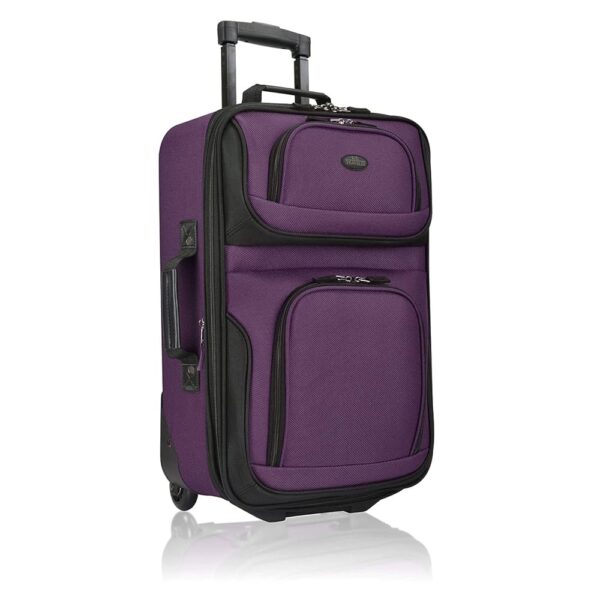
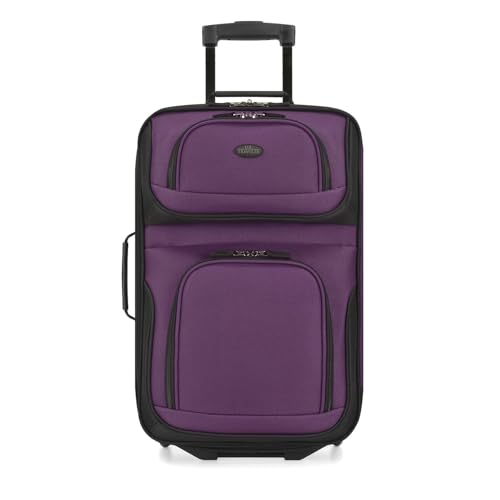
The U.S. Traveler US5600L20 is a softside upright sold in purple at the 20 inch label size, aimed at the occasional flyer who packs light and does not want to think hard about luggage.
The trip and the traveler this suits
This is a two or three night bag for a domestic itinerary on a single mainline carrier. It is a softside case with a fabric shell and external give, which means it swallows a slightly awkward last item better than a rigid shell would, and it is the sort of bag that suits a traveler who checks nothing, carries a coat, and wants the case to disappear into an overhead bin without ceremony.
Dimensions, and what an airline will actually measure
The specification block gives the product dimensions as 13.5 by 7.4 by 21 inches. The listing title calls it a 20 inch case. Those two figures cannot both describe the same measurement, and the listing never reconciles them. The usual explanation is that 20 inches refers to the shell height alone while 21 inches is the height once wheels and the retracted handle housing are included, but the listing does not say that, so it is an assumption rather than a fact and we are not going to present it as one.
The listing also does not state whether the quoted 13.5 by 7.4 by 21 inch figure includes the wheels. On a two wheel case the wheels usually add roughly an inch to the height and nothing to the depth, which is one of the genuine advantages a two wheel design has over a spinner. But because the listing is silent, the honest position is that the reader does not know which number a sizer will produce.
Why the commonly quoted allowance does not settle it
The figure most travelers have in their head for United States domestic carry-on is around 22 by 14 by 9 inches. That is a convention, not a rule. Every airline publishes its own allowance, budget and regional carriers are frequently stricter, and many international carriers enforce a cabin bag weight limit alongside the size limit. Nothing in this listing is a compliance guarantee, and we are not going to write that this bag is airline approved. The maker’s own description claims the Rio pieces meet FAA carry-on regulations. That claim belongs to the maker, and it is loose on its own terms, because the FAA regulates cabin safety rather than publishing a carry-on size chart. Airlines set the chart. Check the specific airline, on the specific route, before you buy.
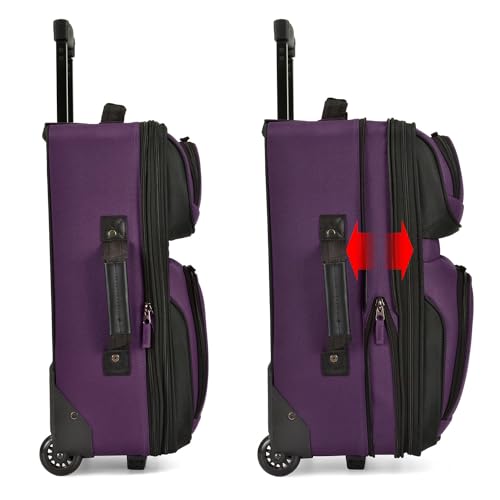
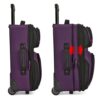
One further wrinkle. The maker’s bullets describe an expandable section that adds packing capacity. Any expansion used is depth added to the exact measurement a gate sizer takes, so a bag that fits closed can fail open. If you buy this intending to fly it expanded, you have bought a small checked bag.
Materials, wheels and handle, and where each gives out
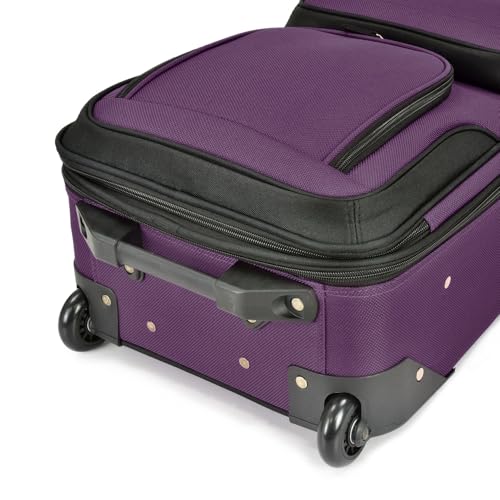
The maker describes a densely woven 1200 denier polyester shell that resists water ingress from the outside, with metal hardware chosen to survive shipping. Polyester at that denier is a reasonable entry level fabric. It abrades rather than cracks, which is the softside trade, and unlike a polycarbonate shell it will not split at a corner. It also absorbs water once any coating wears, and it takes a permanent crease where a belt has pressed it.
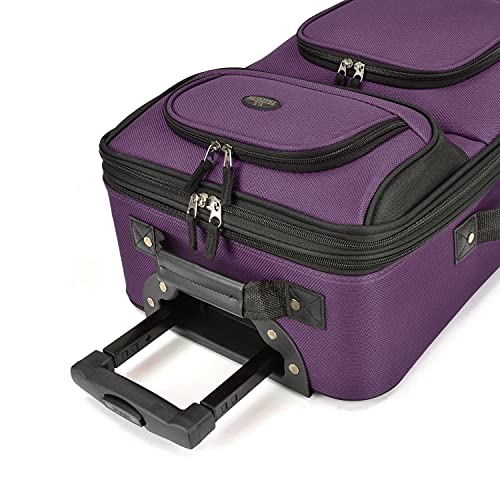
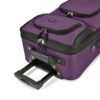
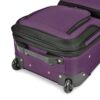
The wheels are described as skate wheels, meaning two inline wheels rather than four spinners. That choice is quietly sensible on a bag at this level. Inline wheels sit partly recessed, they roll better on carpet, curbs and broken pavement than spinners do, and they are far less likely to shear off, because a spinner’s exposed caster is the single most common failure point in inexpensive luggage. The cost is that you drag the case at an angle instead of pushing it upright beside you, which matters on a long terminal walk.
Capacity and weight, where this listing falls apart
This is the part of the listing a buyer needs to treat with suspicion. The item weight is given as 1.3 pounds. A 20 inch wheeled softside upright with metal hardware and a telescoping handle does not weigh 1.3 pounds, and no such product exists. The figure is off by roughly a factor of four, and it is most likely a data error carried through from an unrelated record.
The capacity fields are worse. One field reads 6.6 pounds, which is a weight and not a capacity at all. A second field reads 2.89 liters, which would be smaller than a shoebox and is not a plausible volume for any carry-on. We are naming these contradictions rather than picking whichever one looks most reasonable, because there is no basis on which to choose. The practical consequence is that this listing publishes no usable empty weight and no usable capacity, and empty weight is not a trivia point. On carriers that weigh cabin bags, every pound of case is a pound of clothing you cannot bring.
The written description compounds the problem, because it is not a description of this product. It describes the U.S. Traveler Rio two piece set, a 21 inch expandable wheeled upright plus a 14 inch boarding bag, with a strap that slides the boarding bag over the upright’s handle. The title of this listing says 2 Wheel, 1 Piece. The copy therefore describes two bags while the title sells one. If you are expecting a companion tote in the box, this listing gives you no sound reason to be confident, and you should confirm the piece count before ordering. If the matched set is what you actually want, the multi piece U.S. Traveler Rio configuration is listed separately, and the wider luggage sets category is where matched pieces belong.
Warranty, and what else to weigh
The listing publishes no warranty term. Not a length, not a coverage description, not an exclusion list. On luggage that absence matters more than it would on most products, because the damage luggage actually suffers is airline handling damage, and airline handling damage is the thing luggage warranties most often exclude even when the headline term looks generous. With nothing published here at all, a buyer should assume they are covered by the retailer’s standard return window and by the manufacturer’s discretion, and by nothing more until they see written terms.
Compare that with what sits nearby. The Samsonite UpLIFT softside carry-on publishes a ten year limited warranty against defects in materials and workmanship along with a specific empty weight, which is a materially different level of disclosure even before you compare the bags themselves. Within the same U.S. Traveler family, the teal Rio single upright and the Rio rolling carry-on in a further color are the same chassis under different model codes, and they carry the same weight and capacity errors, so choosing between them is a color decision and nothing more. The full carry-on luggage category holds the rest of the comparison set.
Who should buy it, and who should not
Buy it if you want an inexpensive, light duty softside upright for occasional domestic trips, you prefer inline wheels to spinners, you are willing to measure the bag yourself on arrival, and you accept that no warranty term is published. Do not buy it if you fly carriers that weigh cabin bags, if you need a stated capacity to plan around, if you intend to use the expansion and still carry it on, or if what you actually want is the two piece set that the listing’s own description talks about. In that last case, confirm exactly what ships before you order, because on this listing the title and the description do not agree.