

Description
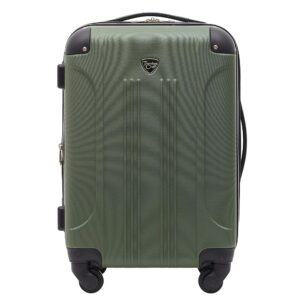
The U.S. Traveler Rio US5600T20 is a 20 inch softside upright in teal, sold as a single piece. It sits in a family of near identical cases that appear in this catalog under different model codes and different colors, and it carries the same set of data problems that the rest of the family carries. Working through those problems is most of what a buyer needs from this page.
The trip and the traveler this suits
It is the wrong bag for a frequent flyer. Nothing in the listing describes a case built for hundreds of cycles through a baggage system, and the absence of any published warranty says the same thing more directly. Travelers who need that should be reading the Samsonite UpLIFT softside carry-on, which publishes a ten year limited term.
Dimensions, and what a sizer will read
The specification block gives 13.5 by 7.5 by 21 inches while the title calls the bag a 20 inch case. Those two numbers describe different things and the listing never says which is which. The likely reading is that 20 inches is the shell height and 21 inches is the height with the wheels and retracted handle housing included, but the listing does not say so and we are not going to present a guess as a fact.
Nothing on the page states whether the wheels are counted in the published figure. That single omission is the most common reason a carry-on that looked compliant is stopped at the gate, because on most wheeled cases the wheels add between one and two inches to the measured height. Take the larger of the two published numbers, measure the assembled bag from the floor to the top of the retracted handle when it arrives, and plan from that.
The FAA claim in the maker’s description
The maker’s description states that the Rio pieces meet FAA carry-on regulations. That claim is the maker’s and we are attributing it rather than repeating it. It is also loose on its own terms. The Federal Aviation Administration regulates cabin safety, including how baggage must be stowed, but it does not publish a carry-on size chart that a bag can meet. Airlines publish those, individually, and they differ. The convention most United States domestic travelers have in mind is around 22 by 14 by 9 inches, budget and regional carriers are frequently stricter, and international carriers commonly enforce a cabin bag weight limit on top of the size limit. There is no such thing as a bag being airline approved in general, and we are not going to write that this one is.
The maker’s bullets also describe an expandable section that adds packing capacity. Expansion used is depth added to the exact dimension a gate sizer measures. A case that clears the frame closed can fail it open, so if your plan is to fly this expanded, you have bought a small checked bag rather than a cabin bag.
Fabric, wheels, handle and closures
The maker describes a densely woven 1200 denier polyester shell, chosen to keep water from seeping through from the outside, with metal hardware selected to survive the shipping process. Polyester at that denier is a competent entry level fabric. It abrades and thins rather than cracking, which is a gentler way to age than a split polycarbonate corner, and it will crease permanently where a belt has pressed it. Fabric also wicks. A softside case left standing on wet ground will pass moisture to whatever is packed against the outer wall, whatever the coating claims.
The wheels are described as skate wheels, which means two inline wheels rather than four spinners. On a bag at this level that is a defensible choice and arguably the better one. Inline wheels sit partly recessed into the shell, they handle carpet, curbs and broken pavement far better than casters do, and they are much less likely to shear off, since an exposed spinner caster is the most common physical failure on wheeled luggage. The price is that you tow the case behind you at an angle rather than pushing it upright at your side, which is more tiring over a long concourse and more awkward in a narrow aisle.
Weight and capacity, where the data breaks down
This listing publishes no usable weight and no usable capacity, and a buyer should treat every figure in this area as unreliable. The item weight is given as 1.3 pounds in two separate fields. A 20 inch wheeled softside upright with metal hardware and a telescoping handle does not weigh 1.3 pounds. Nothing in this category weighs 1.3 pounds. The figure is wrong by roughly a factor of four and appears to be a data error carried in from an unrelated record.
Capacity is given as 6.6 pounds in one field, which is a weight rather than a capacity and therefore not an answer to the question at all, and as 2.89 liters in another, which is a volume smaller than a shoebox and impossible for any carry-on. We are naming both contradictions rather than picking whichever looks least implausible, because there is nothing on the page that would justify a choice. The consequence for a buyer is concrete. If you fly a carrier that weighs cabin bags, and many outside the United States do, you cannot plan your packing against this listing, because the empty weight it publishes is not real.
The description is a further contradiction of the same kind. The written description on this page is not about this product. It describes the U.S. Traveler Rio two piece set, a 21 inch expandable wheeled upright together with a 14 inch boarding bag, with a strap for sliding the boarding bag over the upright’s handle. The title of this listing says Single. So the description sells two bags and the title sells one. Confirm the piece count before ordering. If the matched set is what you want, the multi piece Rio configuration is listed separately and the luggage sets category is where matched pieces live.
Warranty and the near identical alternatives
No warranty is published. No term, no scope, no exclusions. That absence deserves weight, because the damage luggage actually suffers is airline handling damage, and airline handling damage is the exclusion that appears even in generous published terms. With nothing on the page, plan on the retailer’s return window and nothing else.
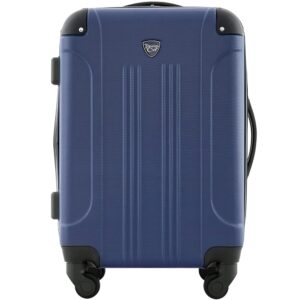
The alternatives worth knowing about are mostly the same bag. The purple US5600L20, the US5600G20 and the US5600C20 are the same chassis in different finishes under different model codes, and each of them repeats the same 1.3 pound weight and the same 2.89 liter capacity. Choosing between them is a color decision. The rest of the field sits in the carry-on luggage category. Buyer feedback here is thin, at 61 ratings averaging 4.1 out of 5, with the bag ranked 257th in Carry-On Luggage and 191,620th in Clothing, Shoes and Jewelry.
Who should buy it, and who should not
Buy it if you want an inexpensive softside cabin bag in a color you can find on a carousel, you prefer inline wheels to spinners, and you are willing to measure and weigh the bag yourself because the listing will not tell you. Do not buy it if you fly carriers that enforce cabin weight, if you need a real capacity figure to plan around, if you intend to fly with the expansion open, or if you expect the two piece set that this listing’s own description describes. Confirm what actually ships before you order.