

Description
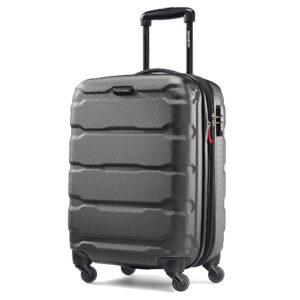
The Samsonite Underseat Carry-On Spinner with USB Port, model 112934-1620 in Ocean, is a small wheeled bag designed to go under the seat in front of you rather than into the overhead bin. It has four spinner wheels, a padded laptop sleeve and a USB pass through port. That last feature carries rules a traveler needs to understand before boarding, and this review deals with those directly.
The trip and the traveler this suits
This is a bag for the traveler who has decided not to fight for bin space. On a basic economy fare that includes a personal item but charges for a full carry-on, an underseat case is how you travel with wheels and still pay nothing extra. It is also how you keep everything within reach for the whole flight, which matters on a long sector or with a tight connection where waiting to retrieve a bin bag costs you the gate.
Dimensions, and the seat you are trying to fit under
The specification block gives 9 by 13.75 by 16.5 inches. Against the roughly 22 by 14 by 9 inch full carry-on convention, that is comfortably inside on every axis, which is the point. The harder question is the underseat space, and there the answer is genuinely variable. Underseat clearance depends on the aircraft type, on whether you are in a bulkhead or an exit row, on whether the seat in front has an entertainment box bolted under it, and on the airline’s own published personal item dimensions, which are often smaller than the space physically available.
Samsonite deserves credit for how it handles this. Its own first bullet says the bag fits under most airline seats and then tells the reader to check with their airline because underseat storage capacities and dimensions vary. That is the maker itself declining to promise compliance, and it is the right position. We are not going to write that this bag is airline approved or that it will fit under your seat, because neither is knowable from a listing. Take 9 by 13.75 by 16.5 inches, compare it against your carrier’s published personal item allowance, and be aware that the aircraft may be the tighter constraint.
Whether the wheels are counted
The listing does not say whether the published figure includes the four spinner wheels or measures the shell alone. On an underseat bag this matters more than usual rather than less, because the underseat space is defined by a hard physical clearance and spinner casters typically add an inch or more to the standing height. If the 16.5 inch figure is the shell alone, the assembled bag is taller than the number suggests and may not slide under a seat that the published dimension said it would. Measure the assembled bag from the floor to the top of the retracted handle when it arrives.
There is no expansion gusset described on this listing, which is one fewer way to grow past an allowance you were relying on.
The USB port, and the battery rules that go with it
The USB port is the feature that needs the most careful reading. Samsonite’s bullet says the port lets you charge electronics on the go and states plainly that batteries are not included. That wording is important and it is good news. This is a pass through port, meaning it routes a cable from a power bank you supply inside the bag to a socket on the outside. There is no built in, non removable battery in the bag itself.
That distinction is the whole regulatory question on smart luggage. Lithium batteries are not permitted in the hold on the great majority of carriers, and airlines have refused boarding to bags whose batteries could not be taken out. Because this design takes a removable power bank rather than an integrated one, you retain the ability to comply: you take the power bank out and carry it in the cabin with you if the bag is ever gate checked or checked. What you must not do is leave the power bank inside a bag that goes into the hold. Check your airline’s published rules on portable chargers, including its watt hour limits, before you fly, because those limits vary and are enforced.
A second practical point. A pass through port is not a charger. It supplies nothing unless you have put a charged power bank inside and connected it, and it will not power anything on its own.
Wheels, handle, capacity and weight
Four multi directional spinner wheels are unusual on an underseat bag and they are the reason to choose this one. Most personal item bags are carried or slung. Wheels turn a heavy work bag into something you push, which matters if you are covering a long concourse with a laptop and a full day of documents. The costs are the ones spinners always carry: casters catch on rough ground, they are the most likely part to fail, and they add to the height that must clear the seat frame.
Capacity is published as 36 liters in both capacity fields. That figure deserves scrutiny. The external box of 9 by 13.75 by 16.5 inches works out to roughly 2,042 cubic inches, or about 33.5 liters, and that is the gross external volume before you subtract the shell, the wheel wells, the handle housing and the padded laptop sleeve. A published interior capacity of 36 liters is therefore larger than the entire external envelope of the bag, which is not possible. We are flagging the contradiction rather than adjusting it. The usable interior is meaningfully smaller than 36 liters, and a buyer should plan on that.
Weight is published as 5.5 pounds in one field and 2.5 kilograms in another. Those two agree, since 2.5 kilograms is 5.51 pounds, so the only issue is the mixed units. Five and a half pounds is substantial for a personal item, and it is worth remembering that on carriers which weigh cabin baggage the personal item can be weighed too.
Warranty and the alternatives
No warranty term is published on this listing. Samsonite generally offers warranties on its luggage, but this page does not state one, and we are not going to assume a term the listing does not give. Whatever the term turns out to be, the point to check in the written document is airline handling damage, which is the damage luggage overwhelmingly suffers and the exclusion that survives even in long and generous sounding warranties.
For alternatives in the same size class, the BAGSMART underseat carry-on and the Verage underseat carry-on cover similar ground at lower cost, the KROSER underseater is another wheeled option, and the Briggs and Riley ZX150 underseat cabin bag is the premium end of the same idea. The wider field sits in the carry-on luggage category and the carry-ons category.
Who should buy it, and who should not
Buy it if you fly fares that charge for a full carry-on, you want wheels under a personal item, you carry a laptop of 13.3 inches or smaller, and you understand that the USB port needs a power bank you supply and remove. Do not buy it if you need more than an overnight of clothes, if 5.5 pounds of empty bag is a problem against a weighed personal item allowance, or if you were planning on the published 36 liter capacity, which exceeds the bag’s own external volume and cannot be right. Measure the assembled height against your airline’s personal item rules, and never leave a power bank inside a bag that goes into the hold.