

Description
The Child This Is Built Around
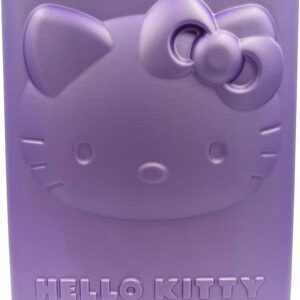
A ride-on suitcase is bought to solve a walking problem rather than a packing problem. The idea is that a small child sits on the case and is towed through a terminal, so the adult is not carrying both the child’s bag and eventually the child. Fast Forward builds this one as a hardside 18 inch case with a molded seat, foot pedestals, an angled extendable aluminum handle, a pull strap and a shoulder belt, printed with licensed artwork under a clear coat.
The first bullet states the target age as two to six. That is young, and it is younger than the five and up floor stated on the comparable Kiddie Totes ride-on scooter case in this catalog. The distinction matters because the two products work differently: this one is towed by an adult with the child seated, while a scooter case is propelled by the child. A towed seat suits a two year old in a way a scooter deck does not.
The Safety Figure That Is Missing
Nowhere on this listing is a rider weight limit published. Not in the description, not in the bullets, not in the specifications. On a product designed for a child to sit on, that is the single most important number and it is absent. Comparable ride-on cases state a limit outright. Ask the seller for it before ordering, and treat the two to six age range as the only guidance available in its place. No supervision guidance, no surface guidance and no restraint beyond a shoulder belt are described either.
The Dimensions, and a Carry-On Claim Worth Checking
The figures nearly agree across sources. The specification block gives 14.5 by 9.5 by 18.9 inches. The description gives 47 by 24 by 37 centimeters and converts it as 18.5 by 9.5 by 14.5 inches. So the height is 18.9 inches in one place and 18.5 in the other, and everything else matches. That four tenths of an inch will not change a decision.
The second bullet calls this a ride on carry on suitcase. Compare the numbers against the commonly cited United States domestic cabin allowance of roughly 22 by 14 by 9 inches: the height is comfortably inside, the width of 14.5 inches is half an inch over, and the depth of 9.5 inches is half an inch over. Two axes are outside the reference on a hard shell that cannot be compressed.
The description also notes that the patent pending design lets the wheels protrude so the case stands elevated off the ground. Protruding wheels are exactly what a sizer catches, and the listing does not say whether the published dimensions include them, so the measured object may be larger still. We are not going to write that this case is airline approved. Check your specific airline’s published cabin dimensions, and check separately whether your carrier permits a ride-on case, since some airports and airlines restrict riding inside terminals as a matter of policy rather than of size.
One clean point: the description states plainly that the case is not expandable, so the measured figure is the figure.
Shell, Wheels and a Contradiction About Both
The description calls this hardside luggage with the print protected by a clear coat that also gives a glossy finish. A clear coat over printed artwork is a genuine durability feature on a child’s case, because unprotected print scuffs off the corners within a few trips. What the listing never does is name the shell polymer. There is no polycarbonate, no ABS and no polypropylene anywhere, which on a case a child will drop repeatedly is a meaningful omission. Polycarbonate flexes and returns to shape; ABS is cheaper, lighter and cracks sooner under the same handling. Ask the seller which it is.
The wheel description contradicts itself. The description says the case features inline skate wheels that make rolling smoother. The third feature bullet says it has front 360 degree wheels for easy maneuvering. Inline wheels and 360 degree casters are different arrangements that behave differently: inline wheels are towed and handle rough ground, casters swivel and roll upright on smooth floors. The most plausible reconciliation is a hybrid with swiveling wheels at the front and fixed at the rear, which is common on ride-on cases because it lets the case be steered while seated, but the listing does not say so and we are not going to assert it.
The handle is an angled extendable aluminum tube, and the angle is a deliberate design choice: a vertical handle is awkward for towing a seated child, and a raked one puts the pulling force at a better line. No stage count and no extended height are published. Closure is a zipper, unbranded, and no lock is described. A conventional child’s spinner without a seat, such as the Fast Forward kids 20 inch spinner, avoids the extra load paths entirely.
Weight, and a Capacity Figure That Is Really a Box Volume
Empty weight is 7 pounds, stated consistently in the description and the specification block. For a hardside case of this size that is substantial, and it is the honest cost of a shell strong enough to sit on plus a seat and pedestals. Practically it means that whenever the child is not riding, an adult is handling seven pounds plus contents. A two year old will not be lifting this into an overhead bin or up a jet bridge step, so plan on doing it yourself.
Capacity is published as 42.6 liters. Run the arithmetic on the stated dimensions: 18.9 by 14.5 by 9.5 inches is roughly 2,604 cubic inches, which converts to about 42.7 liters. The published capacity is therefore identical to the full external volume of the box, which is impossible as a usable figure, because it makes no allowance for the shell thickness, the wheel wells, the handle tubes or the seat structure. Treat 42.6 liters as an external volume calculation rather than as what the case holds, and expect meaningfully less inside.
No Warranty, and a Very Small Sample
No warranty is published on this listing. No term, no exclusions, no coverage period. On a ride-on product, where the seat and the wheel mounts take loads that ordinary luggage never sees, that is worth weighing. The model number field simply reads Luggage, which is a product type rather than a code, and the description carries a specification line reading quality high quality, which is not information.
The feedback record is thin. The rating is 4.7, which is high, but it rests on only 35 ratings, and the sales rank is 271,668th in Clothing, Shoes and Jewelry and 68th in Kids’ Luggage. Thirty five ratings is a very small base, and a 4.7 on it carries far less weight than the 4.4 across 1,271 ratings behind the Emissary unicorn kids set. Note too that the description calls the product a hardside luggage set while only one case is specified.
For alternatives, the Fast Forward Bluey soft carry-on is the same maker’s lighter non ride-on option, and the kids luggage category holds the rest.
Who Should Buy It and Who Should Not
Buy it if you have a child between two and six who cannot walk a long terminal, you want a towed seat rather than a scooter deck, and you are willing to handle seven pounds plus contents yourself. The clear coated print and the angled aluminum handle are both sensible touches. Do not buy it without first asking the seller for the rider weight limit, because none is published anywhere on a product designed to be sat on. Do not count on it clearing a sizer, since the width and depth are both half an inch over the common reference and the wheels protrude. And do not plan around 42.6 liters, which is the external box volume rather than usable capacity.