Description
The Child and the Trip This Is Built For
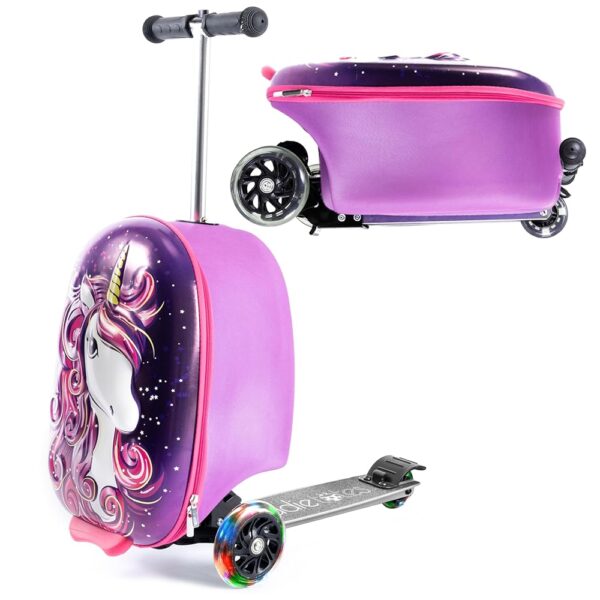
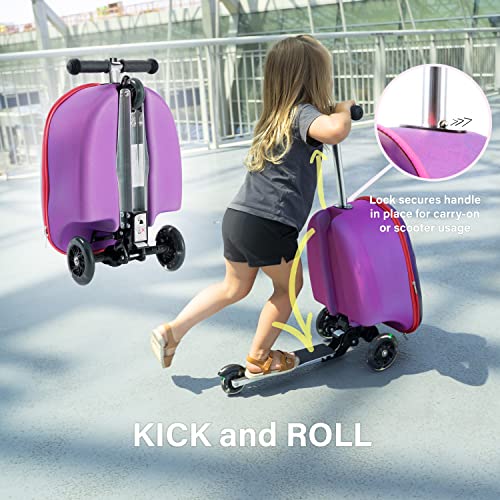
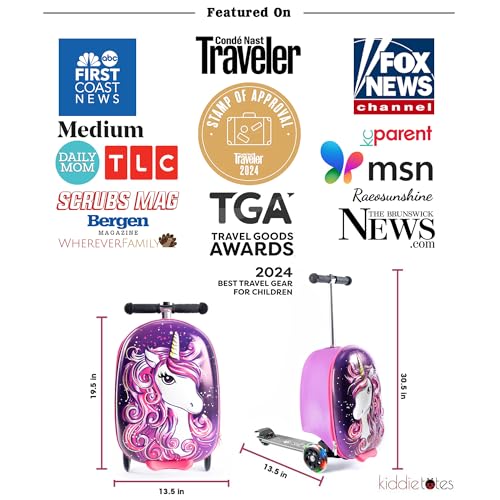
A ride-on suitcase is a behavior product before it is a luggage product. The purpose is to keep a child moving under their own power through a terminal so an adult is not carrying the bag and, eventually, the child. Kiddie Totes builds this one as a hardshell case with a folding scooter deck, LED light-up wheels and a telescoping aluminum handle that doubles as the steering column, extending to a stated 30.5 inches. It folds and locks into a conventional roller bag when the scooting stops.
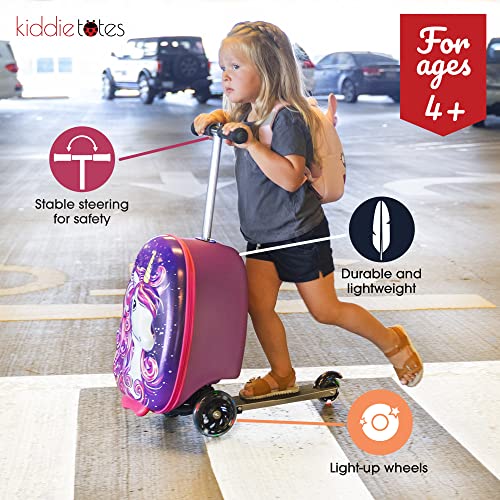
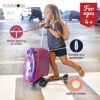
The age guidance is not consistent, which matters more on a child product than anywhere else. The product name says ages 5 to 12. The fifth feature bullet says for ages 5 and up. The second bullet describes it as easy for independent toddlers and children to ride, carry or pull, and a toddler is not a five year old. Take the stated floor of age 5 as the operative guidance and treat the toddler reference as marketing language. There is also a stated 110 pound rider weight limit, which is the more useful constraint for an older child.
Note too that the name and the department field both say girls, while the model number KT-SL03UNI reads as a unisex code. That is a merchandising inconsistency.
Dimensions and the Approval Claims We Will Not Repeat
The size data is consistent for once. The specification block gives 19.5 by 13.5 by 8 inches and the fifth bullet gives the same three numbers reordered as 13.5 by 8 by 19.5. Against the commonly cited United States domestic cabin allowance of roughly 22 by 14 by 9 inches, that is inside on all three axes with a little margin on each. That is a good result and it is the reason a case like this can realistically ride in a bin.
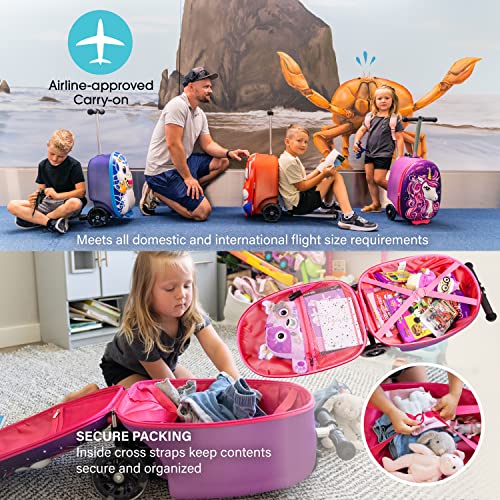
What the listing goes on to claim is another matter, and it needs stating plainly. The fifth bullet says the product is TSA and IATA approved and that it meets all domestic and international flight size requirements. We are not repeating either claim, because neither can be supported. The Transportation Security Administration screens passengers and baggage, it does not certify luggage dimensions, and no product can meet every airline’s size rule when carriers set their own and budget and regional airlines are stricter than the mainstream ones. The IATA cabin guideline is a recommendation individual airlines are free to ignore, and many do.
What to Actually Check
The published measurement of 19.5 by 13.5 by 8 inches is good and worth using. Check it against your specific airline’s cabin allowance before you fly, and check whether your carrier permits a ride-on case at all. Some airlines and some airports restrict scooting inside terminals, and a folded case is a normal roller while an unfolded one is a wheeled toy in a crowded space.
The Shell, the Wheels and the Scooter Mechanism
The exterior is described as strong, thick, water and scratch resistant, and designed to deflect and absorb impact. No polymer is named anywhere: not polycarbonate, not ABS, not polypropylene. On a hardside case that matters, because polycarbonate flexes and returns to shape while ABS cracks sooner under the same handling, and a child.s case gets dropped constantly. The listing says it will not dent or scratch, a stronger claim than any hardshell can carry and one with no named material behind it.
The wheels are the interesting part. They are described as light-up LED and made from waterproof plastic-free polyurethane so they will not crack or lock up. Polyurethane is a good wheel material, quieter and more forgiving than hard plastic. The phrase plastic-free polyurethane is self contradictory, since polyurethane is itself a synthetic polymer, so read that as marketing language rather than a material fact.
The LED Question Worth Asking
Light-up wheels come in two kinds. Most are dynamo powered, generating light from rotation with no battery inside. Some contain small button cells. This listing does not say which type is fitted, and that is a question worth resolving before you fly. Airlines require lithium batteries to travel in the cabin rather than in checked baggage, and bags with non removable batteries have been refused at the gate. If the wheels are motion powered there is nothing to declare; if they contain cells, keep the case in the cabin and check your carrier policy. Ask the seller which it is.
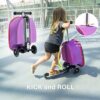
The scooter mechanism uses lean-to-steer, which is the standard and safest arrangement for a child, with a slip proof standing deck. The handle is telescoping aluminum, described as adjustable and unlikely to break or stick, extending to 30.5 inches in scooter mode. Nothing in the listing mentions a brake, a helmet recommendation or supervision guidance. A conventional spinner without a ride-on deck, such as the Fast Forward kids 20 inch spinner, removes that question entirely.
Capacity, Weight and a Figure That Cannot Be Right
The capacity data contains a clear error. The specification block lists capacity as 110 liters and capacity total as 49.89 liters. Those cannot both describe this bag, and 110 liters is impossible for a case measuring 19.5 by 13.5 by 8 inches, whose full external volume is closer to 34 liters. The explanation is visible in the fifth bullet, which states a 110 pound weight limit for the rider. The 110 figure is a pound limit that has been filed into a liter field. The 49.89 liter figure also exceeds the external volume of the stated dimensions, so treat the capacity data as unreliable and go by the physical measurements.
Empty weight is 7.7 pounds, published consistently in two fields. That is a substantial weight for a child’s bag, and it is the honest cost of a hard shell plus a scooter deck plus a steering column. A five year old will not be lifting 7.7 pounds plus contents into an overhead bin. Plan on an adult handling it when it is not being ridden. Inside there are cross straps to hold contents and flexible tear resistant compartments for small items, with a heavy duty outer zipper. No zipper brand is named.
The Warranty Phrase That Contradicts Itself
The fifth bullet states a 1-Year Limited Lifetime Warranty. That phrase cannot mean anything as written: a one year term and a lifetime term are different things, and putting them in the same sentence tells you nothing about what is actually covered. The most likely reading is a one year limited warranty, but the listing does not resolve it. Get the term in writing before relying on it, and read the exclusions, because across luggage generally airline handling damage is commonly excluded, and on a ride-on product normal wear from riding may be excluded too.
The feedback record is 4.2 across 568 ratings, ranked 29th in Kids’ Luggage and 170,946th in Clothing, Shoes and Jewelry. That is a solid category placement on a moderate sample. For alternatives, the Fast Forward kids ride-on suitcase covers the same format, the Emissary unicorn kids spinner set is a conventional roller for the same age group, and the Fast Forward Bluey kids carry-on is a softside option. The kids luggage category holds them together.
Who It Suits and Who It Does Not
It suits a child of five or older, under the stated 110 pound rider limit, traveling with an adult who is willing to carry 7.7 pounds plus contents whenever riding is not possible. The measured 19.5 by 13.5 by 8 inch size is genuinely cabin friendly and the lean-to-steer deck is the right mechanism. It does not suit a toddler despite that reference in the bullets. Disregard the TSA and IATA approval claims and the statement that it meets all flight size requirements, because none of those can be supported. Ask the seller two questions before ordering: what the shell polymer is, and whether the LED wheels contain batteries.