


Description
What this suitcase is, and where it belongs
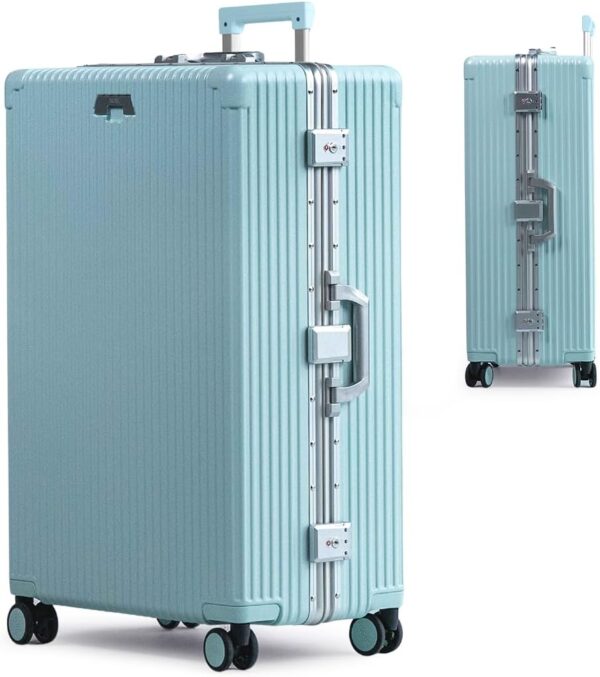
This is a large zipperless check in suitcase with an aluminum frame and a polycarbonate shell, sold by Nobl Travel as model D6. Zipperless means the two halves close on a frame with latches rather than a coil zipper, which is the meaningful design decision here and the reason to consider it.
It is worth clearing up the classification first. This site files the product under carry-ons and the source listing carries a carry-on sales rank, and it is neither. The maker’s own name for it is a check in suitcase, its published dimensions are 30.25 by 20 by 12 inches, and the allowance most commonly cited for a United States domestic carry-on is around 22 by 14 by 9 inches. This is checked luggage by eight inches on one axis and six on another. The product name also asserts approval for cabin use. No bag carries a blanket cabin approval, allowances are set by each carrier individually, and on these dimensions this one is not a cabin bag under any of them. The rest of the large case field is on our suitcases page.
The linear inch problem
Take the published exterior figures at face value. The specification block gives 20 by 12 by 30.25 inches and a feature bullet repeats 30.25 by 20 by 12. The description gives 30.5 by 20 by 12 in one place, a quarter inch taller, which is a transcription difference rather than a real conflict.
Where 62 inches bites
Most United States carriers apply a 62 linear inch limit to standard checked baggage before an oversize fee applies, and linear inches means length plus width plus depth of the outside of the bag. Add 30.25 plus 20 plus 12 and you get 62.25 inches. On the description’s 30.5 inch figure it is 62.5. Either way this case is over the limit as published, before you account for whether the wheels and the frame are inside those numbers.
That is not a theoretical margin. A counter agent measuring the outside of the bag gets a number above 62, and an oversize fee on a single flight can be substantial. Some carriers are more relaxed and some international carriers use different rules, so check your specific airline before committing. The honest summary is that the maker’s own measurements place this bag outside the standard checked allowance most United States carriers publish, while the product name claims airline approval. Those two things sit badly together and the reader should know it.
Capacity is published as 95.1 liters. Against a bounding box of roughly 7,260 cubic inches, or 119 liters, a usable interior of 95.1 liters is credible for a hardside clamshell. The practical limit will be weight rather than volume: against a common 50 pound allowance and an empty weight in the low teens, you have under 40 pounds of contents and 95 liters of space to put it in.
Frame, shell, latches and wheels
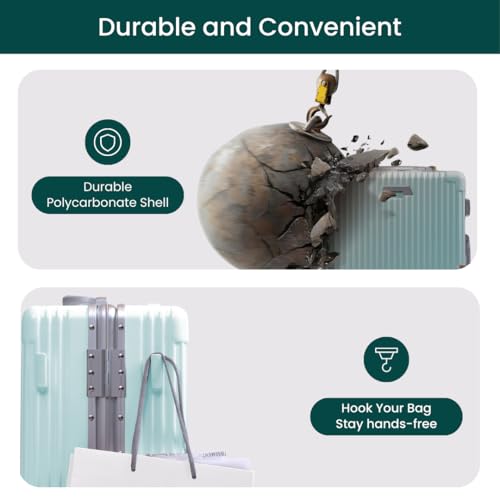
The construction is a reinforced aluminum frame carrying a polycarbonate shell. Naming polycarbonate is a real disclosure: it flexes under impact and returns to shape where ABS cracks, and it is unaffected by water. An aluminum frame around the opening is what makes a zipperless case possible, and it is the right material because aluminum dents rather than snapping.
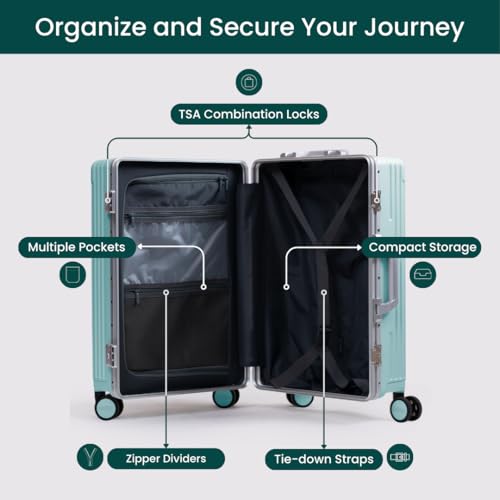
The zipperless closure is the main argument for the case and it is a good one. A coil zipper is the weakest point of most checked luggage: it can be punctured with a pen and resealed by running the sliders along it, leaving no visible sign, and it is the component most likely to burst when a bag is overpacked. A framed closure with dual TSA accepted locks removes that failure mode. Say what the locks are, though: a TSA accepted lock opens to a universal key held by screeners, so it deters an opportunistic hand and does not secure valuables.
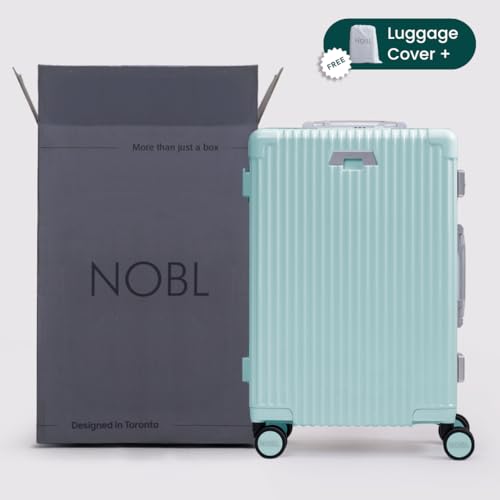
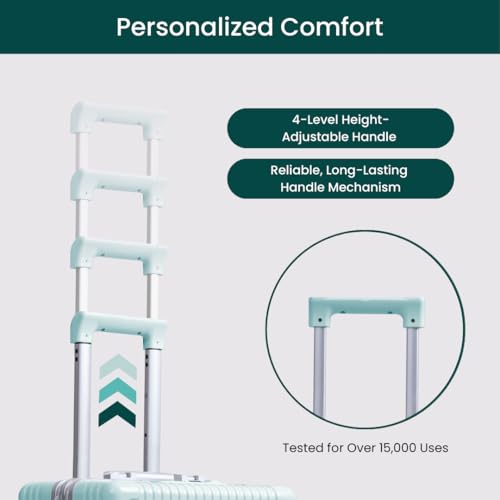
The product name calls the shell unbreakable. Nothing is unbreakable and no drop rating or impact standard is published to support the word, so treat it as marketing. The wheels are 360 degree spinners with no count, no material and no statement of whether they are single or double. The handle is a four level telescoping unit with a slow release mechanism, which is a genuine comfort feature on a heavy case. There are bag hooks on the exterior for hanging a smaller bag, a wet pocket, a mesh pocket, Y straps and a built in compression system inside, and Nobl includes a protective cover in the box, which is a sensible inclusion given that scuffing is the known weakness of a polycarbonate shell.
A weight figure that appears twice, differently
The weight data contradicts itself and the gap is not trivial. The specification block and an attribute field both say 12.7 pounds. The description and a feature bullet both describe the case as lightweight at just 10.7 pounds. That is a two pound difference on the same page, and two pounds of a 50 pound checked allowance is a pair of shoes.
The listing offers nothing to reconcile them. Twelve point seven pounds is a normal weight for a 30 inch framed polycarbonate case, and 10.7 pounds would be genuinely light for one, since the aluminum frame and the latch hardware are exactly what add mass to a zipperless design. We are not going to pick one. If empty weight matters to your decision, get the figure confirmed before ordering, and plan on the heavier number in the meantime.
One further data point worth flagging: the country of origin field reads USA. Nothing else in the listing supports domestic manufacture, and for a product in this category and price bracket it is an unusual claim to find in a bare specification field with no supporting statement. Treat it as unverified.
How it compares, and what is missing
The obvious comparison is the zipperless design itself, which the LUGGEX zipperless carry-on brings to a cabin size. For conventional zippered hardside cases at large sizes, the Delsey Paris Titanium hardside publishes its exterior dimensions with wheels and handles included, the Traveler’s Choice Ultimax II trunk spinner names its polymer and its zipper supplier, and the Kenneth Cole Reaction Out of Bounds 28 inch sits just inside the 62 inch limit where this one sits just outside. Cabin sized options are on our carry-ons page.
No warranty term is published anywhere on this listing. There is no lifetime claim, no limited period, no defect coverage statement and no airline damage provision. On a case whose selling point is a frame and latch mechanism, that absence is the most important thing missing. Reported customer feedback is 3.8 out of 5 from 37 ratings, which is a modest sample and a middling score, and the listing places it ranked 117th in carry-on luggage.
Who should buy it, who should not
Buy it if you want a zipperless framed closure on a large checked case, you value the aluminum frame and named polycarbonate shell, and the included protective cover and interior compression system suit how you pack. Dual TSA accepted locks on a latch closure is a genuinely better security arrangement than a locked zipper.
Skip it if your carrier enforces 62 linear inches, because the maker’s own figures total 62.25 and the product name claims an approval that no bag can carry. Skip it if you need the empty weight settled, since the same page says both 12.7 and 10.7 pounds. And skip it if a published warranty is part of your decision, because there is none here.