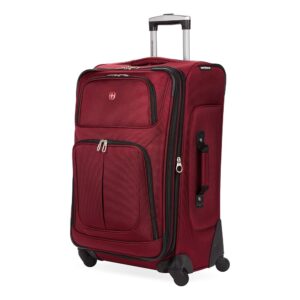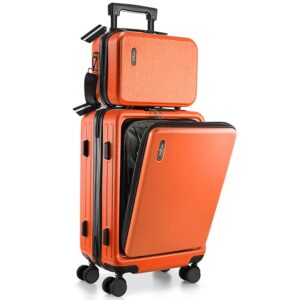


Description
The Amazon Basics 23 inch softside suitcase is a spinner with a TSA lock, a front exterior pocket and an interior split for damp items. It sits in the carry-on category on this site and its own description says it meets most airline carry-on regulations. On the dimensions the same listing publishes, that claim does not hold up, and the listing contradicts itself on both depth and capacity along the way.
The trip and the traveler this suits
The interior is the interesting part. Three interior pockets are arranged to keep dry and damp clothing or towels separate, which is a genuinely practical answer to the one thing that reliably ruins a packed bag. Combined with a front exterior pocket for what you need at security, this is laid out for a beach or pool trip rather than a business one.
At 23 inches and 42 liters it is a bag for four or five nights, or a week for someone who packs lightly and does laundry. Treat it as a small checked bag that you may sometimes be allowed to carry on, rather than as a cabin bag you can count on, and the purchase makes sense. Treat it the other way around and you will be paying gate fees.
Dimensions, and why this is not a cabin bag
The specification block gives 23.2 by 15.7 by 9 inches. The maker’s fifth bullet gives outer dimensions of 15.7 by 10.8 by 23.2 inches. Height and width agree across the two. Depth does not: one says 9 inches and the other says 10.8. That is a difference of nearly two inches on the axis that carry-on frames are least forgiving about, and the listing never reconciles it.
Neither figure clears the convention. The allowance most United States domestic travelers assume is roughly 22 by 14 by 9 inches. This bag is 1.2 inches over on height and 1.7 inches over on width on both readings, and on the larger of the two depth figures it is 1.8 inches over on depth as well. There is no reading of this listing on which the bag fits the common convention.
The description says otherwise
The written description states that the suitcase is sized for overhead compartments and meets most airline carry-on regulations, making it a reliable choice for international excursions and quick domestic getaways. That is the maker’s claim and we are attributing it rather than repeating it, because the dimensions on the same page do not support it. We will not write that this bag is airline approved. Every carrier sets its own allowance, international and budget carriers are typically stricter rather than more generous, and many add a cabin bag weight limit. Measure this against your own airline before you plan to carry it on, and expect the answer to be no on most of them.
The description also mentions expandable storage. Expanded depth is measured depth, so on a bag already over the common convention on two or three axes, expansion is only relevant to a leg where the bag is going into the hold.
Shell, wheels, corners and the lock
This is a softside case and the listing does not name the fabric or give a denier figure, which is a real gap. Softside construction abrades and thins rather than cracking, it takes an awkward last item better than a rigid shell, and it absorbs water. What the maker does document is the protective hardware, and that documentation is better than most: crash guard wheel housings and molded corner guards. Corners and wheel mounts are the two places a bag dies, so reinforcing both is the right instinct on a case likely to spend time on a belt.
Mobility comes from four double wheeled spinner assemblies, described in the title as 8 spinner wheels and in the description as 4 double-wheeled spinners. Those are the same thing said two ways rather than a contradiction. Dual wheel casters spread the load across two contact points, which helps on the rough ground where single wheel spinners struggle most, though the caster remains exposed and remains the most common physical failure on any wheeled bag. The maker also cites support stabilizers positioned to stop the case toppling, which is a real annoyance on tall spinners that stand upright on four points.
There is a built in TSA lock. The maker describes it as keeping belongings secure. We will not describe it that way. A TSA lock opens to a universal key that many people hold, and on a zippered case the zipper can be split with a ballpoint pen and pressed closed again. It keeps the case shut and lets a screener inspect without cutting anything, which is a real function, but it does not secure valuables and nothing you would mind losing belongs in a checked bag.
Capacity and weight, with one figure contradicted
Capacity is published twice and the two figures differ. One field reads 42 liters and the other reads 36 liters, a gap of six liters or roughly a sixth of the bag. The listing offers nothing that would let a reader choose between them. It may be that 42 liters is the expanded volume and 36 liters is the closed volume, which would be consistent with the expandable storage the description mentions, but the fields are not labeled that way and we are not going to assign meanings the page does not give. Plan on the smaller figure.
Weight is published consistently at 7.13 pounds in one field and 3.24 kilograms in another, which is 7.14 pounds. Seven pounds is on the heavy side for a softside case, and it is the price of the corner guards and crash guard housings. Empty weight counts twice on any bag: it eats the allowance and it is what you lift.
Two further data notes. The country of origin field says Cambodia while the description says the product may originate from China or Cambodia, so origin is not fixed. And the model number is NB23064-21 while the product is titled and sized as a 23 inch case, which is a naming inconsistency rather than a specification problem.
Warranty and the alternatives
No warranty is published. No term, no coverage description, no exclusions. On a bag likely to be checked, that absence carries more weight than usual, because a checked bag is the one the airline handles, and airline handling damage is both the damage that happens and the exclusion that survives in most warranties that do exist. Plan on the retailer’s return policy.
Against that, the feedback pool is reasonably deep: 1,138 ratings at an average of 4.4 out of 5, with the case ranked 73rd in Carry-On Luggage and 2,664th in the Our Brands listing. Within the same brand, the Amazon Basics underseat carry-on is the personal item option, the Amazon Basics 21 inch hardside carry-on is the rigid alternative at a size closer to the convention, and the Amazon Basics hardside checked case is the honest larger option. For another case whose published depth exceeds the convention, the SwissGear 7366 is worth reading alongside this one. The wider field sits in the carry-on luggage category and the suitcases category.
Who should buy it, and who should not
Buy it if you want a well protected softside case for four or five nights with a genuinely useful damp and dry interior split, and you are content to check it. Do not buy it as a carry-on, because on its own published figures it exceeds the common convention on height and width and possibly on depth too, whatever the description says. Do not rely on either capacity figure without allowing for the six liter gap between them, and do not treat the TSA lock as security.