

Description
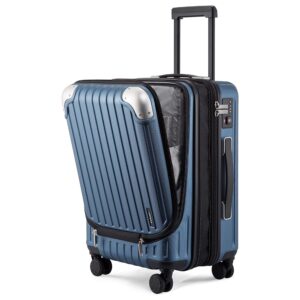
This BAGSMART is a 20 inch polycarbonate hard shell in royal blue with side mounted TSA locks, double ended zippers, a four level aluminum handle and a five year warranty. Its listing describes the same product as a carry on, as checked luggage and as underseat luggage, in three separate bullets. It also publishes an exterior width of 15 inches in the specification block while claiming 14 inches in the marketing copy.
The traveler and the trip
Thirty five liters closed and a stated 42 liters expanded, at 6.83 pounds, is a three to five day bag for one adult, which is exactly the trip length the maker names. The buckle compression system and the two compartment layout aim it at someone who packs folded clothing and wants it to arrive flat.
Polycarbonate is the material to want in a hard shell, because it deforms under a crush load and springs back rather than cracking. If you carry a laptop, a camera or anything glass, that rigidity is the reason to choose this construction over fabric. It does not suit anyone who needs exterior pockets. If pocket access matters, the softside cases in carry on luggage make the opposite trade.
Dimensions, and the inch of width in dispute
The attribute block gives 22 by 15 by 9 inches. A manufacturer bullet says the case measures 22 by 14 by 9 inches with spinner wheels and handle. Those differ by a full inch on the width, and width is one of the three axes a gauge measures.
What each figure would mean
The commonly cited United States domestic carry on allowance is around 22 by 14 by 9 inches, measured with the castors on. On the bullet figure this case matches the allowance exactly on all three axes, leaving no margin at all. On the attribute figure it is a full inch over on width. Neither outcome is comfortable, and a rigid polycarbonate shell cannot be compressed into a gauge it does not fit.
The 22 by 14 by 9 figure in the marketing copy is also the airline allowance itself, and the product name repeats it alongside the words airline approved. A published dimension that matches the allowance exactly, on a listing whose own specification block says something different, is more likely to have been copied from the allowance than measured off the case. Treat the attribute figure of 22 by 15 by 9 inches as the more cautious assumption and confirm the width with the seller.
We are not going to write that this bag is airline approved. Approval is a property of the airline, every carrier publishes its own allowance, budget and regional carriers are consistently tighter, and international carriers frequently add a cabin bag weight limit. The maker’s other bullet is better phrased, saying the case meets most airline requirements for overhead compartments, which is at least scoped.
The expansion adds 1.6 inches and 7 liters, taking the case from 35 to 42 liters. That is a clearly stated figure and it is more disclosure than most expandables offer. It also takes a case already at or over the allowance further outside it, so treat the gusset as a feature for a return leg you are prepared to check. Note that the capacity fields in the specification block give 35 liters twice and never record the 42.
The three product categories in one listing
One bullet opens by calling the product the checked luggage. Another describes it as the underseat carry on luggage with wheels. The product name and every other bullet call it a 20 inch carry on. Those are three different classes of bag with three different size rules: a cabin bag measured against roughly 22 by 14 by 9 inches, a checked bag measured against 62 linear inches, and a personal item measured against roughly 18 by 14 by 8 inches.
A 20 inch upright on spinner castors is a cabin bag. It is not an underseat bag, because it does not fit under an economy seat, and calling it checked luggage is only accurate in the sense that any bag can be checked. The language is boilerplate reused across the maker’s range rather than a description of this product, and it does not change what you are buying. It does tell you how carefully the listing was assembled, which is worth knowing when you are relying on its other numbers.
Shell, wheels, zippers and locks
The shell is stated as 100 percent polycarbonate, described as offering strength, flexibility and lightness, and the maker says the case has passed a shock drop test. That is the right material and the flexibility claim is an accurate description of how polycarbonate behaves. The texture is described as scratch resistant, and a texture genuinely does hide the scuffing a gloss shell shows within a trip. The failure mode remains corner cracking after repeated hard drops onto an edge.
The wheels are 360 degree swivel castors described as quiet and durable, with the maker naming airports, train platforms, sidewalks and cobblestone streets. Cobblestone is the surface every spinner castor struggles with, because the wheel is small and unsprung and the gaps catch it. The listing does not say how many castors there are or whether they are single or dual wheeled, which is a real omission given how much of the copy is devoted to them.
The zippers are described as double ended, meaning two sliders that meet, which lets you open the case from either side and is the normal arrangement on a hard shell. The locks are side mounted and TSA recognized. Side mounting is worth having because a lock on the face of a case takes the impact when the bag is thrown flat. On what the lock does: it opens to a universal key held by screeners, so it deters an opportunist and stops the zipper being pulled open in transit, and it secures nothing of value, exactly as on the BAGSMART Underseat-Black and every other case with the feature.
The handle is a four level adjustable aluminum unit, which is more adjustment than the two position handles common in the class. Soft silicone grips on the top and side handles are a sensible touch, because silicone grips when your hands are wet.
Capacity, organization and weight
Thirty five liters closed is modest for a case with a 22 inch exterior, and 42 liters expanded is competitive. The interior has two main compartments, a buckle compression system, a zippered mesh pocket and a built in small pocket. A buckle compression system is a step above plain cross straps, because a buckle lets you pull the stack down rather than merely holding it in place.
At 6.83 pounds the case is a little heavier than the maker’s own black 20 inch polycarbonate case at 6.39 pounds, and matches the BM0105017AN exactly. Empty weight counts twice on carriers that enforce a cabin bag weight limit, because the case eats your allowance before you pack. The polycarbonate Samsonite Omni PC is the benchmark at 6.81 pounds with a ten year warranty.
Warranty and the sibling listings
BAGSMART states a five year manufacturer’s warranty. Five years is a real commitment and longer than the two year term the same maker publishes on some of its other cases, which is worth noticing when comparing BAGSMART listings against each other rather than against the field.
The exclusion list is not published, and that is where luggage warranties live or die. Airline handling damage is excluded across essentially this entire category. A five year defects warranty covers a shell cracked by a manufacturing fault, not one cracked by a baggage belt, and handling damage is the great majority of what happens to a checked bag. Ask for the exclusions before you rely on the term.
BAGSMART lists several near identical 20 inch polycarbonate cases separately here, differing by color, by whether they expand and by published width. Read them together before choosing, because their specifications differ in ways the products may not. Larger cases in the same construction sit under suitcases.
Who should buy it and who should not
Buy it if you want genuine polycarbonate with a buckle compression system, a four level aluminum handle, side mounted locks and a five year warranty, and you value a clearly stated 1.6 inch expansion that takes the case from 35 to 42 liters. That expansion disclosure is better than most of the field.
Skip it if your airline uses a rigid gate sizer, because the specification block gives a width of 15 inches while the copy claims 14, and either figure leaves you at or over the common allowance. Skip it too if the listing’s inconsistency would worry you, since the same page calls this product a carry on, checked luggage and underseat luggage. Confirm the width before ordering.