Description
What this bag is, and the category it is filed under
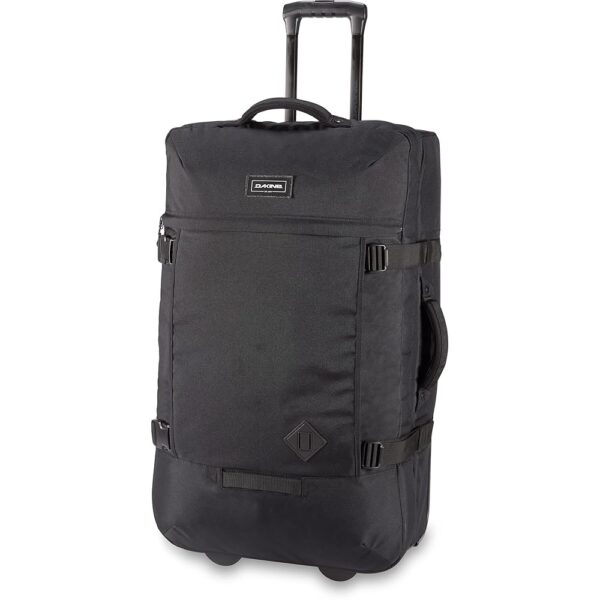
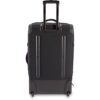
The Dakine 365 Roller 100L is a large softside wheeled bag with a split level interior, built for the traveler who packs bulk: snow gear, camera equipment, a family’s clothing, or the sort of trip where volume matters more than finesse. One hundred liters is a lot of bag.
It is worth clearing up the classification first, because both this site and the source listing file it under carry-on luggage and it is not a carry-on. Dakine publishes exterior dimensions of 30 by 17 by 12 inches. The allowance most commonly cited for a United States domestic carry-on is around 22 by 14 by 9 inches. This bag is eight inches over on length, three over on width and three over on depth. It is checked luggage, and the reader should treat the carry-on labeling as a catalog artifact rather than a fitment claim. The rest of the large bag field is on our suitcases page.
The dimensions, and the checked baggage arithmetic
Two dimension sets appear and they are the same measurement expressed differently. The description gives 30 by 17 by 12 inches, or 76 by 43 by 31 centimeters. The specification block gives 29.92 by 16.53 by 11.41 inches, which is the metric figure converted back. Use whichever you prefer; the difference is rounding.
How it lands against a 62 inch limit
Add the description’s figures and you get 59 linear inches. Add the converted ones and you get 57.86. Most United States carriers apply a 62 linear inch limit to standard checked baggage before an oversize fee, so this bag clears it with three to four inches in hand. That is real headroom and it is unusual for a 100 liter bag, which is a direct consequence of the soft construction. A hardside case of the same interior volume would need a larger bounding box because the shell has thickness and the clamshell wastes depth.
The listing does not state whether the figures include the wheels and the handle housing, which on a softside roller with 8 centimeter wheels is a real question. Even adding two inches to the height, though, the linear total stays under 62. The constraint you will actually hit is weight: at a listed empty weight of around 8.14 to 8.5 pounds against a common 50 pound checked allowance, you have about 41 pounds of contents, and 100 liters of space will absorb far more than 41 pounds. This is a bag that runs out of allowance long before it runs out of room, and that is the single most important thing to understand about buying it.
Fabric, zippers, wheels and panels
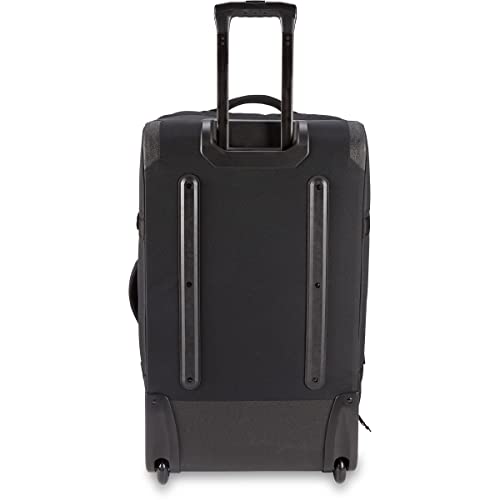
The material specification here is unusually complete and it is the strongest part of the listing. The shell is 600D recycled polyester with a water repellent finish, and Dakine states it is bluesign approved, which is a textile industry certification covering chemical use and environmental practice in manufacturing rather than a durability rating. Six hundred denier is standard backpack weight fabric rather than heavy luggage fabric, and Dakine compensates by adding abrasion resistant bottom and corner panels, which is exactly the right answer. Bags fail at the base and the corners, so reinforcing there and using lighter fabric elsewhere is a sensible engineering choice and part of why this bag is light for its size.
The zippers are named as number 10 lockable YKK on the main compartment. Naming both the supplier and the gauge is a genuine disclosure, and number 10 is a heavy gauge coil, roughly what you would find on expedition duffels rather than on ordinary luggage. Lockable means the pulls accept a padlock, which is worth stating carefully: a TSA accepted padlock opens to a universal key held by screeners, so it deters an opportunistic hand rather than securing valuables, and on a fabric bag a panel can be cut regardless. No lock is included.
The wheels are reinforced urethane, 8 centimeters across, in a two wheel inline arrangement behind a retractable handle. Inline rather than spinner is the right choice on a bag this size and this shape. Two wheels tuck inside the footprint instead of protruding, they tolerate gravel, curbs and snow far better than spinners, and there are half as many things to break. The trade is that you tow the bag tilted rather than pushing it upright, which is harder work when it is heavy. There are multiple exterior padded handles, which matters at this size because getting a loaded 100 liter bag onto a scale needs several grip points.
Interior, capacity and how it packs
Capacity is published as 100 liters and 6,100 cubic inches, and those two agree with each other: 6,100 cubic inches is 99.96 liters. That is a listing whose arithmetic works, which is rarer on this site than it should be. The bounding box of a 30 by 17 by 12 inch bag is 6,120 cubic inches, so the stated capacity is essentially the full bounding box, which is credible for a frameless softside bag with no rigid shell to lose volume to.
The interior is a split level design with zippered dividers, which is the feature that separates this from a plain duffel with wheels. A single 100 liter cavity is a nightmare to pack and worse to find anything in; dividing it into levels gives you a boots and bulk layer and a clothes layer that stay separate. There is a large front quick access pocket for the things you need before the bag is opened, and a tuck away ID pocket, which is a small and genuinely useful detail because an exposed name and address tag on a checked bag advertises to strangers that you are away from home.
Comparable large capacity options include the SwissGear 4010 checked large, which is a conventional upright rather than a split level roller, the AmazonBasics hardside checked luggage for the hard shell alternative, and rolling duffels such as the Wrangler Wesley rolling duffel. The wider duffel range is on our travel duffels page.
Weight figures, warranty and the feedback record
Three weight figures appear and they do not quite agree. The specification block says 8.14 pounds. The description says 8.5 pounds and 3.8 kilograms, and 3.8 kilograms is 8.38 pounds. So the listing publishes 8.14, 8.38 and 8.5 pounds for the same bag. The spread is about six ounces and it is small enough not to change a decision, and it is still a contradiction on a page whose other numbers are clean. Plan on the higher figure.
No warranty term is published anywhere on this listing. There is no lifetime claim, no limited period, no defect coverage statement and no airline damage provision. Dakine publishes warranty terms on its products generally, so this is a gap in the listing rather than necessarily in the product, and it means there is nothing you can weigh before buying. Ask the seller.
The feedback record deserves a plain mention. Reported customer feedback is 3.4 out of 5 from 32 ratings, which is noticeably lower than most bags in this catalog and sits on a small but not trivial sample. The listing places it ranked 723rd in carry-on luggage. A 3.4 average on 32 ratings is a real signal rather than noise, and it is worth reading actual reviews before committing.
Who should buy it, who should not
Buy it if you need genuine bulk capacity, you want a split level interior rather than one cavity, and you value a listing that names its fabric, its certification, its zipper supplier and gauge, and its wheel material. At around 8.5 pounds for 100 liters inside 59 linear inches, the engineering is efficient and the inline wheels are the right choice for rough ground.
Do not buy it as a carry-on, whatever the category label says, because 30 by 17 by 12 inches is nowhere near a cabin allowance. Skip it if you need a published warranty. And be aware that 100 liters will hold far more than a 50 pound checked allowance permits, so the practical limit is the scale rather than the bag.