Description
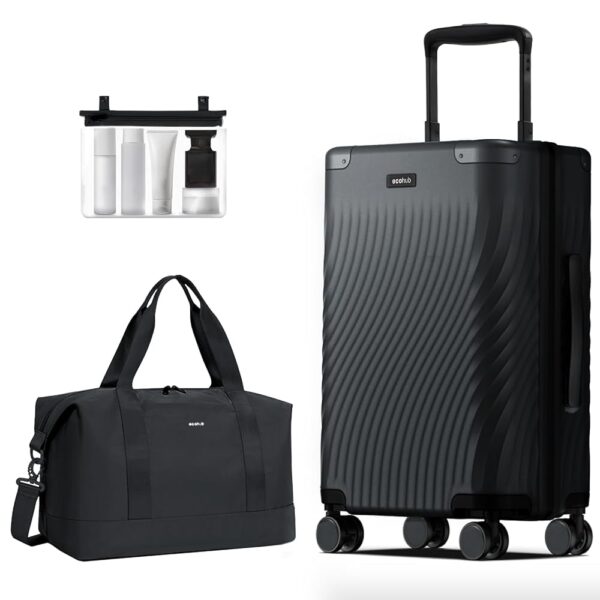
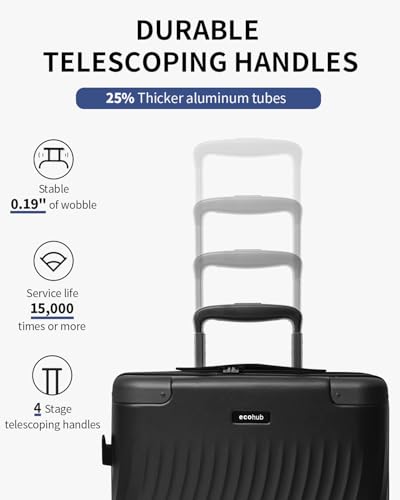
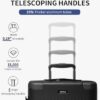
The ECOHUB carry-on is a 20 inch case in Bayer polycarbonate with aluminum corner protectors, a four stage aluminum handle, steel axle wheels and a three year limited warranty. It is made from 60 percent recycled shell material with a fully recycled lining, it ships with a free foldable duffel, and it is one of the better engineered listings in this catalog. It also publishes two weights nearly two pounds apart.
The weight is published twice, and the gap is large
The specification block gives 9.33 pounds. The first bullet says the case weighs only 7.49 pounds. That is a gap of 1.84 pounds on the same product, and the bullet emphasises the lower figure in capitals as a selling point.
The difference matters. At 7.49 pounds this is a mid weight polycarbonate case. At 9.33 pounds it is among the heaviest cabin bags in this catalog, alongside the aluminum frame designs. On a carrier that enforces a cabin bag weight limit, and many outside the United States do, nearly two pounds is a meaningful share of the allowance.
We are naming the contradiction rather than choosing, but note that aluminum corner protectors, a reinforced four stage aluminum handle, steel axle wheels and dual full closure compartments all add mass, and the structured field is the one a data pipeline populates from the product record. Plan on the heavier figure and weigh the case yourself if your carrier is strict.
Dimensions, and what expansion does to them
The specification block gives 14.02 by 9.02 by 22.01 inches. That is the conventional United States domestic carry-on allowance to within a hundredth of an inch on every axis, which is what happens when a listing restates the allowance rather than measuring the product. Nothing says whether the wheels and retracted handle housing are counted.
The title carries the string 22x14x9 airline approved. That is a search keyword, and we are not going to write that this bag is airline approved. There is no general approval for luggage: carriers publish their own cabin allowances individually, budget and regional operators are frequently stricter, and international carriers commonly enforce a cabin weight limit as well as a size limit.
Expanding takes it well outside
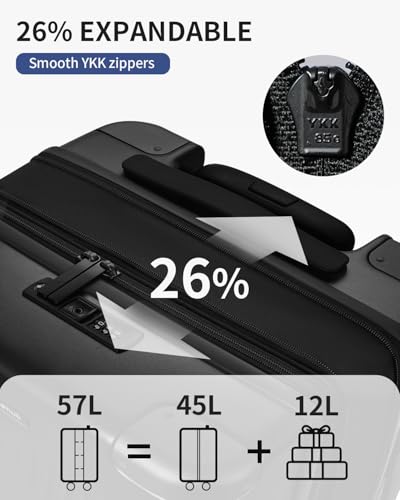
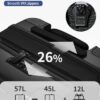
The second bullet is unusually precise about the expansion, and the precision is what makes it useful: the case expands from 9 to 11.3 inches, taking capacity from 45 litres to 57 litres, which the maker describes as up to 26 percent more space.
Eleven point three inches of depth is more than two inches beyond the common convention. This is not a case that can be carried on expanded under any reading. The maker qualifies its own claim by saying the case meets most domestic carry-on requirements, which is a statement about the closed configuration. Expand it for the return leg and expect to check it, or expand it only once the bag is already going into the hold.
The two capacity fields, 45 litres and 57 litres, are the closed and expanded volumes respectively. They look like a contradiction until you read the second bullet, and neither field is labelled, so a buyer comparing this against another case on the capacity total field would be crediting it with expanded volume against a rival closed figure.
Shell, corners, wheels and closures
The shell is named as Bayer polycarbonate, which is a specific supplier rather than a generic description, and the maker states it is 60 percent recycled with a 100 percent recycled lining. Polycarbonate is the better of the two mainstream hard shell plastics: it flexes under load and returns rather than cracking, and it sheds water. Recycled content in a structural shell is worth noting on its own terms and does not, on the published information, appear to be a compromise.
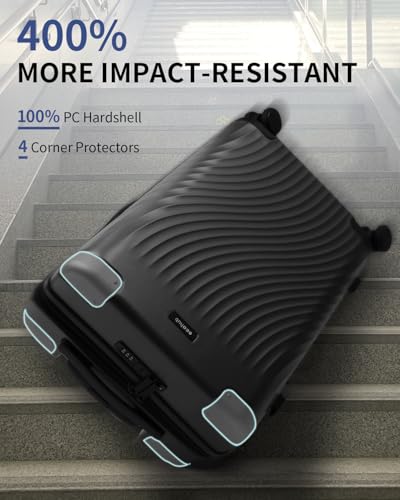
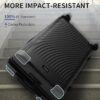
The first bullet also claims the case is 400 percent impact resistant. That figure means nothing without a baseline, a test method and a standard, none of which is given, and we are not repeating it as a durability finding. What can be said is that four aluminum alloy corner protectors are the right answer to the failure that actually happens on a hard shell, since corners are where a case cracks and aluminum dents rather than splitting.
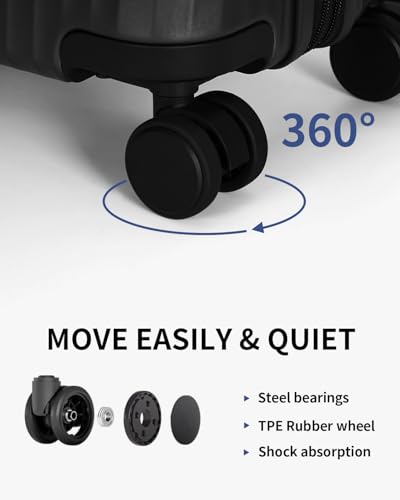
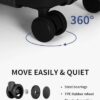
The wheels are described as steel axle TPE spinner wheels. Naming the axle material and the tyre compound is more than almost any listing here manages: a steel axle resists the bending that kills cheap casters, and TPE is a softer compound that grips and runs quieter than hard plastic. Casters remain exposed and remain the most common physical failure on any wheeled bag, but this is a specification rather than an adjective.
The expansion gusset is 1280 denier tear resistant nylon with YKK zippers, and the interior is two fully enclosed compartments with zippered closures, a wet zippered pocket and a mesh pocket. Naming YKK is worth having on the component that ends trips. Two fully closed compartments rather than one deep well and a lid is the layout that keeps packing from shifting and is the right choice on a case that will be handled roughly.
The warranty, the free duffel, and the record
The fifth bullet publishes a three year limited warranty and notes that this is the maker first luggage series. A stated term with a number attached and the word limited is more honest than an open ended lifetime promise, and it is better than the silence most listings in this catalog offer.
Be precise about what it is. Limited means conditions apply, and the listing does not publish them. The point to check in the written document is airline handling damage, which is the damage luggage overwhelmingly suffers and the exclusion that survives even inside long warranties. Compare with the BAGSMART 20 inch in black, which publishes five years, and the LUGGEX FLO3, which offers a three year support plan with no defined scope at all.
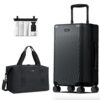
The fourth bullet includes a free foldable 30 litre duffel with a leak proof exterior pocket that folds into its own wet pocket. That is a real inclusion rather than a token, and on a return leg with souvenirs it is the difference between paying for a second bag and not.
Buyer feedback runs to 54 ratings at an average of 4.5 out of 5, with the case ranked 283rd in Carry-On Luggage and 211,173rd in Clothing, Shoes and Jewelry. Fifty four ratings is a very thin pool, which is consistent with a first luggage series, and a high average across it should be read as an absence of evidence rather than as evidence. Manufacturer is ECOHUB, country of origin China, and no model number is published. For alternatives with deeper records, the Tilymol TLM102 and the BAGSMART navy hardside are worth reading. The wider field sits in the carry-on luggage category and the carry-ons category.
Who should buy it, and who should not
Buy it if recycled content matters to you, you want named components rather than adjectives, and a three year limited term and a free packable duffel are worth something. Do not buy it if weight is your binding constraint, because the structured field says 9.33 pounds whatever the bullet claims. Do not carry it on expanded, because 11.3 inches of depth is far outside any common allowance, and ignore the 400 percent impact resistance claim, which has no baseline behind it.