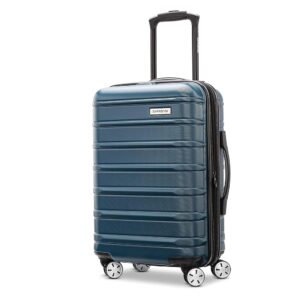


Description
The traveler this Samsonite Octiv is aimed at
The Octiv is a polycarbonate cabin case built around convenience features rather than around toughness claims: eight handle heights, suspension in the wheels, a USB pass through, a snap in packing cube and a pouch for wet items. The maker frames it as three to seven outfits for a short trip or a long weekend, which is an honest description of what 22 inches of hard shell holds.
The buyer is the traveler who flies often enough to care about how a bag rolls and how quickly the handle sets to their height, and who wants the packing organization supplied rather than bought separately. It is not a gear bag and it is not a budget purchase. Within the same brand the Samsonite Omni PC hardside is the longer established alternative and the Samsonite Virtuosa carry on sits alongside it.
Dimensions, and a listing that publishes both sets properly
This listing does something most of the category does not. The final feature bullet states that the packing dimensions are 19.5 by 9 by 13.5 inches and the overall dimensions are 22 by 14 by 9 inches. Two labeled sets, clearly distinguished, on the same product page.
Which number does what
The overall figure is what a gate agent or a sizer measures, because a sizer measures the object in front of it including wheels and handle housing. The packing figure is what you actually get to fill. At 22 by 14 by 9 inches the case sits exactly on the size guideline most commonly cited for United States domestic cabin baggage, with no margin on any axis.
There is a trap in the specification block. It gives product dimensions of 13.58 by 9 by 19.37 inches, which is the packing figure rather than the overall one, presented under a field name that reads like an exterior measurement. A buyer reading only the specification block would conclude the case is 19.37 inches tall when the object is 22 inches tall. Read the bullet, not the field.
We are not going to write that this case is airline approved, and the maker does not claim it. A case sitting exactly on the commonly quoted guideline has zero tolerance: budget and regional carriers publish smaller allowances, several use hard sizers as routine, and many international carriers add a cabin weight limit. Check the allowance published by the airline and fare you booked, and measure the case on arrival.
The expansion makes that tighter still. The zippers add up to 1.5 inches of packing space, all of it on the depth axis, which takes a case already at the commonly cited 9 inch limit to roughly 10.5 inches. Expanded, this case is outside the guideline. Use the expansion on the leg where the bag goes in the hold, and compress it before you approach a gate.
Shell, wheels, handle and lock
The shell is polycarbonate, named plainly, with a scratch resistant coating. Naming the polymer is the disclosure that matters, because polycarbonate flexes under an impact and returns to shape where ABS stars and cracks at a corner. The coating addresses the other half of the hard shell problem, which is that a bare gloss shell picks up visible scuffing on its first trip. The listing describes the case as built to withstand impact and designed to resist cracking, which is a fair characterization of the material rather than a promise about outcomes.
The wheels are four dual spinner casters carrying what the maker calls Aero Trac suspension. Suspension on luggage casters is uncommon and it addresses a real complaint: a rigid case transmits every crack in the pavement up the handle into your wrist, and a sprung caster absorbs some of that. The general spinner trade still applies. Swiveling casters roll sideways easily on smooth terminal floors, catch and tip on curbs and cobblestone, and are the most common failure point on any wheeled bag because they take the impact on every drop.
The handle is the standout feature and it is genuinely well specified. Eight telescopic positions, each one inch apart, locking in place, collapsing flush with the shell. Most cases give you two or three stops, which means most travelers pull at a slightly wrong angle and clip their heels or hunch a shoulder. Eight stops an inch apart is enough for anyone to find a natural height. Two carry handles, one on the side and one on top, cover lifting the case into a bin.
The lock is a TSA approved combination lock, recessed and zipper latched. Recessed matters because a proud lock body is a thing to snap off in a baggage system. What a TSA lock buys you is that a screener can open the case with a master key rather than cutting it. It does not buy security. Those master keys have circulated widely for years, and a coil zipper can be split with a ballpoint pen and closed again by running the sliders over the split. Keep passports, cash and electronics on your person.
Capacity, weight and the USB port
No liter figure is published anywhere on this listing. What you get instead is the packing dimension set of 19.5 by 9 by 13.5 inches, which is roughly 2,370 cubic inches or about 39 liters of usable space, and that is the more honest number in any case. The three to seven outfits framing on the listing is consistent with it.
The interior includes a snap in packing cube, a WetPak pouch for liquids or damp items, mesh pockets and compression straps. Supplying a packing cube in the box is worth more than it sounds, because a cube is what turns a clamshell half into something that stays packed when you open it.
Weight is published twice and slightly inconsistently: 7.5 pounds in the specification block and 7.4 pounds in a feature bullet. That is a rounding rather than a real disagreement. Seven and a half pounds is mid pack for a polycarbonate case with suspension, a lock and an expansion mechanism. On United States domestic routes cabin bags are not weighed. On budget European and many Asian carriers, where the allowance is 7 or 8 kilograms and enforced at check in, seven and a half empty pounds takes roughly half of it before you pack.
The USB port is wiring only and the listing states plainly that the external battery is not included. That is the arrangement airlines want, and it is worth explaining why. Most carriers require lithium batteries and power banks to be removable and carried in the cabin, and luggage with a sealed in, non removable battery has been refused at the gate. Because you supply the bank here and it sits loose, you can take it out and keep it with you. Do that, never check a power bank, and confirm the watt hour limit your airline publishes before buying one.
Warranty, review base and the alternatives
No warranty term appears anywhere on this listing. No period, no coverage description, no exclusions, and nothing about airline handling damage. The brand publishes coverage across much of its range, including on the softside case reviewed as the Samsonite Pro softside expandable carry on, so this reads as a listing gap rather than a policy. Get the terms in writing before ordering, and read what is excluded rather than what is promised, because airline handling damage is the standard exclusion and the damage that actually happens.
The review base is 4.7 from 55 ratings with a rank of 125th in its Amazon carry on luggage category. Fifty five ratings is a small pool. A high average on a small sample tells you the early buyers were pleased, not that the suspension casters survive three years, and casters are the component most likely to fail. Read the one and two star reports for wheel and handle failures specifically.
For a case that publishes an explicit airline damage clause rather than staying silent, the Travelpro Crew Classic spinner is the comparison. Wider options sit in our carry-on luggage and suitcases sections.
Who should buy it and who should not
Buy it if you want a named polycarbonate shell, an eight position handle that will actually fit you, sprung casters and a packing cube in the box, and you fly routes where cabin bags are not weighed. The dual dimension disclosure is a mark of a well maintained listing. Skip it if your carrier enforces a strict sizer, because the case sits exactly on the guideline with no tolerance, and skip it if you need a written warranty before paying, because this listing publishes none. Do not use the expansion on a leg where the case must clear a sizer.