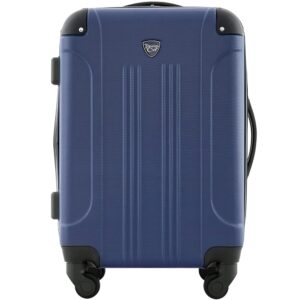


Description
This is a 28 inch checked bag
Start with the category, because it decides everything else. The Omni PC in this listing is the checked large size, with overall dimensions of 30.5 by 21.5 by 13.5 inches. That is a hold bag by a wide margin. It appears in carry on category rankings and it sits in a carry on category on this site, and neither changes what it is. Nothing over 30 inches tall boards with you.
The traveler it suits is the one taking two weeks or more, or the one who is the designated packer for a family. The cabin sized member of the same brand’s range is the Samsonite Octiv hardshell carry on, and the stylistic alternative is the Samsonite Virtuosa carry on.
Dimensions, and the linear total that will cost you money
The feature bullet publishes two labeled sets. Packing dimensions are 28.5 by 20.5 by 13.5 inches. Overall dimensions are 30.5 by 21.5 by 13.5 inches. The specification block gives the packing figure under a field name that reads like an exterior measurement, which is the usual trap: a buyer reading only that field would think the case is 28.5 inches tall when the object is 30.5 inches tall.
Add the three numbers together
Checked baggage is governed by a linear total rather than a sizer box. Most United States carriers publish 62 linear inches, meaning length plus width plus depth added together, as the threshold above which an oversize fee applies. The overall figures here total 65.5 inches.
That is over the common limit by three and a half inches, before the case is expanded. Oversize fees are substantial, often more than the cost of a second checked bag, and they are charged per leg. This is the single most important fact about this product and it is not stated anywhere on the listing. If you fly a carrier that measures rather than eyeballs, plan for the fee or buy a smaller case. Several international and regional carriers publish tighter limits than 62 inches, so check the allowance for the airline and route you booked.
The case is also expandable, and any expansion adds to the depth and to the linear total. Expanding a case that already exceeds the limit makes a bad position worse.
The weight limit is the other constraint. At 10.4 pounds empty with a packing envelope of 28.5 by 20.5 by 13.5 inches, this case reaches the standard 50 pound checked limit long before it runs out of room. Weigh it at home before every trip.
Shell, wheels, handle and the lock claim
The shell is 100 percent injection molded polycarbonate, and the listing describes it accurately as a highly impact resistant plastic that is strong and lightweight. Naming the polymer and the moulding process is a better disclosure than almost anything else in this catalog. Polycarbonate flexes under an impact and returns to shape where ABS stars and cracks at a corner, and it sheds water where fabric absorbs it. On a bag that will spend its life in baggage systems, that is the right material.
The micro diamond surface texture is there to hide scuffing, which is the universal cosmetic failure of hard shells and the reason a gloss finish looks tired after one trip. A textured shell disguises marks rather than preventing them.
The listing also includes care instructions, which is genuinely unusual: gentle soap and warm water, rinse well, and a silicone based automobile or furniture polish if you want to restore lustre, with a specific warning against combination cleaner polish products. That is practical information most makers do not bother to publish.
There are four oversized multi directional spinner casters. Oversized is the useful word: larger diameter wheels roll over gaps, thresholds and rough pavement where small casters catch and judder. On a checked case that matters mostly in car parks and hotel forecourts, but it matters. Exposed casters remain the most common failure point on any wheeled bag, and on a checked bag they take belt and chute impacts a cabin bag never sees.
The lock wording needs correcting
A feature bullet states that the side mounted TSA locks act to deter theft, ensuring that only you or a TSA agent have easy access to your belongings. The first half is right and the second half is not. Deter is the correct verb. Ensuring that only you or a screener can get in is not accurate: TSA master keys have been widely reproduced and circulated for years, and the coil zipper the lock sits on can be split with a ballpoint pen and closed again by running the sliders across the split. Side mounting is a sensible choice because a lock body on the face of a case is a thing to snap off, but the lock is a deterrent, not security. No cash, medication, documents or electronics should travel in a checked bag on the strength of one.
Capacity, weight and one broken field
The capacity field reads 1035 Pounds. That is not a capacity and it is not a weight either; it looks like the 10.35 pound weight with the decimal point lost. No liter or cubic inch capacity figure is published anywhere on this listing.
Work from the packing dimensions instead. An envelope of 28.5 by 20.5 by 13.5 inches is roughly 7,888 cubic inches, or about 129 liters. That is a very large bag: three times a cabin case. Usable capacity will be somewhat under that once the lining and internal structure are subtracted, but the order of magnitude is right and the case will comfortably exceed a 50 pound weight limit before it fills.
Weight is published three times with minor variation: 10.35 pounds, 10.4 pounds and 10.5 pounds in the bullet. Those are roundings rather than disagreements. Ten and a half pounds is reasonable for a 28 inch polycarbonate spinner and lighter than an aluminum framed case of the same size, though every empty pound is a pound of contents you cannot bring under a fixed checked weight limit.
Warranty and the alternatives
Samsonite publishes a ten year limited warranty against defects in materials and workmanship, stated with a period and a scope rather than left as a name. That is a real written commitment and it puts this case ahead of most of the field.
Read the scope. Defects in materials and workmanship means manufacturing faults: a seam that fails, a handle assembled wrong, a shell that cracks without cause. It does not mean damage. Nothing in the statement addresses airline handling damage, which is the standard exclusion across luggage warranties and precisely what happens to a bag that spends its life in holds and on belts. A ten year defects warranty is valuable and it is not damage cover, and on a checked bag that distinction is sharper than on a cabin bag.
The listing also says the products are rigorously tested to meet stringent standards, with no test, standard or result published. Judge the case on the named material and the warranty scope.
The review base is 4.5 from 1,400 ratings, which is a usable pool for reading failure reports; look for caster and handle complaints specifically. For a polycarbonate checked case from another brand at a similar size, the Delsey Helium Aero checked medium is the comparison and sits inside the 62 inch linear limit where this one does not. Larger hold cases are collected in our suitcases section and cabin options in carry-on luggage.
Who should buy it and who should not
Buy it if you need a very large checked case, you want named injection moulded polycarbonate with a written ten year defects term, and you have checked your airline’s linear limit and accepted the oversize position. The textured shell, oversized casters and published care instructions are all marks of a well made product. Skip it if you were shopping for a cabin bag, because this is a 28 inch case, and skip it if your carrier measures checked bags, because the overall dimensions total 65.5 linear inches against a common 62 inch limit. Ignore the 1035 Pounds capacity field, and never check valuables behind the lock.