Description
This Is a Gear Bag, Not a Suitcase
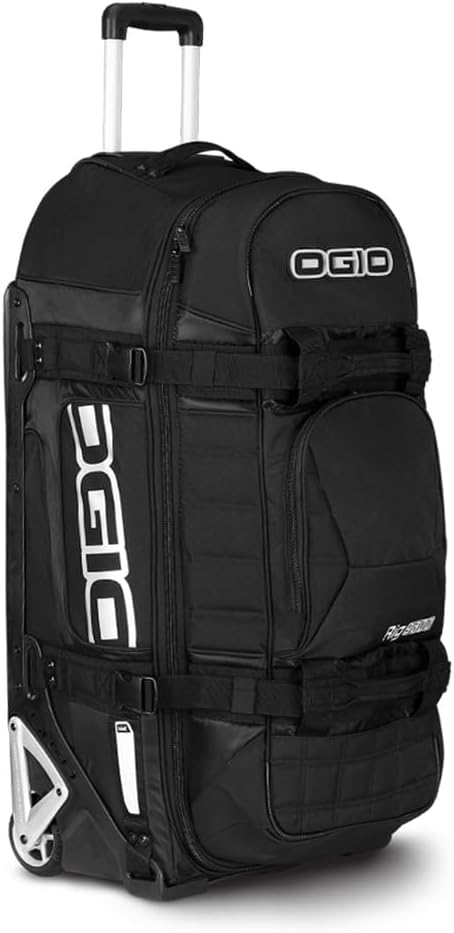
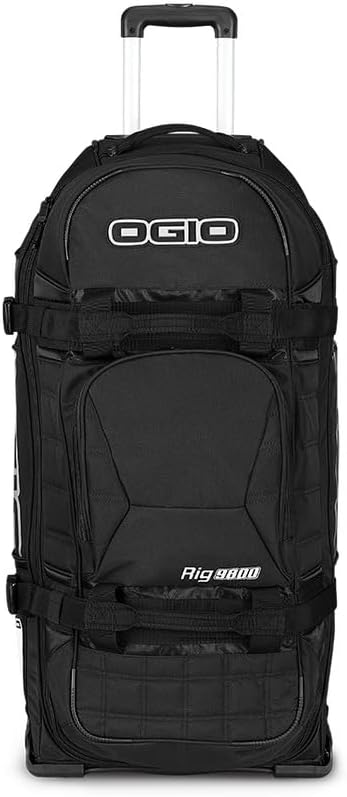
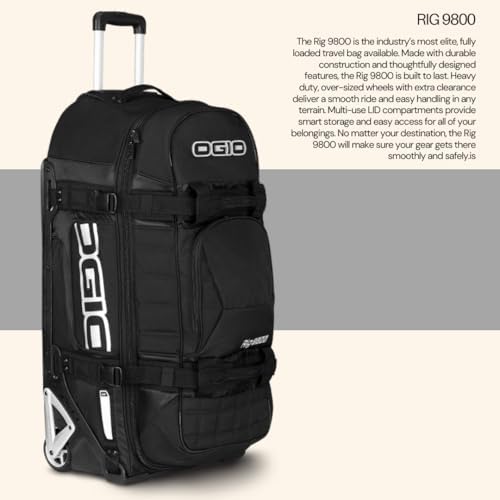
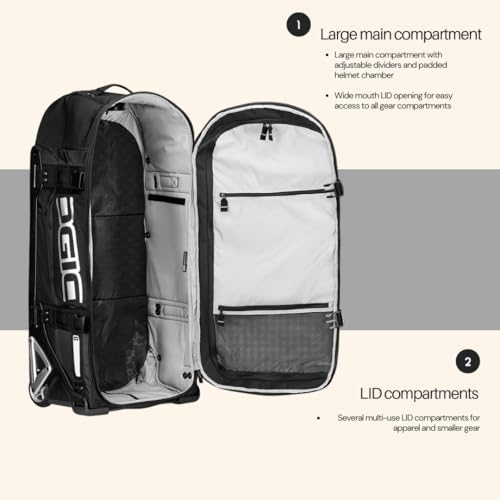
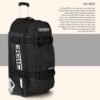
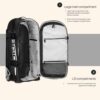
The Rig 9800 is filed under suitcases, and the single most useful thing to say about it is that it is not one. The giveaway is in the feature list: a large main compartment with adjustable dividers and a padded helmet chamber. Helmet chambers exist for motocross, track days, powersports and hockey. This is a wheeled gear bag built to move protective equipment, boots and kit to a paddock or a rink, and OGIO’s own naming calls it a gear bag alongside the checked luggage label.
That changes who should be reading. If you want a case for clothing on a two week holiday, a hardside trunk such as the Traveler’s Choice Maxporter II is the right tool. If you move bulky, awkward, dirty equipment and need it to survive a truck bed and a baggage belt, this format exists precisely for that, and the same logic applies to soft rolling duffels such as the TPRC Sierra Madre II.
Two Dimension Sets, and the Oversize Problem
The specification block gives package dimensions of 37 by 18 by 16 inches at 16 pounds. Note the word package: that is the shipping carton, not the bag. The third feature bullet gives the product dimensions as 34 inches high by 16.5 wide by 15.25 deep. Use the bullet.
Now the arithmetic that decides what this costs to fly. Most United States carriers limit checked baggage to 62 linear inches, meaning the three dimensions added together, before oversize charges apply. Add 34 plus 16.5 plus 15.25 and the total is 65.75 linear inches. That is nearly four inches over the common ceiling, empty, and a soft sided bag swells when packed.
Oversize fees apply per bag per direction and are substantial on most carriers, and some airlines set a hard maximum above which they will not accept an item at all. None of this makes the bag defective, it is simply what a 34 inch gear bag is, but it means the fee has to be part of the buying decision. Sporting and specialist equipment is frequently handled under a separate airline policy with its own allowances, which may work in your favor here, but those policies differ by carrier and by equipment type. Look up your airline’s oversize and sporting equipment rules before flying with it. Nothing about this bag approaches a cabin allowance.
Wheels, the SLED System and Polyester
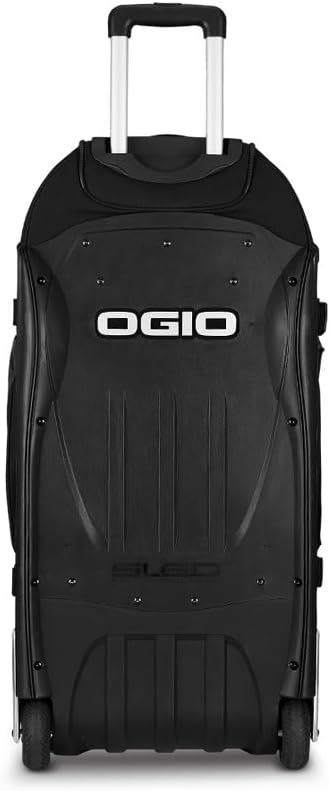
The construction details are where this listing is genuinely informative. The wheels are described as heavy duty oversized units with extra clearance. Extra clearance is the specification that matters on a gear bag: it lifts the base off the ground so the bag can be dragged across gravel, grass, a paddock or a wet parking lot without the underside taking the abrasion. Large diameter wheels also roll over broken surfaces that would stop a small caster dead. There is no indication that these are spinners, and on a bag of this kind inline wheels are the correct and expected choice.
The SLED system, which OGIO expands as structural load equalizing deck, is a rigid base plate that spreads load across the bottom of the bag rather than letting it concentrate at the wheel mounts. On soft luggage the junction between a flexible body and a rigid wheel assembly is exactly where failures start, so a load spreading deck addresses the right weakness. A telescoping pull handle is fitted, with no stage count, no material and no extended height published, which is the same gap seen on the Wrangler Wesley rolling duffel.
The fabric type field says 100 percent polyester. No denier figure and no coating are stated, which on a bag intended for outdoor use is a meaningful omission: assume it is not waterproof and that gear stored inside overnight in rain needs its own liner.
The wide mouth lid opening is the other genuinely useful feature. A gear bag that opens along most of its top lets you see and reach everything at once instead of excavating from one end, which matters when you are looking for one glove in a bag of kit.
Capacity, Weight and the Figures That Are Missing
No capacity is published anywhere on this listing, in liters or cubic inches. For a bag of these dimensions the external volume is substantial, but the internal figure with the adjustable dividers and the padded helmet chamber taken into account is not stated, and we are not going to estimate it.
Weight is a bigger gap. The only figure on the listing is 16 pounds, and it sits in the package dimensions field, which means it is the shipped weight including the carton and any packaging. The empty weight of the bag itself is not published. That matters directly: most carriers cap checked baggage near 50 pounds, and a gear bag with a rigid deck, oversized wheels and a helmet chamber is heavy before anything goes in. If the bag alone is close to 16 pounds, roughly a third of the checked allowance is spent on the bag. Ask the seller for the empty weight.
Listing Faults and What Is Not Stated
Several fields here are unusable and should be named rather than glossed. The first two feature bullets read fabric type 100 percent polyester and origin made in the USA or imported, both of which are specification fields that leaked into the marketing list during import. The origin value itself is not an answer: made in the USA or imported covers every possibility. Two further bullets are duplicates of each other, both reading that there is a large main compartment with adjustable dividers and a padded helmet chamber.
No warranty is published. No term, no exclusions, no coverage period. The Best Sellers Rank field carries no number, only a generic top 100 reference, so there is no ranking signal. The rating is 4.7, and the listing publishes no rating count at all, which sharply limits what that figure can tell you: a 4.7 across five ratings and a 4.7 across five thousand are not the same evidence. First availability is recorded as March 2025, so this is a recent listing and a thin record is expected.
For alternatives within this catalog, the Rockland drop bottom rolling duffel offers a separate lower compartment for boots or dirty kit, and the suitcases category holds the conventional cases.
Who Should Buy It and Who Should Not
Buy it if you move sports or powersports equipment, need a padded helmet chamber and adjustable dividers, and value oversized wheels with real ground clearance and a load spreading base deck. Those are the right features for that job and they are specified more clearly than most of this catalog manages. Do not buy it as a holiday suitcase. Do not fly it without pricing your airline’s oversize charge, because at 65.75 linear inches it is nearly four inches past the common 62 inch limit. And ask the seller two questions before ordering: the empty weight of the bag, and its capacity, because the listing publishes neither.