

Description
The traveler this Copilot is built for
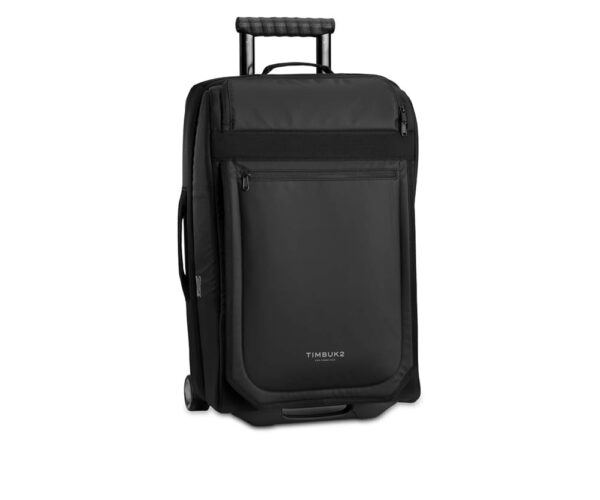
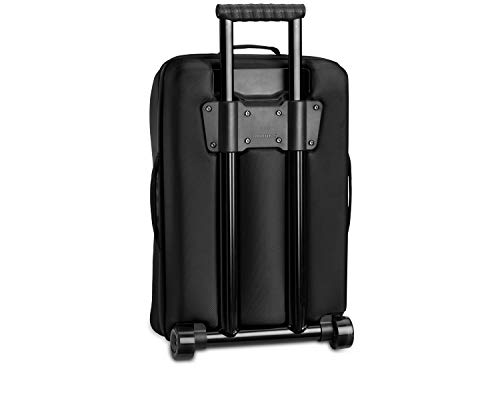
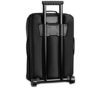
Timbuk2 came out of messenger bags and the Copilot roller carries that thinking: a soft clamshell case with a bike inspired handle, broad skateboard wheels and reinforced grab straps on every side. The buyer is the traveler who wants a light, simple, well built bag and does not care about a suiter panel, a lock or an expansion zipper. It is a bag for people who pack the same way every trip.
The trip is three to six nights at 42 liters. The clamshell layout, where the case opens flat into two halves, is the reason to choose it over a conventional single cavity upright: you pack one side and repack it without unloading the other. If you want the same simplicity without wheels, the Thule Subterra convertible carry on is the closest comparison at half the weight.
Dimensions, and the word legal
The specification block gives item dimensions of 14.17 by 9.84 by 22.83 inches. A feature bullet says the medium roller is 22 inches high. Those disagree by eight tenths of an inch on the dimension airlines care about most, and the bullet figure is the rounder, friendlier one.
Carry on legal is the wrong phrase
The same bullet describes the medium as the domestic carry on legal size and the small as the international carry on legal size. There is no such thing as a legal carry on size. Airlines set their own allowances as a matter of policy, publish them, and enforce them at the gate. No law defines a cabin bag dimension in the United States, and the roughly 22 by 14 by 9 inch figure people quote is a common industry convention rather than a regulation.
That correction matters practically as well as pedantically. If you buy this bag believing 22 inches is a legal standard, you will assume every carrier accepts it. Several do not. Budget and regional carriers publish smaller allowances, some international carriers publish both a smaller size and a weight limit, and a bag at 22.83 by 14.17 by 9.84 inches is over the commonly cited figure on all three axes. It is a soft bag, so it compresses into a sizer in a way a rigid shell cannot, but that is a mitigation rather than a guarantee.
We will not write that this bag is airline approved. Check the allowance published by the airline and fare you booked, and measure the bag on arrival. Nothing on the listing states whether the wheels and the retracted handle are included in the published figures, and a third dimension set on the page, at 24.92 by 16.38 by 11.54 inches, is labeled as the shipping package and should be ignored.
Materials, wheels and the handle
The main body material is given as Reverse 600D, with the specification text truncated mid word after that. Six hundred denier is a mid weight fabric: tougher than the unrated polyester on the cheapest bags, well short of a 1680 denier Oxford or a ballistic nylon. Reverse weave describes the face of the fabric rather than its strength. A separate specification field just says synthetic, which tells you nothing.
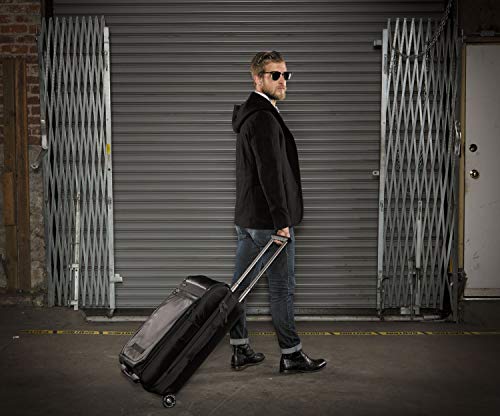
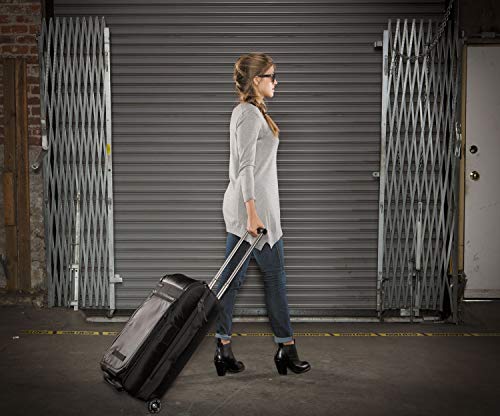
The wheels are the most interesting part of this bag. Timbuk2 describes broad base skateboard wheels and, critically, says they are removable. Removable wheels are rare and genuinely valuable, because wheels are the most common failure on any piece of luggage and a bag whose wheels can be swapped is a bag that does not become scrap when one shears. Broad base skateboard wheels also behave better than spinner casters on rough pavement, gravel and curbs, since they take load in one plane and cannot catch and tip the way a swiveling caster does. The cost is that you tow the bag at an angle rather than pushing it upright, so the load goes through your arm.
The handle is a double pole telescoping system that Timbuk2 calls bike inspired. Two poles rather than one is the more rigid arrangement and it is what stops the wobble that plagues cheap single pole handles. No stage count or extended height is published.
The interior is a clamshell with an internal mesh divider and an expandable top compartment intended for shoes or toiletries, which is a sensible way to keep the dirty things away from the clean ones. There is a padded front zippered pocket for a laptop or tablet up to 13 inches, which is smaller than most competing cases and will not take a 15 inch machine. Reinforced grab handles on all sides make lifting the bag into an overhead bin a one motion job. An integrated ID window is fitted, and there is no lock and no lock provision mentioned anywhere.
Capacity, weight and what the format gives up
Capacity is 42 liters, published once and not contradicted. Against an envelope of roughly 3,190 cubic inches, or about 52 liters, that is a credible usable figure for a softside clamshell with a divider and a handle channel.
Weight is 7.5 pounds empty. That is mid pack for a 42 liter softside roller and is the number to weigh against the format’s advantages. It is heavier than a light polycarbonate shell of similar volume and lighter than a business softside with a full hardware set. On United States domestic routes cabin bags are not weighed. On budget European and many Asian carriers, where the allowance is 7 or 8 kilograms and enforced at check in, seven and a half empty pounds takes about half of it.
What the clamshell format gives up is depth of a single cavity. You cannot pack one tall object down the length of the bag the way you can in a conventional upright, because the case is two shallower halves. For most people packing folded clothes that is an advantage. For anyone carrying a tripod, a set of golf shoes or a rolled suit, it is not. Note also that there is no expansion zipper: what you see is what you pack, which means the case cannot be pushed out of a sizer but also cannot absorb what you bought on the trip.
Warranty, and reading it carefully
Timbuk2 publishes a lifetime warranty on this listing and states the terms plainly enough that they can be read properly. The commitment is that if there is a defect in materials or workmanship, Timbuk2 will repair the bag at its discretion for the lifetime of the product. Three parts of that sentence deserve attention.
First, it covers defects in materials and workmanship. That is manufacturing faults, not damage. Second, the remedy is repair rather than replacement, and it is at the maker’s discretion rather than yours. Third, and most importantly for luggage, nothing in the statement addresses airline handling damage. That is the standard exclusion across the category and it is the damage that actually happens to bags, so a lifetime term that covers only defects is worth less than the word lifetime suggests. It is still a real commitment, stated in specific language, and better than the silence on most listings in this catalog. The removable wheels also mean the most likely failure is a part swap rather than a warranty claim.
The review base is 4.5 from over 400 ratings, and the model year on the listing is 2014, so this is a long lived design with a decade of buyers behind it. That combination is more informative than a high rating on a new product. For alternatives, the Travelpro Crew Classic spinner publishes coverage that explicitly names airline damage for a limited period, and the YETI Crossroads 22 is the rugged nylon alternative. The full field is in our carry-on luggage and carry-ons sections.
Who should buy it and who should not
Buy it if you want a simple, durable soft roller with removable wheels, a rigid double pole handle and a clamshell that packs flat, and you fly routes where cabin bags are not weighed. Skip it if you carry a 15 inch laptop, because the pocket is rated to 13 inches, and skip it if you need an expansion or a lock, because there is neither. Do not read carry on legal as a regulation, and note that the published dimensions are over the commonly cited guideline on all three axes.