Description
Who this Travelers Club Cosmo suits
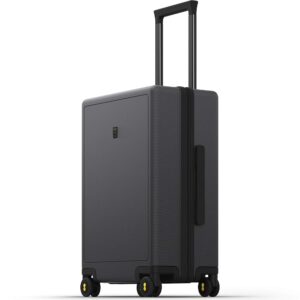
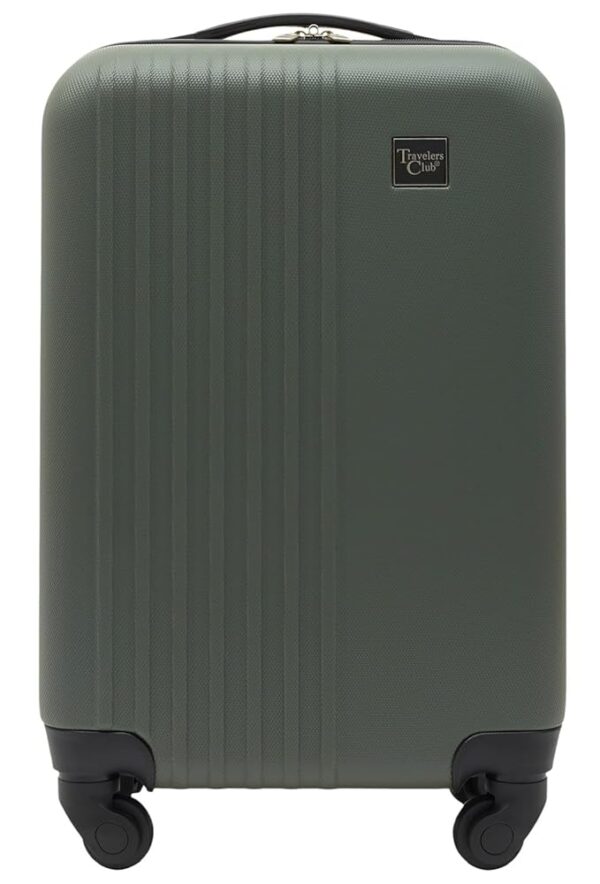
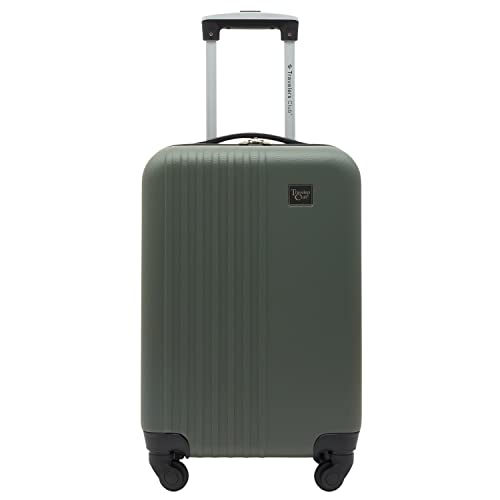
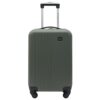
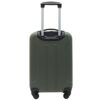
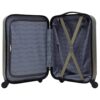
This is an ABS hard shell cabin spinner with a fully lined and divided interior, compression straps, four spinner wheels and rubber studs on one side so the case can lie flat without scuffing. The buyer is the traveler who wants a rigid case with a properly organized interior at a low price, and who values a maker that tells you plainly what its dimensions do and do not include.
The trip is three to five nights at a stated 37 liters. The case ranks tenth in its Amazon carry on luggage category with more than 3,100 ratings, which is a strong position. Within the same family the Travelers Club Chicago hardside spinner is the closest sibling and the Cosmo carry on in another finish is the same case in a different color.
Dimensions, and a bullet that tells you the truth
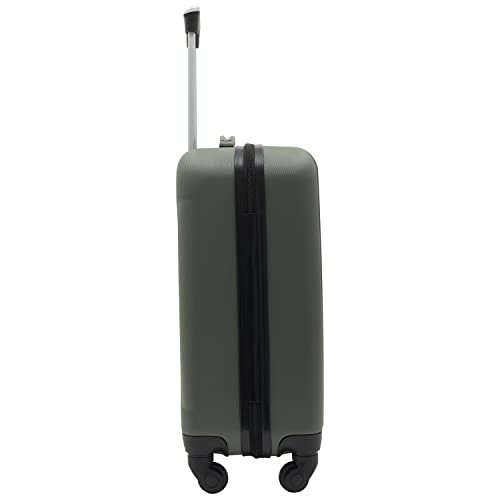
The first feature bullet gives body dimensions of 19.5 inches high by 13.5 long by 8.5 wide, and states in parentheses that the figure is without the wheels. The specification block repeats 13.5 by 8.5 by 19.5 inches.
Why that parenthesis matters more than it looks
Most listings in this category publish a shell measurement and stay silent about the wheels, which is why a case that looked compliant on paper gets stopped at a gate. This one tells you outright that the wheels are not in the number. That is a small piece of honesty and it is genuinely useful, because it means you know to add something rather than assuming the published figure is what a sizer will read.
How much to add is not stated. Four spinner casters typically add somewhere between one and two inches to the height of a hard shell. Assume a measured height around 21 inches and confirm it when the case arrives.
Against the size guideline most commonly cited for United States domestic cabin baggage, roughly 22 by 14 by 9 inches, a case with a 19.5 inch body plus casters is still comfortably inside on height, inside on width at 13.5, and inside on depth at 8.5. That is a genuinely good position and it is the practical argument for this case.
We will not write that it is airline approved and the listing does not claim it. Check the allowance published by the carrier and fare you booked, note that budget and regional carriers are frequently stricter than the majors and that many international carriers add a cabin weight limit, and measure the case on arrival. No expansion is described anywhere, which means the case cannot be pushed out of a sizer and also cannot absorb what you bought on the trip.
Shell, wheels, handle and interior
The shell is ABS, named plainly, and the listing describes it as durable and lightweight. ABS is the lightest of the common luggage polymers, which is why the case weighs 6 pounds, and the most brittle. Under a hard impact it stars and cracks at a corner rather than flexing and returning to shape the way polycarbonate does. That trade defines how the case should be used: keep it in the cabin and it will last a long time; check it every month and the corners are where it ends.
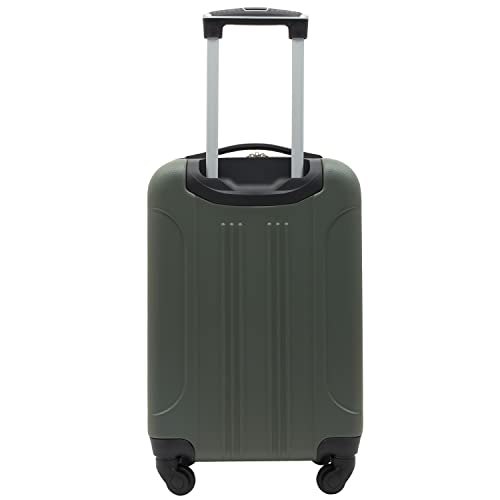
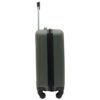
The wheels are four spinning wheels, and the listing says the design eases strain on the wrist. That is true of a spinner rolling upright on level ground and stops being true at a curb or on gravel, where a swiveling caster catches and the case tips. No count per mount, material or bearing detail is given, so whether these are single or double casters is unstated. Exposed casters are the most common failure point on any wheeled case.
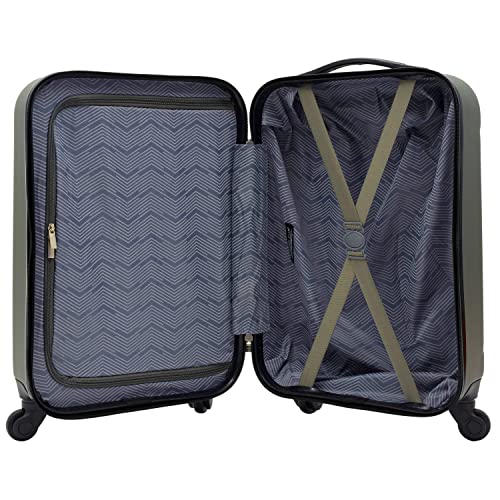
The interior is the strongest part of the specification. Fully lined, with pockets, compression straps and dividers. Dividers matter on a hard shell more than on a soft bag: a clamshell that splits into two restrained halves stays packed when you open it flat on a bed, where a lid and a cavity does not.
Two small details deserve mention. A top carry handle covers lifting the case into a bin. And four rubber studs on one side let the case lie flat on the ground without the shell taking the abrasion, which is a genuinely thoughtful touch on a polymer that scuffs easily. Neither is expensive to add and both are absent from plenty of pricier cases.
The telescoping handle is not described at all: no stage count, no extended height, no material. No lock and no lock provision is described anywhere either. If you need one, check whether the zipper pulls have holes before ordering, and understand that any zipper lock is a deterrent rather than security, because a coil zipper can be split with a ballpoint pen and closed again by running the sliders across the split.
Capacity, weight and one broken field
The capacity field reads 6 Pounds, which is a weight in a capacity field and is broken. A second field, capacity total, reads 37 liters.
Thirty seven liters needs care. The body envelope of 19.5 by 13.5 by 8.5 inches is roughly 2,238 cubic inches, or about 36.7 liters, so the stated capacity is essentially the whole exterior box with nothing subtracted for the shell walls, the handle channel or the internal wheel wells. That is not achievable in practice. A rigid hard shell typically loses a fifth to a quarter of its envelope to structure, which would put realistic usable capacity nearer 28 to 30 liters.
The pattern is common across this catalog: a capacity figure that turns out to be the three exterior dimensions multiplied together rather than a measurement of the space inside. Plan from the linear dimensions, and note that anyone comparing this case against a rival quoting genuine usable liters is not comparing like with like.
Weight is 6 pounds, published consistently in the bullet and the specification block. Six pounds is light for a rigid cabin case with a divided interior, and about a pound under several branded polycarbonate shells. On United States domestic routes cabin bags are not weighed. On budget European and many Asian carriers, where the allowance is 7 or 8 kilograms and enforced at check in, six empty pounds takes roughly half of it before you pack.
Warranty, review base and the alternatives
No warranty term appears anywhere on this listing. What the description offers instead is a note telling buyers to contact the manufacturer directly if there is an issue with the product, with a promise of help and assistance. That is a support contact, not a warranty: no period, no scope, no remedy and nothing about airline handling damage, which is the standard exclusion in luggage coverage and the damage that actually happens.
The rest of the description is a list of everything the brand makes, from duffels to messenger bags, and contains no information about this case. The feature bullets are the only specification on the page.
The review base is where the confidence should come from: 4.4 from 3,141 ratings with a rank of 10th in its Amazon carry on luggage category. Three thousand ratings is a substantial pool and a top ten rank means real volume. Read the one and two star reports for caster failures and corner cracking, which are the two things an ABS spinner is most likely to suffer and which no specification sheet will tell you about.
A close competitor with a much larger review base but an unnamed shell material is the Chicago case linked above. For a case at a similar weight with a stated ten year defects warranty, the American Tourister Stratum XLT is the step up, and wider options sit in our carry-on luggage section, and for personal item companions the carry-ons section.
Who should buy it and who should not
Buy it if you want a light rigid cabin case with a genuinely divided interior, dimensions that sit comfortably inside the common guideline even after you add the wheels, and a maker honest enough to tell you the wheels are not in the number. The rubber studs and compression straps are small marks of a well thought out case. Skip it if the case will be checked regularly, because ABS cracks where polycarbonate flexes, and skip it if you need a lock or a written warranty, because neither is published. Do not plan around 37 liters; that is the outside of the case multiplied out.