

Description
The traveler this Rio upright is sold to
The U.S. Traveler Rio is an entry level softside upright aimed at the occasional flyer who wants a wheeled bag without spending on hardware they will use twice a year. The pitch on the listing is straightforward: densely woven polyester, metal hardware, a locking handle, an expandable main compartment and a lined interior with tie down straps. That is a competent budget specification, and for two or three trips a year it is often enough.
What it is not is a bag for someone who flies monthly. Budget uprights fail at the wheels and the handle mounts, and they fail sooner in proportion to how often the bag is dragged and dropped. If the trip count is high, spending up buys engineering rather than styling. Within the same family, the U.S. Traveler lightweight rolling carry on and the U.S. Traveler rolling suitcase sit in the same bracket with their own published figures.
The listing contradicts itself, and we are not going to pick a side
This is the most confused source listing in its category, and buyers deserve to see the confusion rather than a tidied version of it.
One bag or two
The product name sells a single item: a Rio lightweight carry on suitcase, 20 inch, softside, expandable, four wheel, in teal. The product description on the same listing describes something else entirely, a two piece set containing a 21 inch expandable wheeled upright and a 14 inch boarding bag, and explains how the boarding bag slides over the upright’s handle. Those cannot both be what arrives in the box. Before ordering, confirm with the seller whether you are buying one piece or two, because the answer changes what the item is worth.
Three heights
The product name says 20 inch. The description says 21 inch. The specification block gives product dimensions of 13.5 by 7.5 by 21 inches. Two of the three sources say 21, so 21 is the more likely figure, but the listing does not settle it and does not say whether that 21 inches includes the wheels and the retracted handle. On a softside upright the wheels usually sit proud of the shell, so the measured height can exceed the published one. Against the size guideline most often cited for United States domestic carry on baggage, roughly 22 by 14 by 9 inches, a 21 inch bag is inside the height limit with very little margin once wheels are counted.
Two wheels or four
The product name says four wheel. The description says a set of skate wheels, which is the language normally used for two inline wheels recessed into the base. Those are different bags with different behavior. Inline skate wheels are recessed, harder to break and better on rough ground, and they require you to tilt and pull. Four spinner casters roll sideways on smooth floors, add to the measured depth, and are the most common failure point on any wheeled bag. Ask which you are getting.
Two specification figures that are simply wrong
The specification block lists item weight as 1.3 pounds and capacity as 1.3 liters. Neither is credible for a 21 inch wheeled suitcase. A 21 inch upright with metal hardware, a telescoping handle and wheels weighs somewhere between five and nine pounds empty; 1.3 pounds is roughly the weight of the handle alone. And 1.3 liters is about the volume of a large water bottle, against an exterior envelope of 13.5 by 7.5 by 21 inches that works out to over 2,100 cubic inches, or around 34 liters.
The pattern here is recognizable. The same value, 1.3, has been written into both the weight and the capacity fields, which is what happens when import data copies one number into two places. We are not substituting a guess. We are telling you that the published weight and capacity on this listing cannot be relied on, and that if empty weight matters to your cabin allowance you must get the real figure from the seller before ordering. On luggage that is not a detail; on a carrier that weighs cabin baggage it is the whole purchase.
The compliance claim, and why FAA is the wrong authority
The description states that both pieces meet FAA carry on regulations. That is worth correcting plainly. The Federal Aviation Administration does not set carry on baggage size limits. Individual airlines set their own allowances, publish them, and enforce them at the gate with sizers. There is no federal size standard for a suitcase to meet.
So we are not writing that this bag is airline approved, and the FAA framing on the listing should not be read as a compliance guarantee. What you should do instead is look up the cabin baggage dimensions published by the airline you actually booked, note that budget and regional carriers are frequently stricter than the majors and that many international carriers add a weight limit, and then measure this bag on arrival with the wheels and the retracted handle included. Given that the listing cannot agree with itself on the height, measuring is not optional here.
The bag is also expandable. Whatever the closed depth turns out to be, expanding it adds to that figure, and an expanded bag can fail a sizer that the same bag passed closed. Treat the expansion as a feature for the hold, not for the cabin.
Fabric, hardware and what the description does support
The description names 1200 denier polyester, which is a specific and useful disclosure, and one that most budget listings do not make. Twelve hundred denier is a genuinely heavy weave for the price bracket. It resists abrasion better than the unrated polyester used on cheaper bags, and it will keep light rain out of the panel, though never out of the zipper line. Metal hardware is called out as holding up to shipping handling, which is a fair claim for metal corner and handle fittings against the plastic ones on the cheapest bags.
The handle is described as an internal deluxe retractable push button system that locks in place. A handle that locks rather than floats is worth having, because a handle with play concentrates stress at the mounts and is the second most common failure after the wheels. The interior is fully lined with tie down straps and a large mesh zippered pocket, which is a conventional and effective layout.
The listing carries a rating of 4.0 from a little over 700 ratings and sits ranked 310th in its Amazon carry on luggage category. A 4.0 average on a bag this cheap usually means the failure reports are worth reading before buying, and with a review base that size there are enough of them to be informative.
Warranty, alternatives and the verdict
No warranty term appears anywhere on this listing. No period, no coverage description, no exclusions, and nothing about airline handling damage, which is the damage luggage actually suffers. Buy this as a bag rather than as a commitment, and assume a broken caster is your problem.
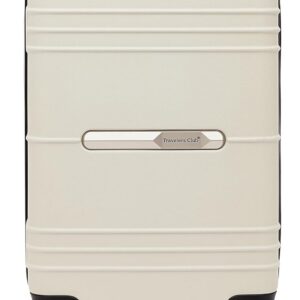
If the possibility that this is really a set appeals to you, look at products sold explicitly as sets in our luggage sets section, including the U.S. Traveler Rio luggage set, where the piece count is not in doubt. If you want a single carry on with cleaner published data, the Travelers Club Cosmo carry on spinner and the wider carry-on luggage range publish figures that at least agree with themselves.
Who should buy it and who should not
Buy it only after the seller confirms three things in writing: whether it is one bag or two, the real empty weight, and the wheel configuration. With those answers, the 1200 denier fabric and locking handle make it a reasonable occasional use bag. Skip it if you are not willing to chase those answers, and skip it if you fly a carrier that weighs cabin baggage, because the published weight on this listing is not a number anyone should plan around.