

Description
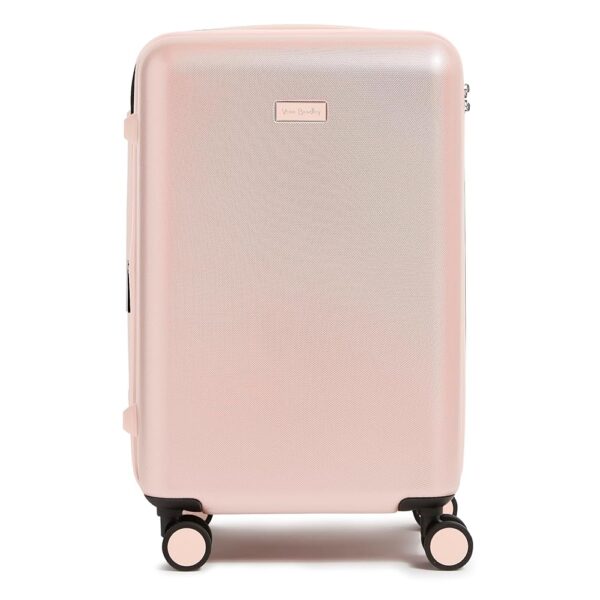
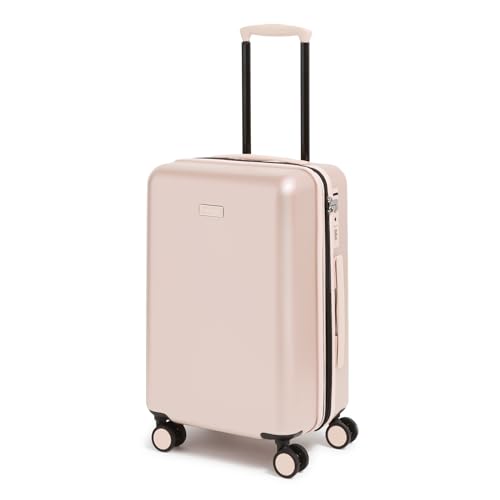
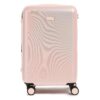
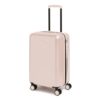
The Vera Bradley hardside rolling suitcase in rose quartz, model 28134-M97, is a printed cabin case with an unusual feature for this catalog: a USB port built into the lock. The listing also describes the case as carry-on compliant while publishing a depth an inch over the figure most travelers work to. Both need dealing with.
The traveler and the trip this suits
This is a short trip cabin case bought partly for its finish. Vera Bradley sells the format as a set you build yourself, buying one case now and a matching size later, which suits someone who wants coordinated luggage without paying for three pieces at once.
At 7.8 pounds empty it is mid weight for a hard cabin case. Readers comparing printed and patterned cabin cases should read the BEBE Adriana 21 inch hardside carry-on, and those wanting a plainer option should see the LEVEL8 Luminous hard shell suitcase.
The compliance claim, and the published depth
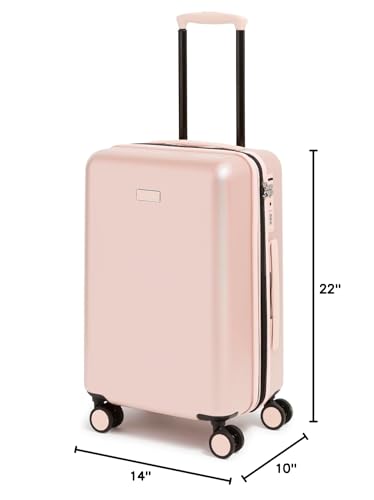
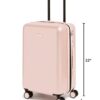
The description states carry-on compliant. The specification block gives Product Dimensions of 10 by 14 by 22 inches, and a feature bullet repeats that the case measures 22 inches high, 14 wide and 10 deep.
Setting those against each other
The commonly cited United States domestic cabin allowance is around 22 by 14 by 9 inches. This case matches the height exactly, matches the width exactly, and is a full inch over on depth.
Depth is the axis a sizer slot constrains hardest, because the bag has to go in flat, and there is no margin on the other two axes to compensate. So the phrase carry-on compliant is the maker’s claim, it is repeated here as the maker’s claim, and we are not adopting it. On the listing’s own published numbers this case does not fit the figure most travelers have in mind.
Whether it is stopped depends on the carrier. Many United States airlines do not measure unless a flight is full. Budget and regional carriers do, international carriers frequently add a cabin weight limit, and every airline publishes its own allowance. Check the one you are flying and expect the depth to be the point of failure.
There is also a 1.5 inch expansion zipper panel. Used, it takes the depth to 11.5 inches, which is 28 percent over the common figure. An expanded case here is a checked bag, and the listing does not say so.
The listing does not state whether 22 inches includes the four double wheels and the retracted handle, which on a case already over on one axis is the remaining unknown.
Capacity is published as 39 liters in both fields. Cross checking, the outer envelope of 22 by 14 by 10 inches is about 3,080 cubic inches or 50.5 liters, so a stated 39 liters sits sensibly below it and reads as a genuine usable figure.
The USB port, and the rule that governs it
The description states there is a USB port attached to the lock. This is the feature that needs the most care in this review, and the listing gives it one sentence.
Nothing here says whether a battery ships with the case, whether one is installed internally, or whether the port simply routes to a pocket where you supply your own power bank. That distinction decides whether the bag boards.
Most airlines require lithium batteries and power banks to travel in the cabin and to be removable, and bags with non removable batteries have been refused at the gate and banned outright by some carriers. If you use this port, you must be able to remove whatever powers it, and you must remove it if the case is ever gate checked, which on a full flight is a real possibility for any cabin bag. Confirm with the seller whether a battery is included and whether it comes out before flying with it. Readers who prefer a cabin case with no powered components should look across the carry-on luggage category.
Shell, wheels, lock and interior
The listing calls the shell a hard shell and never names a polymer. Not polycarbonate, not ABS, not polypropylene, not a blend. That gap matters because the three behave differently under impact: polycarbonate flexes and recovers, ABS is stiffer and cracks, polypropylene bows under load. A listing that says only hard shell is telling you nothing about how the case will fail.
The wheels are four double spinner assemblies giving 360 degree movement. Double wheels track straighter under load and roll more quietly on hard flooring than single castors. Exposed castors remain the most common failure point on any wheeled case, they are part of the measured height, and they cope poorly with gravel and cobbles.
An integrated TSA compliant lock is fitted, and the listing says it allows the case to be unlocked and inspected by security authorities without damage. That description is accurate as far as it goes and it needs the other half: the universal key that lets screeners open it has been widely reproduced, so the lock deters casual tampering and keeps a zipper closed rather than securing anything. Nothing valuable should be in the case on the strength of it.
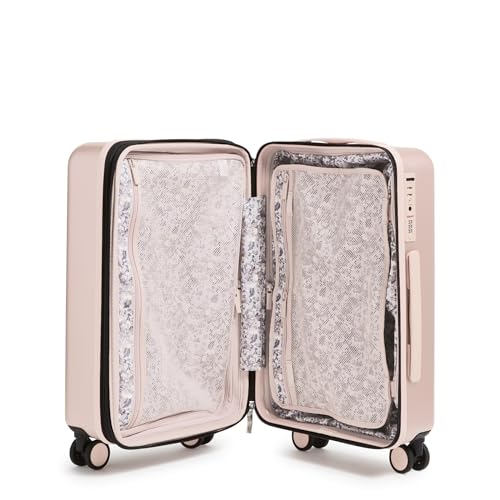
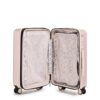
The interior is well specified for the tier. The front compartment has two elastic mesh pockets. The main compartment has a mesh zip pocket, a zip compartment, adjustable compression straps and mesh overlays. Compression straps matter on a hard case because the shell opens into two roughly equal halves and an unsecured load spills every time it is opened flat.
The lining zips out and is machine washable on a cold gentle cycle, line dried. A removable washable lining is genuinely unusual on hard luggage and it is the standout practical feature here. The shell is spot clean only. Comparable interiors appear in the Kenneth Cole Reaction Renegade carry-on and the Samsonite Virtuosa train case.
Warranty and the demand picture
No warranty term is published anywhere in this listing. No period, no scope, no exclusions. Where luggage warranties are published, lifetime and limited lifetime terms commonly exclude damage caused by airline handling.
The listing shows a 4.7 star average across 4 ratings. Four ratings is not a sample and no conclusion should be drawn from that average in either direction. It ranks 222nd in Carry-On Luggage and 138,383rd in Clothing, Shoes and Jewelry. The contents field reads no included components, and no country of origin is published. More options sit in the carry-ons category.
Who should buy it, and who should not
Buy it if you want a printed hard cabin case with a removable washable lining, double spinner wheels, compression straps and a well organized front compartment, and you fly carriers that do not measure cabin depth.
Skip it if your airline uses a sizer, because at 10 inches the published depth is an inch over the common figure before the expander is touched. Skip it too if you want a named shell polymer or a published warranty, and confirm the USB port’s battery arrangement before you fly with it.