Description
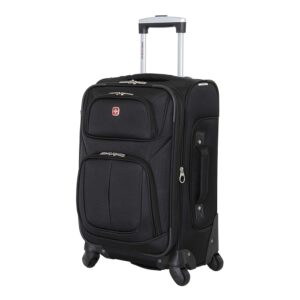
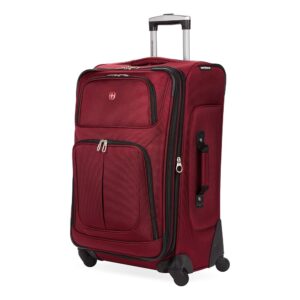
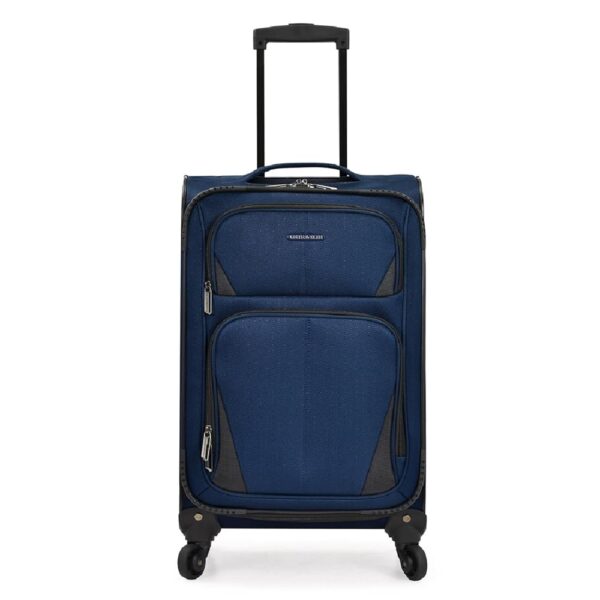
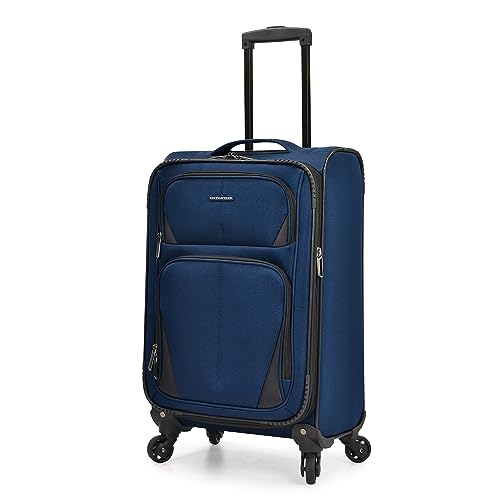
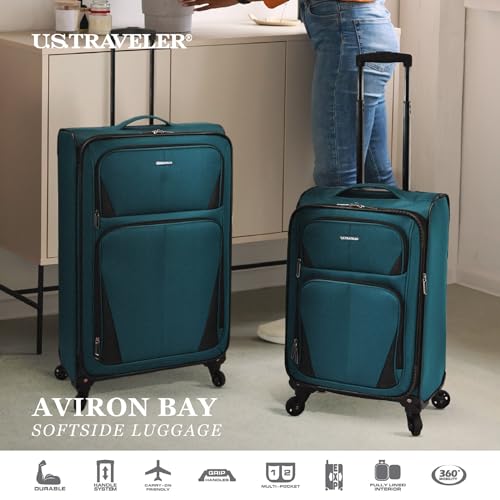
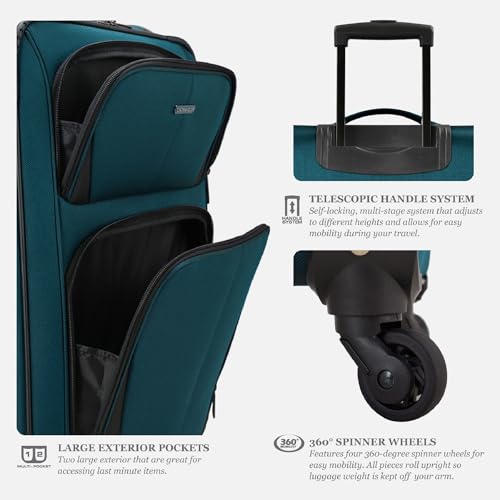
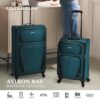
The U.S. Traveler Aviron Bay is a softside expandable spinner in twill polyester with two large exterior pockets, compression straps and top, bottom and side carry handles. The specification is sensible. The numbers are a mess. The same listing calls this a 22 inch and a 23 inch case, publishes two different heights, two different weights, two different expansion figures, and a capacity of 119.73 liters that is roughly three times what a cabin bag holds.
The traveler and the trip
A 22 inch softside expandable is a three to four day bag for one adult. The two large exterior pockets are the everyday advantage of fabric over a shell: a laptop, a passport and a boarding pass come out without opening the case. Compression straps and a full interior lining suggest a traveler who packs folded clothing and wants it to arrive flat.
Bottom carry handles deserve a mention because they are underrated and this case has one. A bottom handle is what you grip lifting a full case into an overhead bin or a car, and most cases at this price omit it. It suits leisure and short business travel. If a rigid shell is the requirement, the maker’s own U.S. Traveler polycarbonate hardside is the alternative, and the wider field sits in carry on luggage.
Dimensions, and four numbers that do not agree
The manufacturer bullet gives the exterior of the 22 inch spinner as 22 inches high by 14 wide by 8 deep, plus a 1.5 inch expansion, at 6.5 pounds, with an interior of 20 by 14 by 8 inches plus the same 1.5 inch expansion.
The product description gives exactly the same interior figures but labels them as belonging to a 23 inch spinner, and gives the exterior of that 23 inch spinner as 22.5 inches high rather than 22. The same description also says the case includes a 2 inch expansion gusset, while both dimension lines say 1.5 inches. The attribute block gives 22 by 14 by 8 inches at 5 pounds, a pound and a half lighter than the 6.5 pounds in the maker’s copy. The model code itself ends in 23.
What survives all that
The one figure every source agrees on is the footprint: 14 inches wide by 8 inches deep. The height is either 22 or 22.5 inches. The commonly cited United States domestic carry on allowance is around 22 by 14 by 9 inches, measured with the wheels on. On the 22 inch figure this case matches the height and width exactly and has a full inch of margin on depth, which is genuinely good. On the 22.5 inch figure it is half an inch over on height.
The 8 inch depth is the standout. Almost every case in this batch is at or over 9 inches deep, and depth is the axis a rigid gauge is least forgiving about. A softside at 8 inches has real room to spare there, and fabric compresses on top of that. This is one of the better positioned cases in the batch on the axis that usually causes trouble.
The interior figures repeat the exterior’s width and depth exactly, at 14 by 8 inches, which is not possible on any bag once you allow for wall thickness, lining and wheel housings. Only the two inch difference on height looks like a real measurement. And the capacity of 119.73 liters in the attribute block is simply wrong: a case with a 20 by 14 by 8 inch interior encloses about 37 liters. Disregard the capacity field entirely.
U.S. Traveler makes no explicit compliance claim in the bullets we can read, and we are not going to make one on their behalf. Measure the case standing on its wheels on arrival and check it against your carrier.
Fabric, wheels and handles
The fabric is named as durable twill polyester. Twill is a weave rather than a material, and a twill weave resists abrasion somewhat better than a plain weave at the same yarn weight because the diagonal structure spreads wear. Naming the weave is better than nothing and it is still less useful than a denier figure, which the listing does not give. Polyester absorbs water, so this is not a bag to leave on a wet ramp.
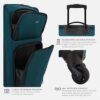
The wheels are four 360 degree spinner castors, and the maker makes the standard point that the case rolls upright so there is no weight on your arm. That is accurate on terminal flooring and misleading everywhere else. Spinner castors are small, exposed and unsprung, they judder on cobble and gravel, and they are the most common failure point on any wheeled bag. The listing does not say whether the castors are single or dual wheeled. Compare that against the recessed skate wheels on the maker’s own U.S. Traveler Rio, which survive rough ground considerably better.
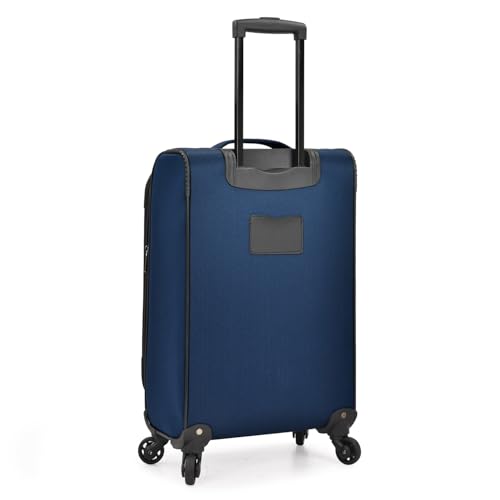
The handle is a push button multi stage unit, and multi stage means more than two heights, which is useful for travelers of different statures. Top, bottom and side grab handles are all fitted, which is a more complete set than most cases at this level offer.
Capacity, organization and the expansion
The usable capacity is not published in any reliable form. Working from the interior figure of 20 by 14 by 8 inches, the enclosed volume is roughly 37 liters, which is a normal figure for a case of this footprint. That is an estimate, not a published number, and the 119.73 liter field on this page should be ignored.
The expansion is either 1.5 or 2 inches depending on which part of the listing you read. Either way it adds depth to a case published at 8 inches, which is the one axis where this case has margin. That makes the gusset more usable here than on most expandables in this batch: even expanded by 2 inches to 10 inches deep, you are looking at a case that has traded a comfortable position for an over one, rather than a marginal one for a hopeless one. It is still a feature best used on a return leg you are prepared to check.
Organization is two large exterior pockets, a large interior zippered mesh pocket, tie down straps and a full interior lining with compression straps. Compression straps genuinely reduce the height of a packed stack rather than merely holding it flat, which is a step above the plain tie downs on cheaper cases. The Travelpro Maxlite 5 is the benchmark comparison in this format.
Warranty and the comparison set
No warranty term appears anywhere in the source data. Get the term and the exclusion list in writing before ordering, and expect airline handling damage to be excluded, as it is across essentially this entire category. On a fabric case the failures that matter are the zipper, the wheel mounts and the handle mechanism, so ask specifically what any term covers on moving parts.
If a published warranty is what decides the purchase, Samsonite states ten years against defects and Travelpro states a limited lifetime term that explicitly covers carrier damage for one year after registration. Larger cases in the same line, including the U.S. Traveler Anzio large spinner, sit under suitcases.
Who should buy it and who should not
Buy it if the 8 inch depth appeals, and it should. That single figure gives this case an inch of margin on the axis where almost every competitor in this batch is over, and the two exterior pockets, compression straps and bottom carry handle are all sensible inclusions.
Skip it if you need reliable numbers before ordering. The listing calls this both a 22 inch and a 23 inch case, gives the height as both 22 and 22.5 inches, the weight as both 5 and 6.5 pounds, the expansion as both 1.5 and 2 inches, and the capacity as 119.73 liters, which is about three times the truth. Confirm the height and weight with the seller, and disregard the capacity field entirely.