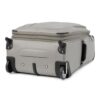
Description
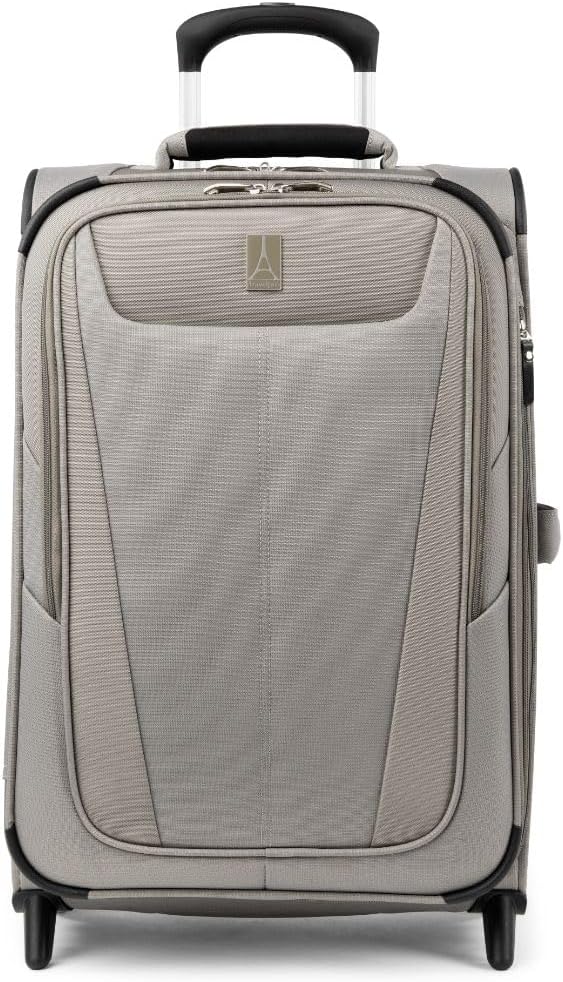
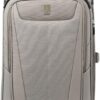
This Travelpro Maxlite 5 is the two wheel version, and that is the fact the site title omits and the one that should decide whether you buy it. Almost every cabin bag sold today rolls on four spinner castors. This one has two inline ball bearing wheels and is pulled at an angle, which is an older format with real advantages and one obvious drawback. It is also the reason this case holds 52 liters where the four wheel version of the same bag holds 46.
The traveler and the trip
Fifty two liters at 5.4 pounds is a five day bag for one adult, and it is one of the best volume to weight ratios on this site. The buyer is someone who has decided that spinner castors are a liability rather than a convenience, or who wants the maximum packing space from a cabin sized footprint.
Two wheel cases suit travelers who cross rough ground: cobbled streets, gravel, broken sidewalk, train platforms. Inline skate wheels are larger, they are recessed into the body, and they roll over surfaces that stop a spinner castor dead. They also survive being dragged, which is what actually happens to luggage.
The drawback is that you cannot push the case upright beside you through a terminal. If that is how you like to move, the four wheel Travelpro Maxlite 5 spinner is the same bag with castors, six liters less volume and the same weight. Other four wheel options include the Travelpro Platinum Elite, and the wider field sits in carry on luggage.
Dimensions, and the label the listing cannot settle
Travelpro publishes both figures and labels them. Case dimensions are 21 by 14 by 9 inches. Overall dimensions, stated to include the wheels and carry handles, are 23 by 14.5 by 9 inches. The attribute block gives 9 by 14.5 by 23 inches, the same overall figure in a different order.
The manufacturer title calls this a 22 inch carry on. The four wheel version of the same bag, with identical case dimensions of 21 by 14 by 9 inches, is sold as a 21 inch. Two products with the same measured case, one labelled 21 inch and one labelled 22 inch, is a marketing decision rather than a difference in the product.
Reading the overall figure against a sizer
An airport sizer measures the overall figure. The commonly cited United States domestic carry on allowance is around 22 by 14 by 9 inches. This case is a full inch over on height, half an inch over on width, and exactly at the limit on depth. Travelpro’s bullet says the case meets carry on size restrictions for most domestic airlines, which is hedged with the word most, and we are not going to restate it as a guarantee.
The one advantage of a softside here is genuine: fabric compresses in a sizer where a hard shell cannot, so a fabric case that is nominally an inch over frequently goes in. That is a property of the construction, not a promise. The two wheel format helps too, because the wheels are recessed rather than protruding, which is part of why the depth stays at 9 inches while the four wheel version of the same case measures the same 9 inches but loses interior volume to castor housings.
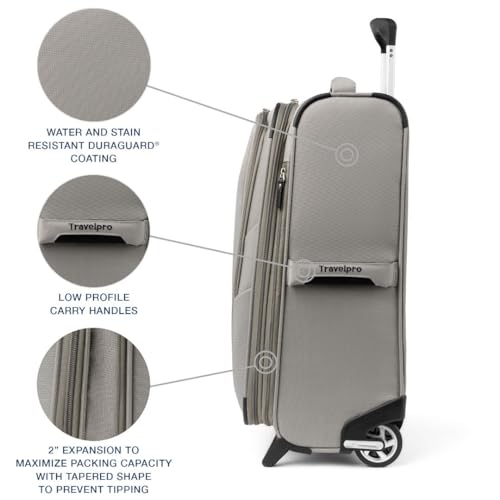
The case expands up to 2 inches, and the listing is clear elsewhere in the range that a fully expanded carry on may not meet airline restrictions. Take that at face value.
Fabric, wheels and handle
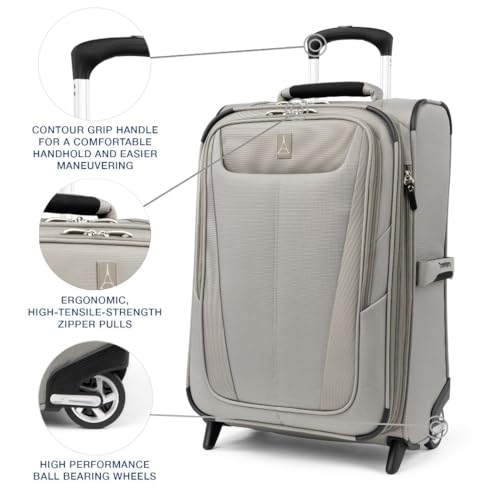
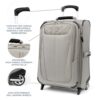
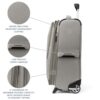
The fabric is polyester with a stain resistant, water repellent Duraguard coating. Naming the coating is better than most listings manage. A coating is not waterproofing, so a case left on a wet ramp will eventually take on moisture, but it does mean spills bead rather than soak and dirt brushes off. The zipper pulls are described as high tensile strength and ergonomic, and the zipper is the weak point on any case that has one.
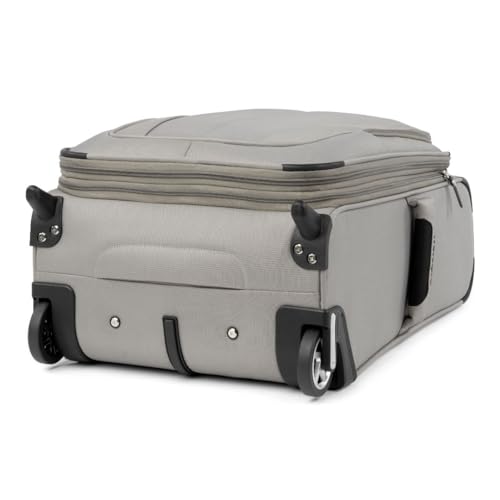
The wheels are high performance ball bearing inline skate wheels. Ball bearings matter here: a sealed bearing rolls under load far longer than a plain bushing, and the larger diameter of an inline wheel means it clears thresholds and expansion joints that stop a small castor. This is the wheel format that survives, and it is the strongest argument for this case over its spinner sibling.
The handle is the PowerScope Lite, locking at 38 inches and 42.5 inches with a contoured grip. Two stops is fewer than the multi stage handles on some competitors, but 42.5 inches suits most adults and the light assembly is part of how the case reaches 5.4 pounds. Low profile top, side and bottom carry handles are included, and the bottom handle is what you grip lifting a full case into an overhead bin.
The body is tapered rather than square, which Travelpro says prevents tipping. On a two wheel case that is a real consideration, because a two wheel bag stands on its wheels and its rear feet rather than on four points, and a top heavy load will topple it.
Capacity, organization and the weight
Fifty two liters is the headline. For comparison, the four wheel version of the same case publishes 46 liters from identical case dimensions. The six liter difference is the castor housings, which intrude into the bottom corners of a spinner and take volume that an inline wheel recessed into the body does not. If packing volume is your constraint, two wheels are strictly better.
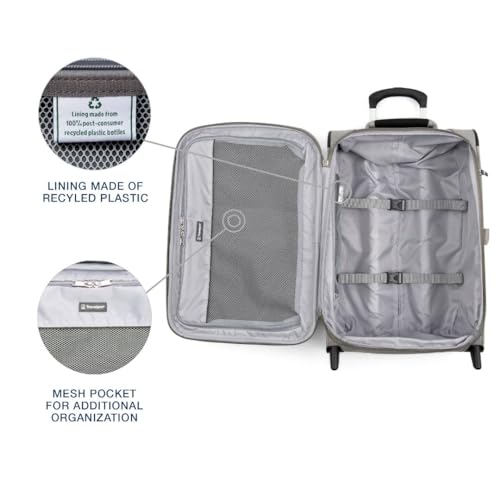
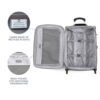
Organization is two exterior compartments, a full length interior lid pocket, a side accessory pocket and adjustable hold down straps. The two front compartments are the everyday advantage of a softside: a laptop, a passport and a boarding pass come out without opening the case. Hold down straps keep a packed side flat; they do not compress the way a purpose built panel does.
At 5.4 pounds this is among the lightest cabin cases on this site, matching its four wheel sibling exactly. That is slightly surprising, since a two wheel case usually weighs less than the same bag on castors, and it suggests the larger inline wheels and their bearings offset the saving. Either way, 5.4 pounds is a strong number on any carrier that enforces a cabin bag weight limit.
The warranty, read carefully
Travelpro states Limited Lifetime Coverage plus a trusted companion promise, and specifies that the promise covers the cost of repair for damage from an airline or other common carrier for one year, applicable when purchased new and after registration.
Read those two clauses together. The lifetime element is a defects warranty against faults in materials and workmanship. The airline handling element, which is the damage that actually happens to luggage, runs for twelve months and requires you to register the bag. That is a better deal than the category norm, because most competitors exclude carrier damage entirely, and Samsonite’s ten year term on cases like the Winfield 3 DLX is silent on it. It is not a lifetime guarantee against baggage handlers.
Register the bag the day it arrives, because the twelve month window starts running. Larger cases in the same line sit under suitcases.
Who should buy it and who should not
Buy it if you want maximum packing volume from a cabin footprint, you cross rough ground, and you would rather have two large ball bearing wheels than four small castors. Fifty two liters at 5.4 pounds with a published lifetime defects warranty and one year of carrier damage cover is a strong package.
Skip it if you want to push a case upright beside you, because two wheels do not do that. Skip it too if your airline uses a rigid gate sizer, because at an overall 23 by 14.5 by 9 inches this case is over the common 22 by 14 by 9 allowance on height and width. And be aware that the 22 inch in the product name describes the same case that the four wheel version calls 21 inch.