Description
Who this Wrangler Astral is aimed at
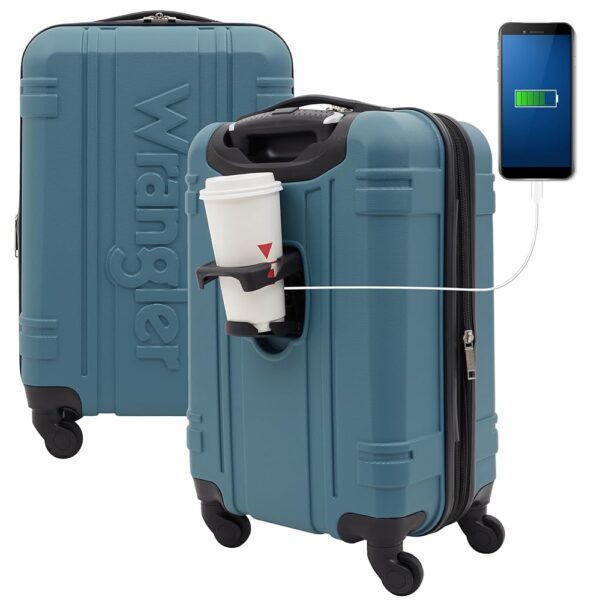
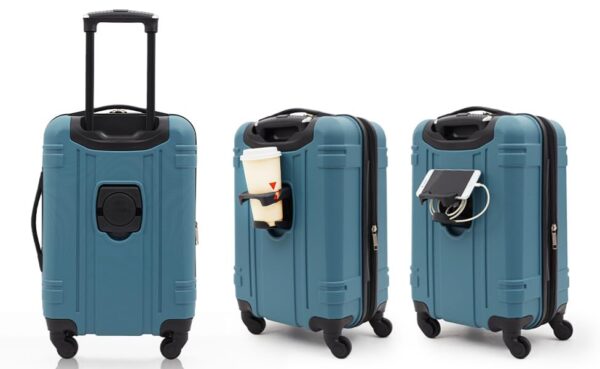
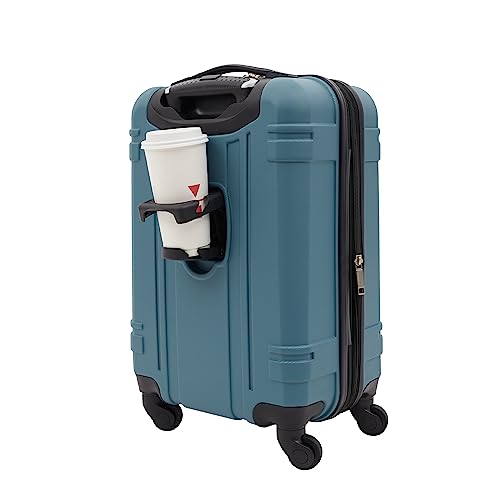
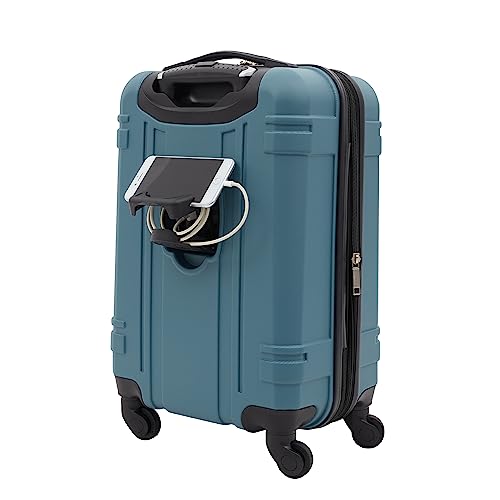
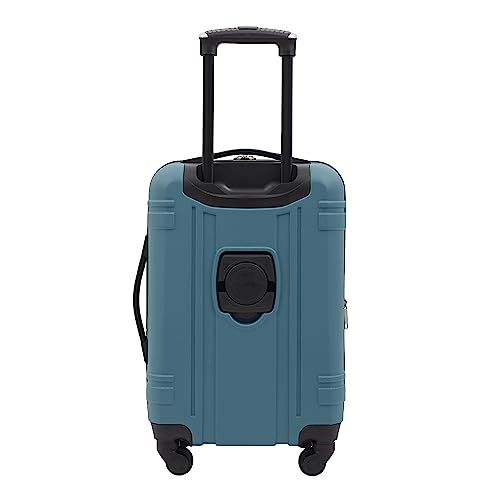
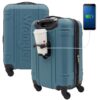
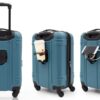
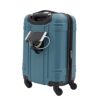
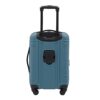
This is a hard shell cabin case with a three in one fitting on the back: a cup holder, a phone holder and a USB port. That combination points at a specific traveler, the one who spends time standing in terminals with a coffee in one hand and a phone in the other, and who has decided the bag should carry both.
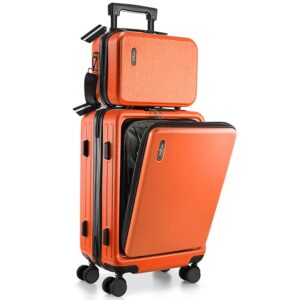
It is a convenience purchase rather than a durability one, and the specification below bears that out. The trip is three to five nights. A plainer hard shell from the same manufacturer is the Wrangler hardside spinner, which weighs nearly three pounds less, and the gadget forward alternative is the UrbanExplorer zipperless carry on.
Dimensions, and what the back fittings do to them
The specification block gives 14.5 by 9.5 by 22 inches. Against the size guideline most commonly cited for United States domestic cabin baggage, roughly 22 by 14 by 9 inches, that is exactly at the height limit with no tolerance, half an inch over on width and half an inch over on depth.
The cup holder is part of the measurement problem
Nothing on the listing says whether the 9.5 inch depth includes the cup holder and phone holder mounted on the back panel, or whether it is a shell measurement taken before those were added. On a case where the distinguishing feature physically protrudes from the back, that is not a small omission. A sizer measures the object as it stands, fittings and all.
Nor does the listing say whether the wheels are included in the 22 inch height. On a hard shell the casters bolt outside the shell, so if 22 inches is a shell figure the object a gate agent measures is taller than the commonly cited limit before you consider anything else.
We will not write that this case is airline approved and the listing does not claim it. Check the allowance published by the carrier and fare you booked, note that budget and regional carriers are frequently stricter than the majors and that many international carriers add a cabin weight limit, and measure the case on arrival including the back fittings. A rigid shell does not compress into a sizer the way a soft bag does.
The shell, the wheels and what is not described
The largest gap on this listing is the shell material. The case is called a sturdy hardside shell and a durable hardside shell, and the polymer is never named. On a hard shell that is the product. Polycarbonate flexes under an impact and returns to shape. ABS is cheaper, lighter and more brittle, and stars or cracks at a corner. A blend behaves between the two. At 8 pounds empty for a 20 inch nominal case, this is heavy enough that the weight is going somewhere other than the shell, so the material question is genuinely open. Ask before ordering.
The wheels are described as a 360 degree four wheel system with no material, mounting or bearing detail. Four spinner casters roll sideways easily on smooth terminal floors, catch and tip on curbs and cobblestone, and are the most common failure point on any wheeled case because they take the impact on every drop. There is no expansion described, which means the case cannot be pushed further out of a sizer but also cannot absorb what you bought on the trip.
Top and side carry handles are fitted, which is what you want when lifting a case into a bin from an awkward angle. The telescoping handle is not described at all: no stage count, no extended height, no tube material.
No lock and no lock provision is described anywhere on this listing. No zipper brand or type is given either, and there is no interior description beyond the general claim of protection. For a case at this price with this many gadget features, the underlying luggage specification is thin.
The USB port, and the question the listing does not answer
The three in one back fitting is the reason to buy this case, and the USB port is the part that needs care. Nothing anywhere on this listing states whether a battery is included, whether it is removable, or whether the port is wiring only with the power bank supplied by you.
That matters, and it is the most important unanswered question on the page. Most airlines require lithium batteries and power banks to be removable and carried in the cabin rather than in the hold, and luggage with a sealed in, non removable battery has been refused at the gate by carriers enforcing that rule. The overwhelmingly likely arrangement here is that the port is wiring only and you supply the bank, which is standard across this category and carries no restriction. But likely is not the same as confirmed.
Ask the seller directly before ordering: is there a battery in the case, and if so can it be removed. If the answer is that a battery is fitted and sealed in, treat the case as a gate risk on any carrier enforcing lithium rules. Whatever the answer, carry any power bank in the cabin, never in a checked bag, and confirm the watt hour limit your airline publishes.
The cup holder and phone holder carry no such caveat. They are a bracket and a clip, and the only thing to note is that a cup of coffee on the back of a case is stable while the case is upright and stationary and considerably less so while it is being pulled.
Capacity, weight and the alternatives
The capacity field reads 0.24 liters. That is not a suitcase; it is roughly the volume of a coffee cup, which is an accidental irony on a case with a cup holder. Both capacity fields carry the same broken value. No usable capacity figure is published anywhere on the listing.
Work from the exterior instead: 22 by 14.5 by 9.5 inches is roughly 3,030 cubic inches, or about 49.7 liters of envelope, and a rigid case typically loses a fifth to a quarter of that to structure, which points at something in the high thirties of usable liters. That is an estimate rather than a published figure, and the back fittings will take a further share.
Weight is 8 pounds empty, published consistently in two fields. That is heavy for a 20 inch nominal cabin case and nearly three pounds above the plainer hard shell from the same manufacturer. The gadget fittings and their mountings are where the difference goes. On United States domestic routes cabin bags are not weighed. On budget European and many Asian carriers, where the allowance is 7 or 8 kilograms and enforced at check in, eight empty pounds takes more than half the limit before you pack, which is a serious constraint on those routes.
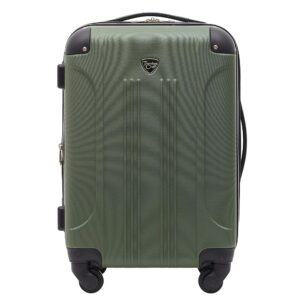
No warranty term appears anywhere on this listing. No period, no coverage, no exclusions, and nothing about airline handling damage. On a case with electrical fittings that omission covers more than it would on a plain shell. The review base is 4.6 from 932 ratings with a rank of 33rd in its Amazon carry on luggage category, which is a usable pool; read the one and two star reports for comments about the back fittings and the wheels specifically. A cheaper, lighter and much more heavily reviewed alternative is the Travelers Club Chicago hardside spinner. The wider field sits in our carry-on luggage and carry-ons sections.
Who should buy it and who should not
Buy it if the cup holder and phone holder are things you would genuinely use, you fly United States domestic routes where cabin bags are not weighed, and you have confirmed the battery arrangement with the seller. Skip it if you fly anywhere the cabin bag goes on a scale, because eight pounds empty is a lot, and skip it if you need to know what the shell is made of, because the listing never says. Measure the case including the back fittings before your first flight, and ignore the 0.24 liter capacity field.