

Description
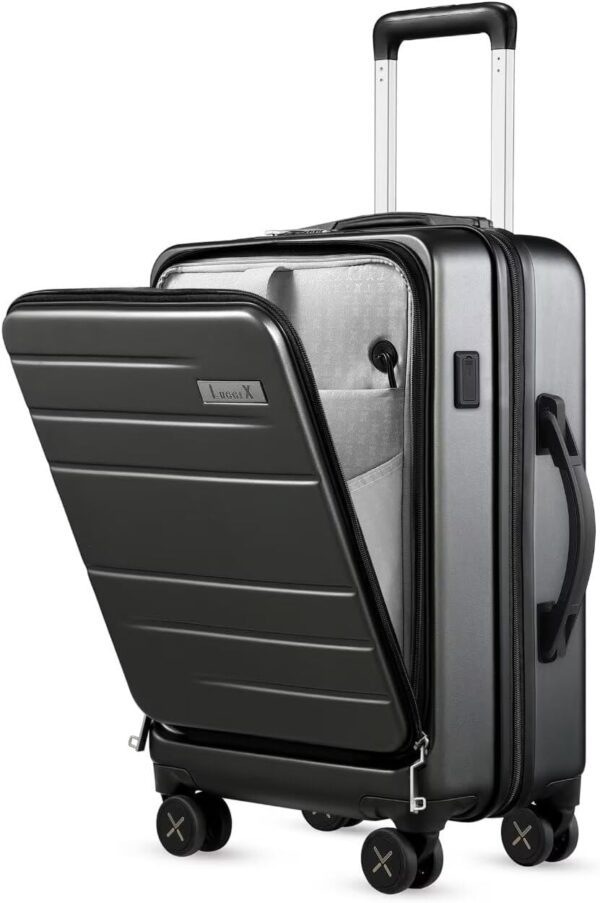
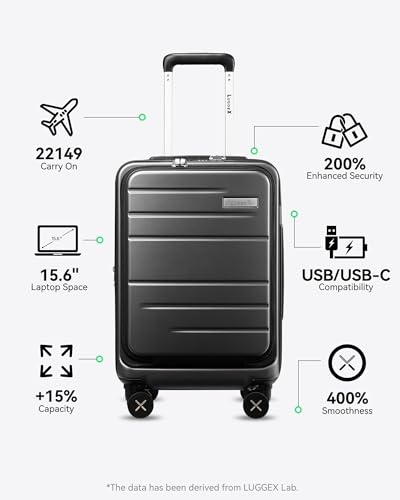
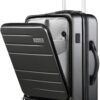
The LUGGEX FLO3 is a 20 inch polycarbonate case in charcoal metallic with a front pocket sized for a 15.6 inch laptop, USB and USB-C ports, and no expansion section. Its first bullet is one of the best disclosures in this catalog, giving external and internal dimensions with the basis stated for each. Its capacity fields, however, disagree by a factor of nearly three.
The disclosure that works, and the field that does not
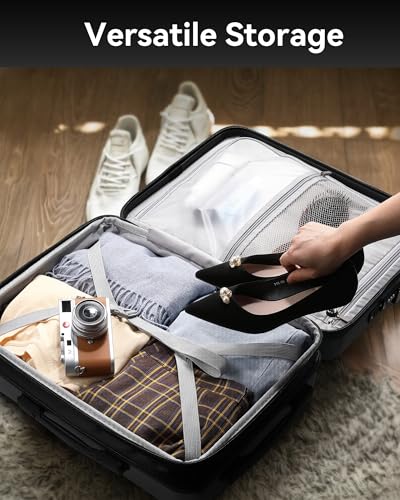
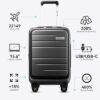
The first bullet reads as a specification sheet rather than advertising: not expandable, external dimensions including wheels and handles of 22 by 14.5 by 9.3 inches, internal dimensions of 18.3 by 13.1 by 9 inches, weight 7.7 pounds, capacity 35 litres. Labelling both boxes and saying which includes the wheels is exactly what a cabin bag listing should do.
Against that, the capacity fields on the same page publish 35 litres in one and 98 litres in the other. Ninety eight litres is a large checked bag volume, roughly three times this case, and it is not physically possible in a box measuring 18.3 by 13.1 by 9 inches, which is about 2,157 cubic inches or 35.3 litres. The bullet figure and the geometry agree with each other at 35 litres, so the 98 litre field is simply wrong, and it appears to be data bled in from another product. We are naming it rather than quietly using the better number, because a buyer comparing on the capacity total field would be badly misled.
Size against the allowance, and the title keyword
The product title carries the string 22x14x9 Airline Approved, and the third bullet says the case meets the 22x14x9 airline approved dimensions. Neither is a measurement of this bag: the same listing measures it at 22 by 14.5 by 9.3 inches including wheels and handles.
Against the roughly 22 by 14 by 9 inch convention most United States domestic carriers apply, that puts the case exactly at the limit on height, half an inch over on width and three tenths of an inch over on depth. Small overages, but over on two axes nonetheless, and the 22x14x9 in the title is the allowance restated as a keyword rather than a specification.
We are not going to write that this bag is airline approved. There is no general approval for luggage: every carrier publishes its own cabin allowance, budget and regional operators are frequently stricter, and international carriers commonly enforce a cabin bag weight limit alongside the size limit. Check the 22 by 14.5 by 9.3 inch figure against the airline you are actually flying.
One genuine point in the case favour: the first bullet states plainly that this is the not expandable version. A case with no expansion is one whose size does not change on the return leg, and expansion is the most common way a compliant cabin bag stops being compliant. That is a design decision worth crediting, and it means the 35 litres you are told about is the 35 litres you get.
The front pocket, and the charging ports
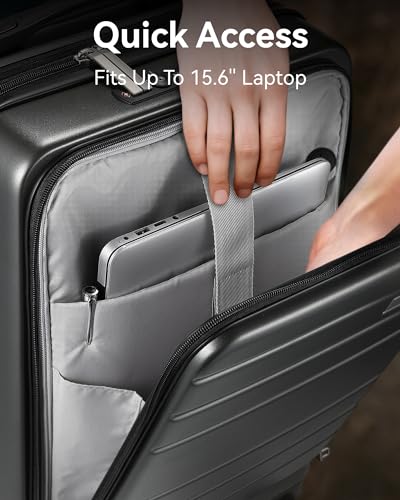
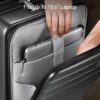
The front pocket is the reason to choose this over a plain shell. A hardsided front compartment that opens separately for a 15.6 inch laptop means reaching a machine at a security table without opening the main case, which is the difference between a smooth screening and a slow one. Very few rigid cases at this size offer it, and the CAARANY aluminum frame carry-on is one of the few others in this catalog that does.
The fifth bullet describes built in USB and USB-C ports and adds a caveat that is unusually candid: the ports have been tested to work with Apple original cables, and some other cables may not work due to protocol issues. Publishing a known compatibility limitation rather than hiding it is genuinely rare, and it is exactly the sort of detail a buyer would otherwise discover on a plane.
What the bullet does not say is whether a battery is included, whether one is required, or whether any battery fitted can be removed. That omission matters. Lithium batteries are not permitted in the hold on the great majority of carriers, and airlines have refused boarding to bags whose batteries could not be taken out. Establish before you fly whether this is a pass through fed by your own power bank, which is unproblematic because you can always remove the battery, or an integrated system, which is a boarding risk. Other listings handle it properly: the KROSER hardside carry-on states outright that the power bank is not included.
Shell, weight and what is not described
The shell is named as polycarbonate, described as lightweight and durable against time and impact. Pure polycarbonate is the better of the two mainstream hard shell plastics: it flexes under load and returns rather than cracking, which is why it survives being at the bottom of a stack, and it sheds water. Its weaknesses are scuffing, which a metallic finish will show, and corner cracking after a genuinely hard impact.
Weight is published consistently at 7.7 pounds in both fields and repeated in the bullet. For a polycarbonate case with a separate front compartment and charging hardware that is reasonable rather than light, and it is a pound heavier than several plain shells at this size, including the Tilymol TLM102 at 6.93 pounds. Empty weight counts twice on a cabin bag: it eats any enforced allowance, and it is what you lift.
The support plan, the record, and the alternatives
The sixth bullet offers what LUGGEX calls a comprehensive support plan for three years, with a promise that its team responds within twelve hours. A stated three year period is better than the silence many listings offer, and the response time commitment is at least specific enough to hold someone to.
Read the wording carefully, though. A support plan is not a warranty document. Nothing states what failures are covered, whether repair or replacement is offered, or what is excluded. On luggage the exclusion that matters is airline handling damage, which is the damage that actually happens, and it is carved out even from many written warranties. Three years of support with no defined scope is a customer service posture rather than a commitment you could rely on.
Buyer feedback runs to 516 ratings at an average of 4.5 out of 5, with the case ranked 68th in Carry-On Luggage and 37,993rd in Clothing, Shoes and Jewelry. That is a reasonably deep pool and a good average. Manufacturer is LuggeX Luggage, model FLO3_GBK20, and no country of origin is published. Within the brand, the LUGGEX LTB2 carry-on is the close relative. The wider field sits in the carry-on luggage category and the carry-ons category.
Who should buy it, and who should not
Buy it if the front laptop pocket solves a daily problem, you want a case whose size does not change because there is no expansion, and you value a listing that labels its internal and external dimensions properly. Do not buy it if your carrier enforces the 14 inch width and 9 inch depth strictly, because the inclusive figures run over both. Ignore the 98 litre capacity field entirely, treat the three year support plan as a service posture rather than a warranty, and establish the battery arrangement before you fly with the ports.