Description
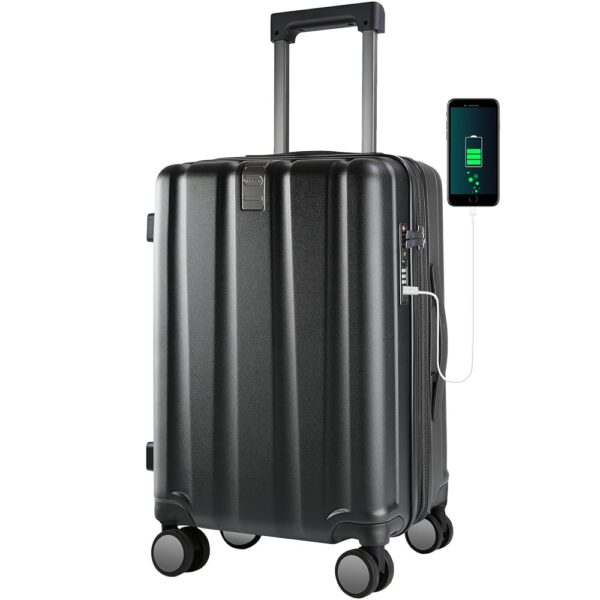
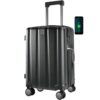
The KROSER hardside expandable carry-on is a 20 inch polycarbonate spinner with a built in USB pass through port, a TSA combination lock and a reverse coil zipper. The USB port carries boarding rules that a traveler needs to understand before flying, and the published dimensions sit marginally over the common cabin convention on two axes. Both are dealt with below.
The trip and the traveler this suits
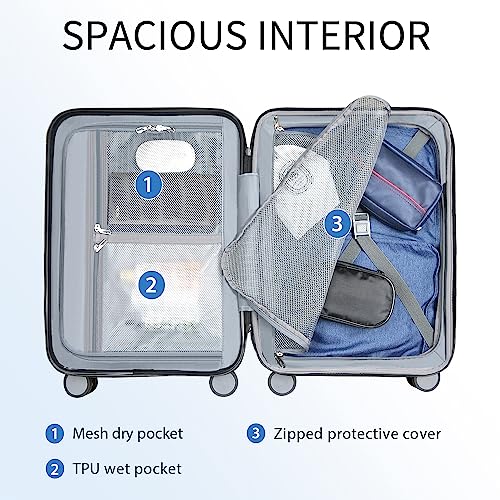
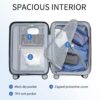
This is a case for short trips and business travel where a phone running flat matters. The interior is well divided for that use: a main compartment with cross straps, a waterproof compartment for toiletries and a U frame zippered compartment described as being for privacy. Keeping wet items away from clothes is the most useful thing a suitcase interior does, and having a separate closed section for anything you would rather not display at a security table is a sensible second.
The USB port, and the battery rules that come with it
The second bullet is precise and the precision matters: the built in USB port charges a phone from a connected power bank, and the power bank is not included. That means this is a pass through port routing a cable from a battery you supply inside the case to a socket on the outside, not an integrated power system.
That distinction is the entire regulatory question on so called smart luggage. Lithium batteries are not permitted in the hold on the great majority of carriers, and airlines have refused boarding to bags whose batteries could not be removed. Because this design takes a removable power bank rather than a built in one, you keep the ability to comply: take the power bank out and carry it in the cabin with you if the case is ever gate checked or checked. What you must never do is leave a power bank inside a bag that goes into the hold. Check your airline rules on portable chargers, including their watt hour limits, before you fly, because those limits vary between carriers and are enforced.
Dimensions, and where the margin runs out
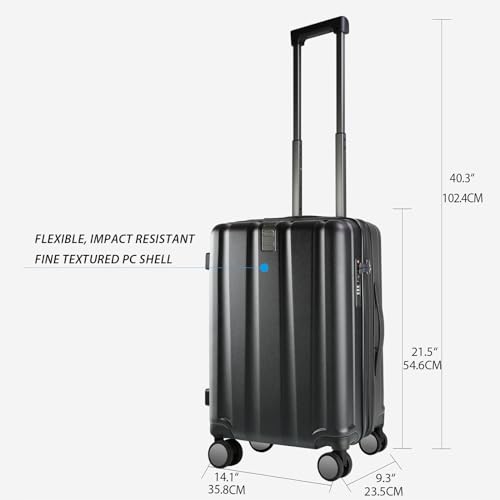
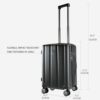
The specification block gives 21.5 by 14.1 by 9.3 inches, and the first bullet gives the same three figures with the useful addition that they include the wheels and handles. Agreement between a structured field and a maker bullet, with the inclusive basis stated, is better disclosure than most listings in this catalog manage, and it means the number you measure is the number you were given.
Against the roughly 22 by 14 by 9 inch convention that most United States domestic carriers apply, this case clears on height by half an inch, exceeds on width by a tenth of an inch, and exceeds on depth by three tenths of an inch. Those overages are small. On a forgiving sizer they pass, and on a strict frame they do not.
The claim in the bullet, and the expansion
The first bullet says the case fits in most airline overhead compartments and describes it as airline approved. That is the claim of the maker and we are attributing it rather than repeating it. There is no general airline approval for luggage. Every carrier publishes its own allowance, budget and regional operators are frequently stricter than the mainline convention, and international carriers commonly enforce a cabin bag weight limit as well as a size limit. Take 21.5 by 14.1 by 9.3 inches and check it against the carrier and route you are actually flying.
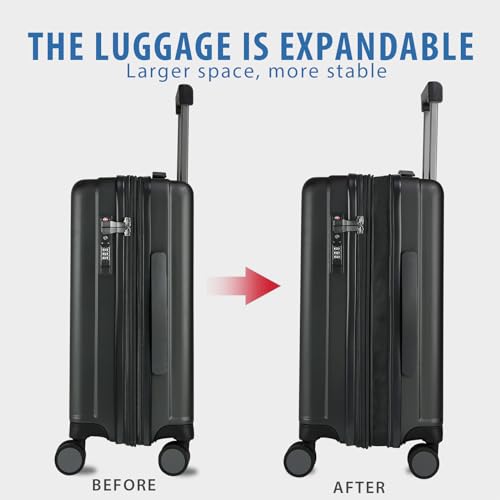
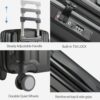
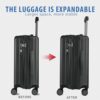
The bullet also states that the luggage is expandable, without giving a figure for how much. That omission matters more here than it would elsewhere, because the case already sits three tenths of an inch over the common depth convention closed. Expanded depth is measured depth, so any expansion pushes it further past the axis that carry-on frames are least forgiving about. Use the expansion on a leg where the bag is going into the hold.
Shell and lock
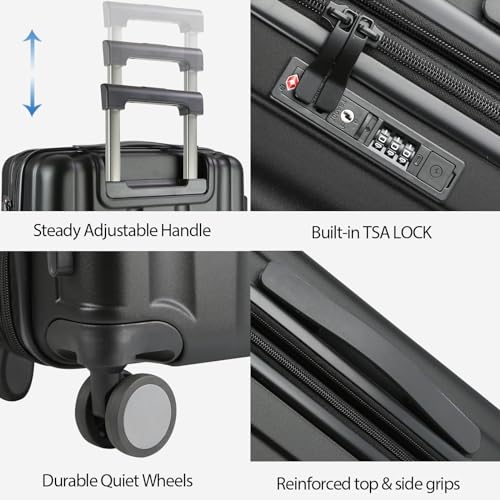
The shell is named as 100 percent polycarbonate, described as solid and scratch resistant. Naming the polymer is worth having, and pure polycarbonate is the better of the two mainstream hard shell plastics. It flexes under load and returns rather than cracking, which is why it survives being at the bottom of a stack, and it sheds water. Its weaknesses are scuffing, which is cosmetic, and cracking at a corner after a genuinely hard impact.
The lock is a TSA approved combination lock. It keeps the case shut and lets a screener inspect without cutting anything. It is not security: TSA locks open to a universal key held by a great many people, and any zippered case can be split with a ballpoint pen and pressed closed again. Treat it as a deterrent, and keep nothing you would mind losing in a bag you may be forced to gate check.
Capacity, weight and a shared chassis
Capacity is published as 36 liters in both capacity fields with no internal disagreement. Against an external box of 21.5 by 14.1 by 9.3 inches, which is roughly 2,820 cubic inches or 46 liters, a 36 liter interior leaves a plausible allowance for shell walls, wheel wells and the handle housing. That is a capacity figure that survives a sanity check, which is not something every listing here manages.
Weight is 7.04 pounds in one field and 7 pounds in another, which agree. That is on the heavier side for a 20 inch polycarbonate case, and empty weight counts twice: against any enforced cabin weight allowance, and against your own arms at the bin.
Worth knowing before you compare prices: the EMPSIGN carry-on in this catalog publishes identical dimensions of 14.1 by 9.3 by 21.5 inches, an identical 7.04 pound weight, an identical 36 liter capacity and bullet text that matches word for word in places. These are almost certainly the same case from the same factory under two brand names. That is normal in luggage and not a defect, but it means a choice between them is a choice of finish, price and after sales contact rather than of engineering.
Warranty, the record, and the alternatives
No warranty is published. No term, no coverage description, no exclusions. On a case with an expansion mechanism, a USB pass through, a lock and four casters, that is no stated commitment on any of the parts that fail. Airline handling damage is the damage luggage actually suffers and it is routinely excluded even where warranties exist, so with none published the realistic fallback is the retailer return window.
Buyer feedback runs to 417 ratings at an average of 4.4 out of 5, with the case ranked 47th in Carry-On Luggage and 35,204th in Clothing, Shoes and Jewelry. Country of origin is China. Within the brand, the other KROSER hardside expandable carry-on is the close relative and the KROSER underseater is the personal item option. For another bag with a USB pass through, the Samsonite underseat spinner takes the same approach at a smaller size. The wider field sits in the carry-on luggage category and the carry-ons category.
Who should buy it, and who should not
Buy it if you want a polycarbonate cabin bag with a reverse coil zipper and a USB pass through you will actually use, and you understand that the power bank is yours to supply and yours to remove. Do not buy it if your carrier enforces the 14 inch width and 9 inch depth strictly, because the published figures exceed both, and do not expand it on a leg you intend to carry on. Do not expect a warranty, because none is published, and know that the same case is sold under at least one other brand.