Description
The traveler this Stratum 2.0 is aimed at
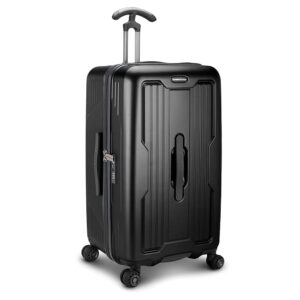
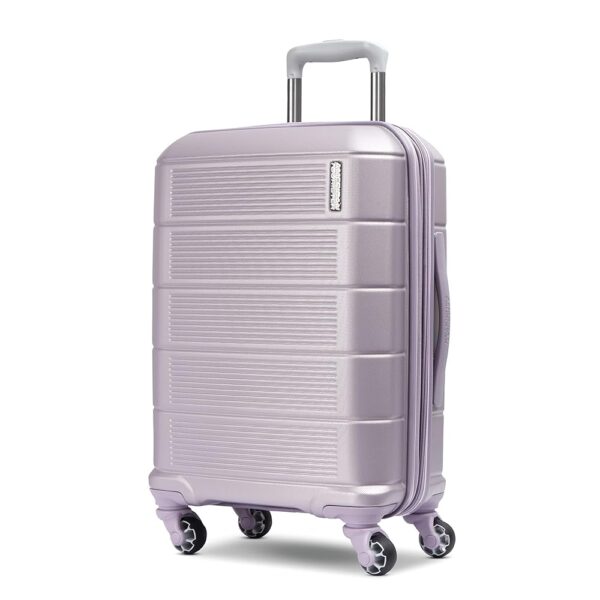
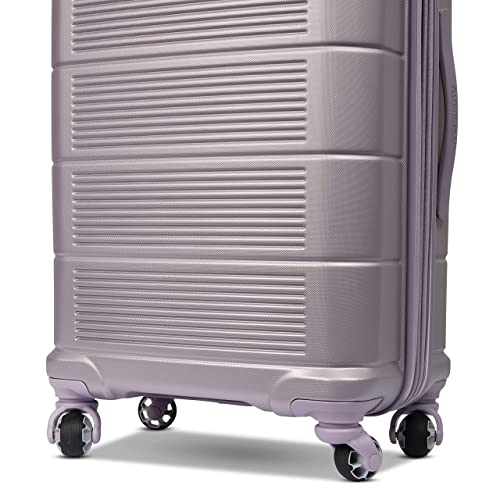
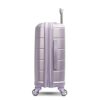
American Tourister positions the Stratum 2.0 as a design led cabin case: a barrel shaped ABS shell with a metallic finish, a textured trolley grip, and the sort of detailing that photographs well. The maker suggests it for one to three day trips, and that is an honest framing. This is a short trip bag for someone who wants a rigid shell from a recognized brand and cares how it looks coming off a belt.
American Tourister is Samsonite’s value brand, which is useful context: you are getting a large company’s manufacturing and distribution behind a product built to a mainstream price rather than a premium one. The country of origin on this listing is recorded as Cambodia rather than the China that appears on almost everything else in this catalog, which is a small but genuine point of difference in supply chain.
Dimensions, and two axes over the common benchmark
The listing publishes one dimension set: 15 by 9.5 by 22 inches. It does not say whether the wheels and the retracted handle are inside that figure, which is the standard omission here and a consequential one, because if they are excluded the real numbers will be larger.
Set against the commonly cited United States domestic cabin allowance of roughly 22 by 14 by 9 inches with wheels and handles counted, this case is exactly at the limit on length at 22, one inch over on width at 15, and half an inch over on depth at 9.5. A sizer is a box, and a bag has to clear every dimension, so margin on one axis does not offset excess on two others. Whether that becomes a problem depends on the carrier, the aircraft and how strictly the gate is being run, and low cost and regional carriers publish tighter figures than mainline domestic ones. We never write that a bag is airline approved, because the limit belongs to the airline.
The expansion makes it conditional again
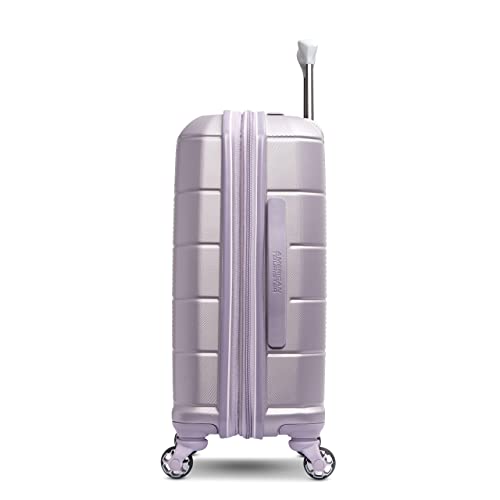
The maker states that all cases in this range expand, though the figure in the source data is truncated after the numeral one, so the amount is unclear. It is most likely an inch or an inch and a half. What is clear is the principle: an expandable cabin case is a cabin case only while the expansion is closed. Opening it adds depth, takes the bag outside whatever figure it was measured at, and a gate sizer does not care that it collapses again. On a case already over on two axes, the expansion is best regarded as a checked bag setting.
Shell, wheels, handle and interior
The shell is named as textured shiny ABS. Naming the polymer is useful, and the honest description is this: ABS is the cheapest of the common suitcase plastics, it is stiff and light, it takes a metallic finish and a molded barrel shape beautifully, and it cracks rather than flexes when a corner takes a heavy impact under load. Polycarbonate is the polymer that deforms and springs back. On a cabin bag that lives in an overhead bin rather than under a container load, ABS is a defensible economy, and the barrel shape with beveled detailing genuinely does add stiffness compared with a flat panel. The textured finish also hides fine scuffing that a plain gloss shell shows within a trip, which is the practical benefit of the styling rather than just a look.
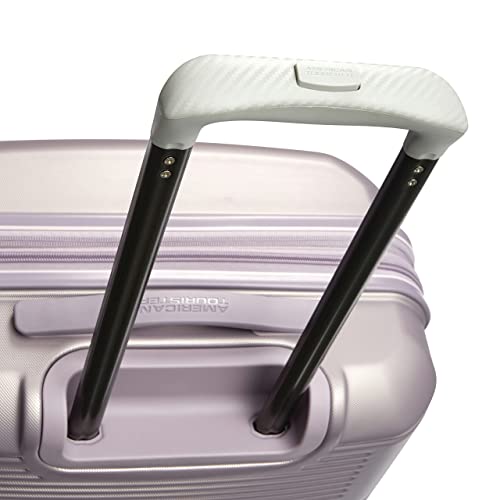
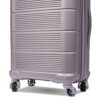
The wheels are described as a wear and tear tested ball wheel, delivering stability and comfort. No count is given, though the product is sold as a spinner, so four casters is the reading. Spinner casters move easily on smooth terminal floors and badly on cobbles, gravel and curb cuts, they are exposed, they add to the measured depth at a sizer, and they are the most common single failure point on hardside luggage. The handle is an ergonomic trolley grip with a carbon fiber texture that adjusts to height. Carbon fiber texture means a surface finish rather than a carbon fiber component, and it is worth being clear about that.
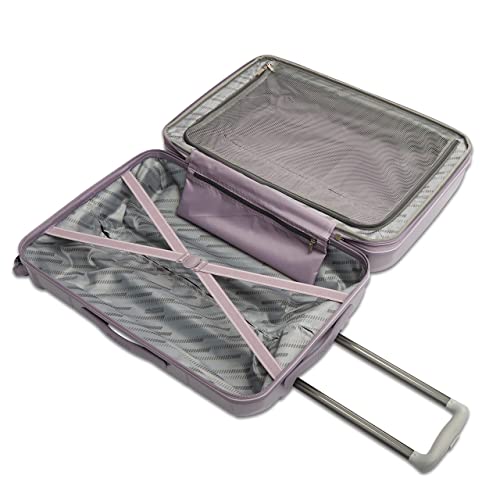
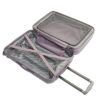
Inside there is a maximum capacity interior with a modesty pocket, a mesh door pocket and elastic tie tapes, plus large zipper pulls that the maker notes are easier to grip. Large pulls are a small detail that matters more than it sounds if you have limited hand strength or are wearing gloves. No lock of any kind is described anywhere on this listing, TSA recognized or otherwise, which is worth stating plainly rather than assuming.
Capacity, weight and a unit problem
Capacity is published as 3,135 cubic inches in both fields. That is roughly 51 liters, but the listing never converts it, and cubic inches is an unusual unit in a category where nearly every competitor publishes liters. Comparing this case against others therefore requires arithmetic the maker should have done. Fifty one liters is generous for a cabin sized case and it is consistent with the dimensions being over the usual benchmark on two axes: the extra volume has to come from somewhere.
The empty weight is 7.28 pounds, restated as 7.3, so the listing agrees with itself. That is on the heavy side for a 20 to 22 inch cabin case, noticeably above the four to six pound figures elsewhere in this catalog. On a carrier that caps cabin baggage at 7 kilograms, an empty case at 7.3 pounds consumes about 47 percent of the allowance before you pack a shirt, which is the constraint that catches travelers out on international and low cost tickets far more often than the linear dimensions do. On United States domestic tickets where cabin bags are not weighed, it costs you only effort.
Warranty, standing and the alternatives
No warranty term appears anywhere in the source data for this product. American Tourister publishes warranty terms on its products generally, but this listing records neither a length nor a coverage description nor an exclusion list. On luggage the question worth asking is specific: whether damage caused by airline handling is covered, since that is the damage bags actually suffer and the exclusion luggage warranties most often carry. Ask before ordering.
The listing shows 4.5 stars from 1,709 ratings and a position of tenth in the suitcases chart. That is a good score on a reasonable base. Within the same brand, the American Tourister 4 KIX 2.0 carry-on is a direct alternative, the Stratum XLT expandable hardside is the larger relative in the same family, and the American Tourister 122711 and Stitch carry-on cover the rest of the range. For a lighter case from the parent company, compare the Samsonite UpLIFT. Browse suitcases and carry-ons for the field.
Who should buy it and who should not
Buy it if you want a recognized brand, a distinctive barrel shell that hides scuffs, and 51 liters of capacity in a cabin case for short trips. Do not buy it if your airline enforces 14 inches of width or 9 inches of depth, since the published figures exceed both; if you fly with a 7 kilogram cabin weight cap, because 7.3 pounds empty is nearly half of it; or if you need a lock or a stated warranty, since neither appears.