
Description
Who this 4 KIX 2.0 carry-on is for
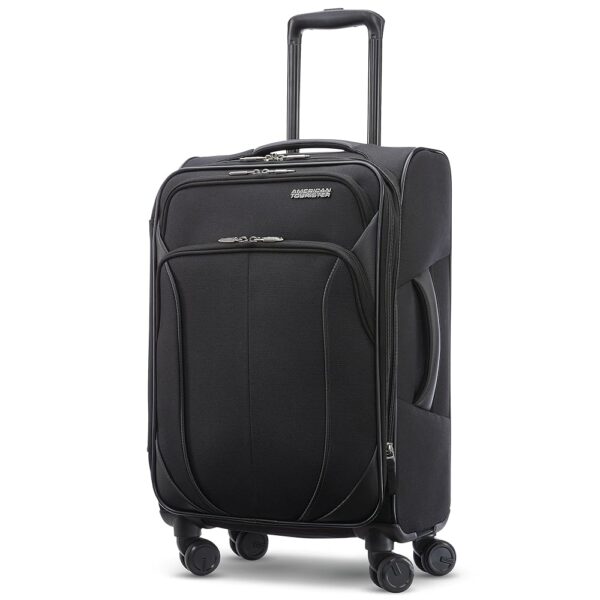
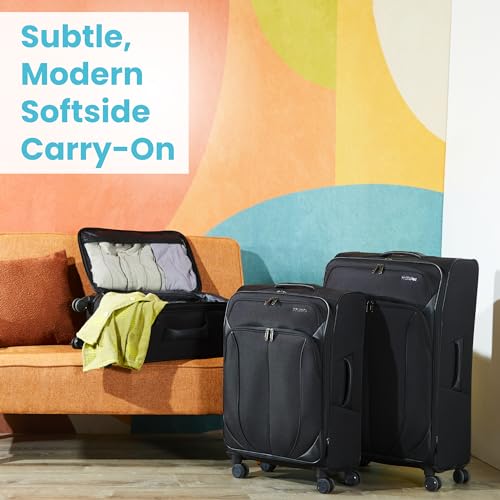
This is a softside expandable spinner from American Tourister, Samsonite’s value brand, finished in black polyester with carbon fiber trim accents and gunmetal hardware. The maker frames it as a one to three day bag, and that framing is honest. It is aimed at someone who wants a recognized brand and the practical advantages of soft construction: external pockets, a body that compresses into a full overhead bin, and an expansion zip for the way home.
Softside versus hardside is a real trade rather than a matter of taste. Fabric gives you outside access to a laptop or a jacket, absorbs an awkwardly shaped item, and squeezes into a gap a molded shell will not enter. A shell gives you water resistance, crush protection and a clamshell that packs flat. This bag is firmly on the fabric side of that line.
The dimensions are over on all three axes
The listing publishes one dimension set: 14.5 by 9.5 by 23.5 inches. Nothing states whether the casters and the retracted handle are inside that figure, and on a spinner they often are not, which would make the real numbers larger still.
The commonly quoted United States domestic cabin allowance is around 22 by 14 by 9 inches with wheels and handles counted. This case is 1.5 inches over on length at 23.5, half an inch over on width at 14.5, and half an inch over on depth at 9.5. That is over on every axis, with the longest dimension the furthest out. A sizer is a box and a bag must clear every dimension, so there is no angle at which this goes into a correctly built frame.
What that means in practice, and what the expansion does
Whether an oversize cabin bag becomes your problem depends on the carrier, the aircraft, how full the flight is and how strict the gate is being run. Mainline domestic carriers in the United States frequently do not measure at all on lightly loaded flights; budget and regional carriers measure routinely and publish tighter figures; many international carriers add a cabin weight cap on top. A soft bag also has a small advantage a shell does not, in that a partly packed fabric case can be squeezed into a sizer that a rigid one would fail. That is a real practical difference, and it is not the same as compliance. We never write that a bag is airline approved, because the limit belongs to the airline.
The case is also expandable, and no expanded figure is published. Using the expansion adds depth to a bag already over on depth. Treat the expanded state as a checked bag setting.
Fabric, wheels, handle and interior
The fabric is described as rugged polyester with carbon fiber trim accents. No denier figure is published, which is the number that would tell you the grade, and its absence on a bag whose whole structure is fabric is the most substantive gap in the listing. Carbon fiber trim here means a woven look on the accent panels rather than a structural material, and it is worth being clear about that. Polyester is light, takes a coating well and resists everyday abrasion adequately; it absorbs water rather than shedding it, and it is less abrasion resistant than ballistic or Cordura nylon.
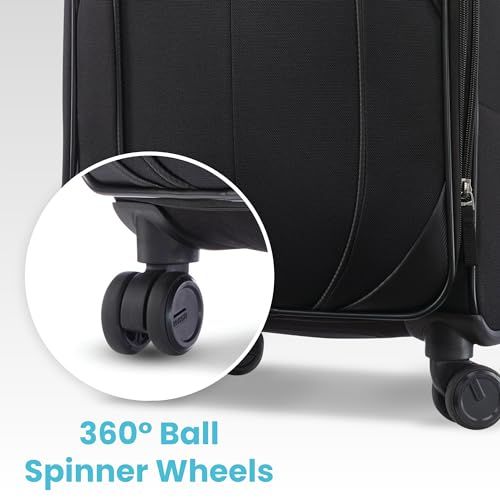
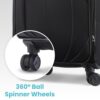
The wheels are described as a wear and tear tested ball wheel delivering stability and comfort. No count is given, though the product is sold as a spinner, so four casters is the reading. On a softside bag the casters mount to a base plate rather than to a molded shell, which means a caught wheel transfers load into fabric and stitching rather than into plastic. Spinners are easier across smooth terminal floors and worse on cobbles, gravel and curb cuts, and they are the most common single failure point on wheeled luggage.
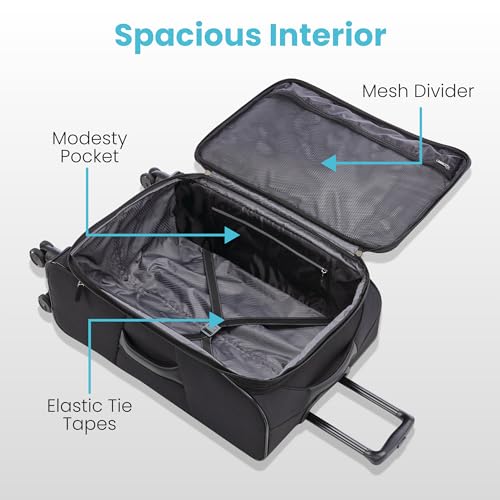
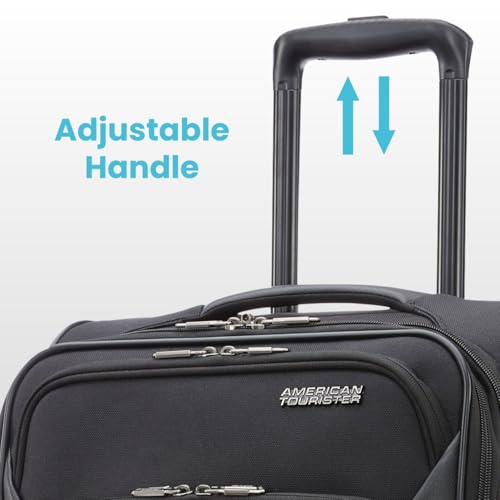
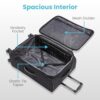
The handle is an ergonomic trolley grip with a carbon fiber texture that adjusts to height. Large zipper pulls are called out specifically, and that is a small detail that matters more than it sounds if you have limited hand strength or are wearing gloves. No lock of any kind is described anywhere on this listing, TSA recognized or otherwise, and nothing is published about the interior layout beyond the expansion.
Capacity, weight and a unit problem
Capacity is published as 3,237 cubic inches in both fields. That is roughly 53 liters, but the listing never converts it, and cubic inches is an unusual unit in a category where nearly every competitor publishes liters. Comparing this bag against others therefore requires arithmetic the maker should have done. Fifty three liters is generous for a bag sold as a carry-on, and it is consistent with dimensions that exceed the common benchmark on every axis: the extra volume has to come from somewhere.
The empty weight is 7.5 pounds, published consistently. That is heavy for a softside cabin bag, where five to six pounds is common, and it is heavier than several hardside cases of similar size elsewhere in this catalog. On a carrier that caps cabin baggage at 7 kilograms, an empty bag at 7.5 pounds consumes about 49 percent of the allowance before you pack a shirt. On United States domestic tickets where cabin bags are not weighed, it costs you only effort. The combination of a heavy fabric bag with generous volume points to a case built for people who check it rather than carry it.
Warranty, standing and the alternatives
No warranty term appears anywhere in the source data. American Tourister publishes warranty terms on its products generally, but this listing records neither a length, nor a coverage description, nor an exclusion list. On luggage the question worth asking is specific: whether damage caused by airline handling is covered, since that is the damage bags actually suffer and the exclusion luggage warranties most often carry. Ask before ordering.
The listing shows 4.5 stars from 827 ratings and a position of second in the suitcases chart. That is a good score on a modest base combined with a strong sales position. Within the same brand, the American Tourister Stratum 2.0 is the hardside equivalent at a similar size, the Stratum XLT is the larger relative and the Stitch carry-on is another option in the range. For softside cabin bags that measure inside the common benchmark, compare the Travelpro Platinum Elite and the Samsonite Solyte DLX. Browse suitcases and carry-ons.
Who should buy it and who should not
Buy it if you want a recognized brand, 53 liters of soft, compressible packing space, and you fly carriers that rarely measure cabin bags. Do not buy it if your airline enforces its sizer, because the published figures exceed the common benchmark on all three axes; if you fly with a 7 kilogram cabin weight cap, since 7.5 pounds empty is nearly half of it; or if you need a lock or a stated warranty, because neither appears.