
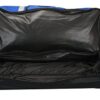
Description
The Load, and a Category That Does Not Fit
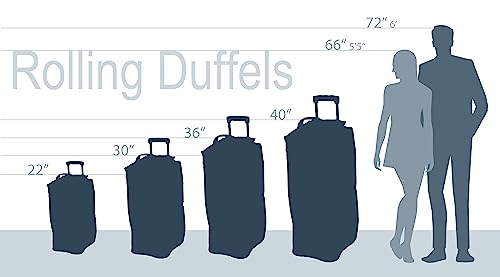
Start with a correction. This bag sits in the carry-ons category on this site and ranks 432nd in Carry-On Luggage on the source data. It is a 40 inch rolling duffel measuring 40 by 17 by 16 inches. Nothing about it is a carry-on and it is not close. Treat both placements as marketplace artifacts.
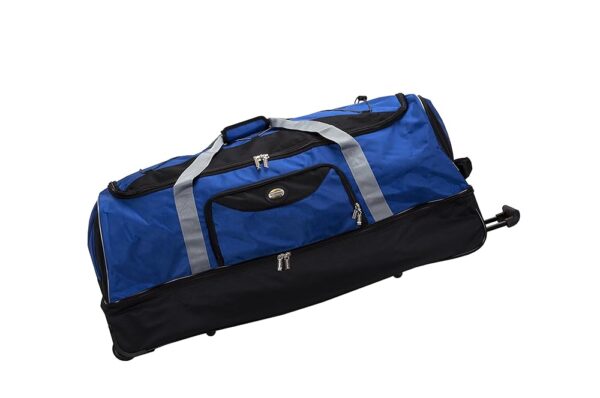
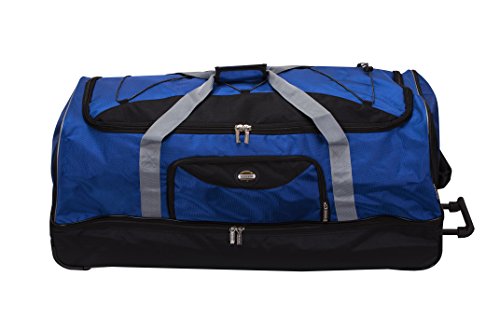
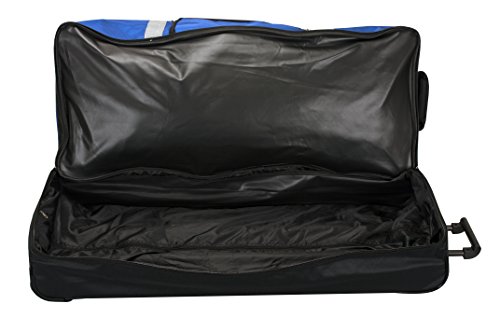
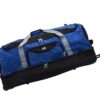
What it actually is, is a large soft hauler with a drop bottom. Rockland names the college student, the camper and the long weekend traveler, and the first two are the right fit. The defining feature is a separate zippered compartment across the bottom of the bag, which expands the total volume and, more usefully, isolates boots, wet gear or dirty laundry from clean clothing above. A bungee cord across the top takes a jacket or a rolled mat, and there is a zippered side pocket.
For a smaller soft hauler that stays inside airline limits, the Wrangler Wesley rolling duffel is the closer comparison, and the TPRC Sierra Madre II sits between the two at 36 inches.
Seventy Three Linear Inches
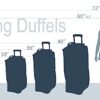
The dimensions agree across sources for once: the description gives approximately 40 inches long by 17 wide by 16 high, and the specification block gives 40 by 17 by 16. Neither says whether the wheels and handle housing are included, so treat these as the bag body and expect the measured object to be larger.
Now the number that decides what flying with this costs. Most United States carriers limit checked baggage to 62 linear inches, meaning the three dimensions added together, before oversize charges apply. Add 40 plus 17 plus 16 and the total is 73 linear inches. That is eleven inches past the common ceiling, empty, before anything is packed, and a soft duffel swells considerably when loaded.
Oversize fees apply per bag per direction and are substantial on most airlines. Some carriers set a hard maximum above which they will not accept an item at all, and 73 linear inches is close to or past several of those. This does not make the bag defective, it is simply what a 40 inch duffel is, but it means the fee has to be priced into the purchase before you book. Check your specific airline’s published linear inch limit and its oversize charge. Anyone who needs a bag that flies without a surcharge should be looking at 30 inch and under, which is a different product entirely.
1200 Denier Nylon, Skate Wheels and a Hidden Handle
The shell is 1200 denier nylon, and naming both the weight and the fiber is a genuinely useful specification that much of this catalog omits. Nylon is the better choice than polyester for abrasion resistance, which is what a duffel takes when it is dragged across gravel, loaded into a truck bed or run along a conveyor. At 1200 denier it is a heavy cloth. No coating is described, so assume it absorbs water in sustained rain and pack anything sensitive in its own liner.
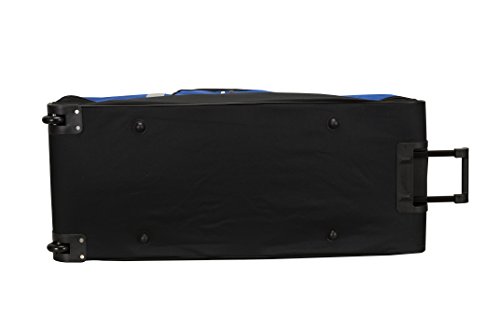
The wheels are described as skate wheels, meaning inline units recessed into a runner at the base. On a bag this size that is the right choice: they sit within the footprint rather than protruding like spinner casters, they handle curbs, gravel and dock lips far better, and they present less to be sheared off on a belt. The trade is that a loaded 40 inch duffel has to be tilted and towed rather than pushed upright, and at full load that is a real effort on the arm and shoulder.
The handle is described as a completely hidden telescoping system, meaning the tubes run inside the bag body rather than being surface mounted. That is worth something on a soft bag: an exposed handle assembly on a flexible body is a snag point and a stress concentration. No stage count, no material and no extended height are published, which is the usual gap, and on rolling duffels the handle tube is the second most common failure point after the wheels because the bag flexes around it.
The main compartment opens with a double zipper along a U-shaped top with handles that can be secured together. No zipper brand is named, which matters on a bag whose main closure is long, curved and load bearing. The Samsonite Stryde 2 is one of the few cases in this catalog that does name one.
Capacity, Weight and the Figure That Is Wrong
The capacity data on this listing is not usable. The capacity total field reads 40 liters. Run the arithmetic: a bag measuring 40 by 17 by 16 inches has an external volume of roughly 10,880 cubic inches, which is about 178 liters. Forty liters is the volume of a large daypack. The published figure is almost certainly the 40 from the bag’s 40 inch length, misfiled into a liter field, and it should be disregarded entirely. Use the physical dimensions instead.
The compartment count is also inconsistent. The specification block says two compartments. The description names a main compartment, a large zippered bottom compartment, a zippered side pocket and a bungee cord top, which is more than two by any reading. The likely explanation is that the count refers to the two main chambers and excludes the pockets, but the listing does not say.
Weight disagrees between sources. The description says 8 pounds. The specification block says 7.55 pounds in one field and 7.6 in another. That is roughly half a pound of spread. Around seven and a half pounds for a 40 inch nylon duffel with a hidden handle system is reasonable, and it matters against the roughly 50 pound checked weight cap most carriers apply: a lighter empty bag leaves more of the allowance for contents. Note that a bag of this volume will reach 50 pounds long before it is physically full, so weight rather than space is the binding constraint.
No Warranty, and a Weak Record
No warranty is published on this listing. No term, no exclusions, no coverage period. Across luggage generally even the makers who publish terms commonly exclude airline handling damage, which narrows the practical gap, but nothing here is written down. The brand is Rockland while the manufacturer field says Fox Luggage, which is the company behind the name and also behind the Rockland Fashion softside set.
The feedback record is soft: 3.8 across 726 ratings, ranked 359,267th in Clothing, Shoes and Jewelry. A 3.8 is below the range most bags in this catalog occupy, on a sample large enough to take seriously. It is better than the 3.7 on the TPRC Sierra Madre II and well short of the 4.3 and above that the smaller rolling duffels manage. The travel duffels category holds the alternatives.
Who Should Buy It and Who Should Not
Buy it if you are moving a lot of soft gear by car, to a campsite or into a dormitory, and you want a heavy 1200 denier nylon shell, inline skate wheels and a drop bottom that keeps dirty kit away from clean clothes. The material specification is better than most at this level. Do not buy it as airline luggage without pricing your carrier’s oversize fee, because at 73 linear inches it is eleven inches past the common 62 inch limit. Ignore the 40 liter capacity figure, which is off by more than a factor of four. And weigh the 3.8 rating across 726 ratings against the alternatives before deciding.