

Description
Who the LUGGEX PCF-20BK is really for
This is a 20 inch expandable hardshell on four spinner casters, sold at a weight the maker gives as 5.84 pounds in the specification table and 6.0 pounds in the feature bullets. The traveler it suits is someone flying three to six times a year, packing for three or four nights, who wants a rigid shell and an expansion zip for the return leg when the bag comes home fuller than it left. It is not a bag for a weekly flier who needs a handle to survive a thousand cycles, and it is not the right choice if your airline weighs cabin bags aggressively and you intend to use the expansion.
The listing is more forthcoming than most in this category, and it also contains three internal contradictions that a buyer should see before deciding. We will take them in order rather than resolving them silently.
Dimensions, expansion and the size claim
The specification table gives 13.8 by 8.3 by 22 inches. The first feature bullet gives 22.0 by 13.8 by 8.3 inches, which is the same case written in a different axis order, so on this point the listing agrees with itself. That is unusual in this catalog and worth crediting. What the listing does not say anywhere is whether the wheels and the retracted handle sit inside that 22 inch figure. On a spinner, casters typically add half an inch to an inch to the depth or height depending on how the bag is presented to a sizer, and that gap is the single most common reason a case sold as cabin size gets gate checked.
The expansion cancels the size claim while it is open
The maker states the case measures within 22 by 14 by 9 before it is expanded. That phrasing is doing a lot of work. An expandable cabin case is a cabin case only in its collapsed state. Open the expansion zip and the depth grows, the bag no longer matches the figure that was quoted, and a gate sizer does not care that it collapses again. The honest way to think about this bag is that it has two settings: a cabin setting and a checked setting. The capacity fields on the listing tell the same story, giving 34.6 liters in one field and 40 liters in another. Those are almost certainly the collapsed and expanded volumes, but the listing never labels them, so the buyer is left to infer it.
On airline rules generally: the roughly 22 by 14 by 9 inch figure quoted across the United States domestic market is a common benchmark rather than a standard. Regional jets, budget carriers and most international airlines publish their own numbers, and a large share of non United States carriers add a cabin weight cap that a 6 pound empty case eats into before you pack. We do not describe any bag as airline approved, because compliance belongs to the airline. Check the carrier you are actually flying.
Shell material, zippers, wheels and handle
The maker names the material as polypropylene. That is a genuinely different choice from the ABS and polycarbonate blends that dominate this shelf, and it deserves a straight description rather than a slogan. Polypropylene is light, it is very resistant to fatigue cracking, and it flexes a long way before it fails, which is the property that keeps a case alive after a drop. Its weaknesses are that it is softer than polycarbonate, so it scuffs and gouges more readily, and it deforms under sustained load rather than springing straight back. In practice that means a polypropylene case tends to look older sooner while surviving longer, which is the opposite trade from a glossy polycarbonate shell. Note also that the product’s own model code, PCF, suggests polycarbonate to most readers, so the naming and the stated polymer point in different directions.
The zippers are described as anti explosion, which is marketing language for a reinforced coil intended to resist the failure where an overpacked bag forces the teeth apart. No zipper brand is named, which is a small omission but a real one at this price, and it is worth contrasting with cases that name YKK outright. The lock is TSA recognized, which means it opens to a screener’s master key and should be treated as a deterrent rather than as security. Four spinner casters give easy movement across terminal floors and hand it back on cobbles, curb cuts and gravel, where two large inline wheels do better; the casters are also the part most likely to snap off first, and on a spinner they are unprotected.
Capacity, weight and the numbers that do not line up
Capacity is given as 34.6 liters in the capacity field and 40 liters in the capacity total field, and the feature bullet quotes 34.6 liters alongside the collapsed dimensions. The reading that makes sense is 34.6 collapsed and 40 expanded, but the listing never states it. Weight is given as 5.84 pounds in the specification table and 6.0 pounds in the feature bullet. That gap is small, but if you fly a carrier with a 7 kilogram cabin cap it is the sort of small that gets noticed at a scale. Take the higher figure when planning.
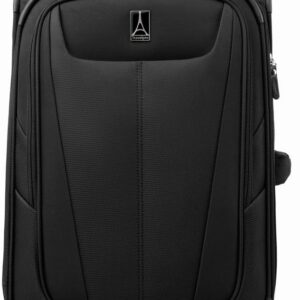
Interior layout is described as two main compartments plus several smaller pockets. That is the standard clamshell arrangement on a hardside and it packs differently from a softside upright: everything must lie flat in two halves, there are no external pockets for a laptop or a jacket, and anything you want in flight has to come out before the case goes in the bin. If external access matters to you, a soft case such as the Travelpro Maxlite 5 solves a problem this shell cannot.
Warranty, market standing and the alternatives
LUGGEX states a three year protection plan, described on the listing as claimed, with a promise of a response within 12 hours. Three years is a fair term for the price. What is missing is the exclusion list, and specifically whether airline handling damage is covered. That matters more on luggage than on almost any other product, because handling damage is the damage that occurs, and it is the exclusion that luggage warranties most often carry. Get the terms in writing before you rely on them.
The listing shows 4.6 stars from 214 ratings, and it sits at 408,007th overall in its department and ranked 503rd within carry-on luggage, so this is a modestly selling item rather than a chart leader. Within the same brand, the LUGGEX zipperless 20 inch removes the zipper failure mode entirely, the LUGGEX 16 inch underseat is the answer if you fly basic economy fares that only include a personal item, and the LUGGEX foldable rolling duffel trades the rigid shell for packability. For a polycarbonate comparison at the same size, see the BAGSMART 20 inch spinner, and browse the full carry-ons and carry-on luggage sections for the rest of the field.
Who should buy it, who should not
Buy it if you want a light, flexible polypropylene shell, you value an expansion zip for the journey home, and you understand that using the expansion turns it into a checked bag. Do not buy it if you fly carriers with strict cabin weight caps and were counting on the lower of the two published weights; if you need a bag that keeps its cosmetic finish, since polypropylene scuffs; or if you need warranty coverage that explicitly names airline handling damage, because this one does not.