Description
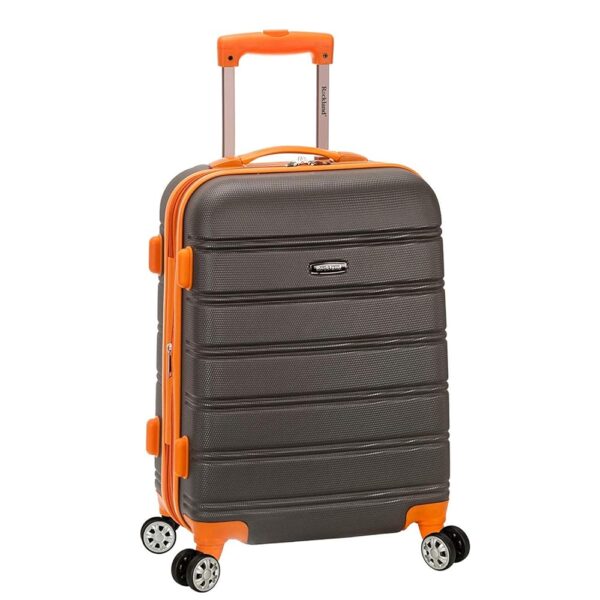
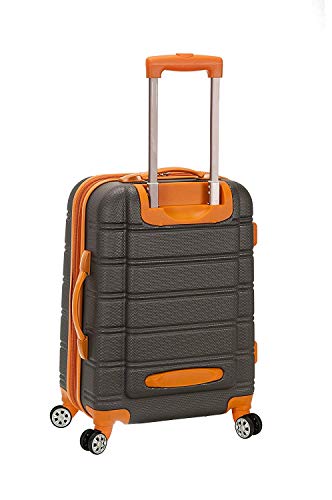
The Rockland Melbourne in charcoal is a 20 inch ABS hard shell spinner with an expansion section, double spinner casters and an aluminum telescoping handle. It carries more than twenty thousand ratings, which is by a very wide margin the deepest feedback record on this site. Its listing also gives three sets of dimensions, two different weights and two different handle materials.
Dimensions, and which one gets measured
Three figures appear. The written description says the case measures 20 by 13 by 9 inches. The first feature bullet says 22 by 13.5 by 9 inches, and states that figure is with wheels. The specification block gives 13 by 9 by 22 inches, which is the with wheels figure reordered.
Read together these are mostly coherent: 20 inches is the shell height and 22 inches is the height once the wheels and the retracted handle housing are added, a two inch stack that is entirely normal on a four wheel spinner. The width disagrees slightly, 13 inches in the description against 13.5 in the bullet, which is a small inconsistency rather than a serious one.
The number that matters is the one with the wheels in it. Against the roughly 22 by 14 by 9 inch convention most United States domestic carriers apply, 22 by 13.5 by 9 inches is exactly at the limit on height, half an inch inside on width, and exactly at the limit on depth. It fits, and it fits with no margin on two of three axes. A sizer knocked out of true, or a front panel bulging under a full load, is enough to make the difference.
The airlines named, and the expansion
The second bullet says the carry-on meets the size restrictions of United, American, Delta, Southwest and Allegiant. That is a claim made by the maker and we are attributing it rather than repeating it. Naming carriers does not create an approval, airlines do not certify individual luggage models, and published allowances change. There is no general airline approval for luggage: budget and regional operators are frequently stricter than the mainline convention, and international carriers commonly enforce a cabin bag weight limit as well as a size limit.
The case is also expandable, and the listing never states by how much. Expanded depth is measured depth, and this case starts at the 9 inch depth limit closed. Any expansion at all takes it over. Use the expansion on a leg where the bag is going into the hold, and treat the extra volume as checked capacity rather than cabin capacity.
Two weights, and two handle materials
The specification block gives 6.49 pounds in one field and 2.95 kilograms in another, which is 6.50 pounds, so those agree. The written description says the case weighs 7.5 lbs. That is a full pound heavier, and the listing never reconciles it.
A pound matters. On carriers that enforce a cabin bag weight limit it is a pound of clothing you cannot bring, and it is also the difference between a case you can lift one handed into a bin and one you cannot. Plan on the heavier figure and weigh the bag yourself if your carrier is strict.
There is a second, smaller contradiction in the same area. The description calls the handle a modern internal chrome telescoping handle with a push button, while the fifth bullet calls it a sturdy ergonomic aluminum telescoping handle. Chrome and aluminum are different things: chrome is a plating over steel, aluminum is a base metal, and they behave differently in weight and in corrosion. Neither the stage count nor a load rating is published.
The listing does one genuinely honest thing worth crediting: the description notes that the wheel design may vary between black and silver wheels. Telling a buyer in advance that a cosmetic detail is not guaranteed is more than most listings bother to do.
Shell, wheels and capacity
The shell is named as ABS, and the description is candid about why: extremely lightweight, durable, and protective of the contents. ABS is the cheaper of the two mainstream hard shell plastics. It is light and easy to mould, and it is more brittle than polycarbonate, which means it is likelier to crack at a corner under a hard impact rather than flex and recover. On a cabin bag that mostly lives in an overhead bin that is a fair trade. On a bag you expect to gate check regularly it is less so, and the ABS shells in this catalog, including the American Tourister Stratum 2.0, share the same characteristic.
Mobility comes from four multi directional double spinner wheels. Dual casters spread the load over two contact points, which helps on the rough ground where single wheel spinners struggle most. They remain exposed, remain the most common physical failure on any wheeled bag, and contribute the two inches of stack that separate the 20 inch and 22 inch figures above.
Capacity is published consistently at 38.3 liters in both capacity fields. Against an external box of 22 by 13.5 by 9 inches, which is about 2,673 cubic inches or 43.8 liters, a 38.3 liter interior leaves a plausible allowance for the shell walls, wheel wells and handle housing. That figure survives a sanity check, which is not something every listing here manages. Inside there is a mesh zip pocket and an elasticated pocket.
One further claim in the description deserves a note. It says the luggage allows you to pack more while avoiding the excess weight surcharges imposed by most airlines. A lighter case does leave more of a weight allowance for contents, which is the sensible reading, but no bag lets you avoid a surcharge. The allowance is the allowance.
Warranty, the record, and the alternatives
No warranty is published. No term, no coverage description, no exclusions. On a case with an expansion mechanism and four casters there is no stated commitment on the parts that fail. Airline handling damage is routinely excluded even where written warranties exist, so with none here the realistic fallback is the retailer return window.
Against that sits the strongest evidence base on this site: 20,829 ratings at an average of 4.5 out of 5, with the case ranked 11th in Carry-On Luggage and 7,888th in Clothing, Shoes and Jewelry. A pool that size has had many years and many thousands of trips to surface failures, and a 4.5 average across it is a materially stronger signal than the same average across a hundred ratings. If you want evidence rather than specifications, this is where it is.
One data note: the manufacturer field reads Fox Luggage while the brand on the product is Rockland. Fox Luggage distributes the Rockland brand, so this is a corporate relationship rather than an error, but the listing never explains it. Model number is F145-CHARCOAL, country of origin China.
The same case appears in other finishes, including the Melbourne in grey and the Melbourne in mint, and the brand children’s range includes the Rockland Jr hardside spinner. The wider field sits in the carry-on luggage category and the suitcases category.
Who should buy it, and who should not
Buy it if you want an inexpensive rigid cabin bag with an enormous body of owner feedback behind it, you accept ABS rather than polycarbonate, and you are content to weigh and measure it yourself. Do not buy it expecting margin against a strict sizer, because the with wheels figure sits exactly at the limit on height and depth, and do not fly it expanded on a leg you intend to carry on. Plan on the heavier 7.5 pound figure rather than 6.49, and do not expect a warranty.