


Description
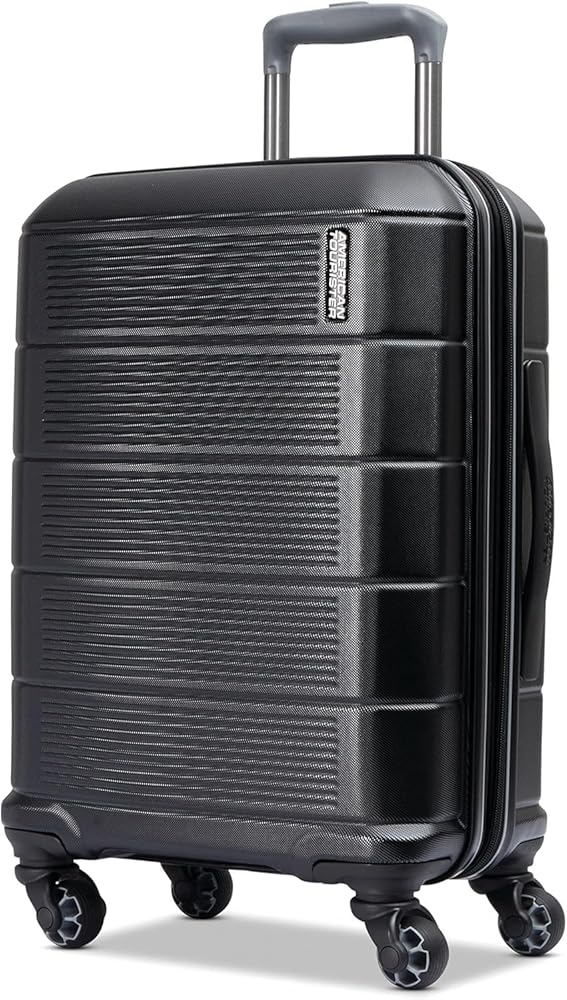
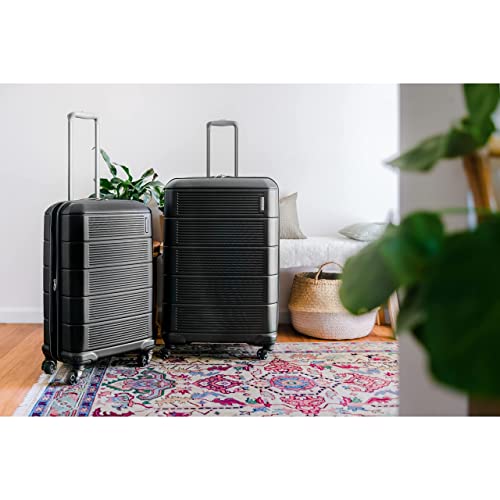
The American Tourister Stratum 2.0 carry-on is an expandable ABS hard shell spinner in jet black, with a barrel shaped body, ball spinner wheels and a textured trolley grip. It is one of the better reviewed cases in this catalog. It also carries a written description belonging to a different product line, and a capacity field that measures the outside of the bag rather than the inside.
The description on this page is for another product
The written description opens by naming the Westridge hardshell suitcase set and goes on to describe the Westridge barrel shape, shell and trolley grip. The product being sold is the Stratum 2.0 carry-on. Those are different lines, and the description also says set while the item is a single case.
Some of the described features do match what the bullets say about the Stratum 2.0, including the ABS shell, the barrel shape, the adjustable carbon fiber texture grip and the expandable capacity. That overlap makes the mix up easy to miss and does not make it harmless. A buyer reading the description cannot know which details belong to the case in the box. We are naming the substitution rather than quietly treating the description as authoritative.
Dimensions, and where they sit against the allowance
The specification block gives 15 by 9.5 by 22 inches. No bullet repeats the figure, no packing dimension is published, and nothing states whether the wheels and the retracted handle housing are included. On a case sold as a carry-on that last omission is the significant one, because wheels excluded from a published height are the most common reason a bag believed to be compliant is stopped at a gate.
Against the roughly 22 by 14 by 9 inch convention that most United States domestic carriers apply, this case is exactly at the limit on height with no margin, a full inch over on width, and half an inch over on depth. Two of three axes are already over before anything is packed.
The one inch expansion makes it worse
The fifth bullet states that all cases expand one inch. Expanded depth is measured depth, and this case starts half an inch over the common depth convention closed. Open, it is around an inch and a half over on the axis that carry-on frames are least forgiving about. Treat the expansion as something for a leg where the bag is going into the hold, not as usable cabin capacity.
We are not going to write that this bag is airline approved. There is no general approval for luggage, carriers publish their own allowances individually, budget and regional operators are frequently stricter, and international carriers commonly add a cabin weight limit. Check 15 by 9.5 by 22 inches against the airline and route you are actually flying, and be prepared for a strict carrier to refuse it.
The capacity figure is the outside of the case
Capacity is published as 3,135 cubic inches, in the capacity field alone, with no capacity total field to cross check it. That number is worth doing the arithmetic on. The external box of 15 by 9.5 by 22 inches works out to exactly 3,135 cubic inches.
So the field labeled capacity is not a capacity. It is the external volume of the whole case, including the shell walls, the wheel wells and the handle housing, none of which is space you can pack anything into. The genuine interior will be meaningfully smaller, and the listing never publishes it. A buyer comparing this against a case that publishes a real interior figure would be crediting the Stratum 2.0 with room it does not have. The same mislabeling appears on the Samsonite Virtuosa, which at least publishes both the external and the interior figure so the difference is visible.
Weight is published consistently at 7.28 pounds in both fields. For a 22 inch ABS case with an expansion mechanism that is on the heavy side, and empty weight counts twice: it eats any enforced cabin weight allowance, and it is what you lift into the bin.
Shell, wheels, handle and closure
The shell is a textured shiny ABS in a barrel shape. ABS is the cheaper of the two mainstream hard shell plastics: light and easy to mold, and more brittle than polycarbonate, so it is likelier to crack at a corner under a hard impact than to flex and return. The texture is a sensible response to its main cosmetic weakness, which is that a smooth gloss shell shows every scuff after one trip. A barrel profile, meaning curved rather than flat sides, adds stiffness for a given shell thickness, which is a real structural benefit and also the reason the interior is smaller than the external box suggests.
The wheels are described as wear and tear tested ball wheels, said to deliver stability and comfort. Ball style spinner casters are effortless on terminal flooring and poor on cobbles, gravel and curbs, where they catch and take side loads. Exposed casters remain the most common physical failure on any wheeled bag and they contribute to the height a sizer measures. No test standard is named behind the wear tested claim.
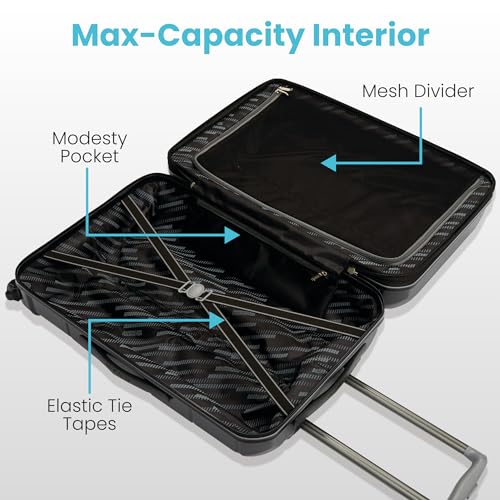
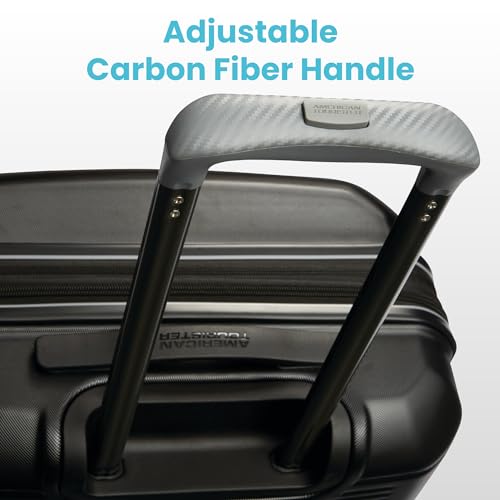
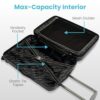
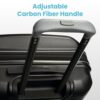
The handle is an adjustable trolley grip with a carbon fiber texture, described as adjusting to the user. Note that carbon fiber texture means a surface finish rather than carbon fiber construction, and no stage count or load rating is published. The zippers get a specific mention, described as large pulls that are easy to operate, which is a genuine ergonomic point on a case you open in a hurry. Inside there is a modesty pocket, a mesh door pocket and elastic tie tapes.
No lock of any kind is described on this listing, which is worth knowing given that most competitors at this size fit a TSA lock as standard.
Warranty, the record, and the alternatives
No warranty is published. No term, no coverage description, no exclusions. On a case with an expansion mechanism and four casters, there is no stated commitment on the parts that fail. Airline handling damage is the damage luggage overwhelmingly suffers and it is routinely excluded even where written warranties exist, so with none here the realistic fallback is the retailer return window.
The evidence base is the strongest thing on this page: 1,613 ratings at an average of 4.5 out of 5, with the case ranked 48th in Carry-On Luggage and 6,560th in Clothing, Shoes and Jewelry. A pool that size has had time to surface failures. Manufacturer is American Tourister, model 142348-1465, country of origin Cambodia. The bullets also carry several spelling errors, which is cosmetic but is another sign of how loosely this page was assembled.
Within the same line, the Stratum 2.0 in another finish is the same case, and the Stratum XLT expandable hardside is the larger version. The 4 Kix 2.0 is the alternative in the same brand. The wider field sits in the carry-on luggage category and the suitcases category.
Who should buy it, and who should not
Buy it if you want a well reviewed rigid case for one to three nights, you value large zipper pulls and a stiff barrel shell, and you fly carriers with generous cabin allowances or are content to check it. Do not buy it expecting to clear a strict sizer, because the published figures are over the common convention on width and depth before the one inch expansion. Do not use the 3,135 cubic inch figure to compare capacity, because it is the outside of the case, and do not rely on the written description, because it describes a different product line.