
Description
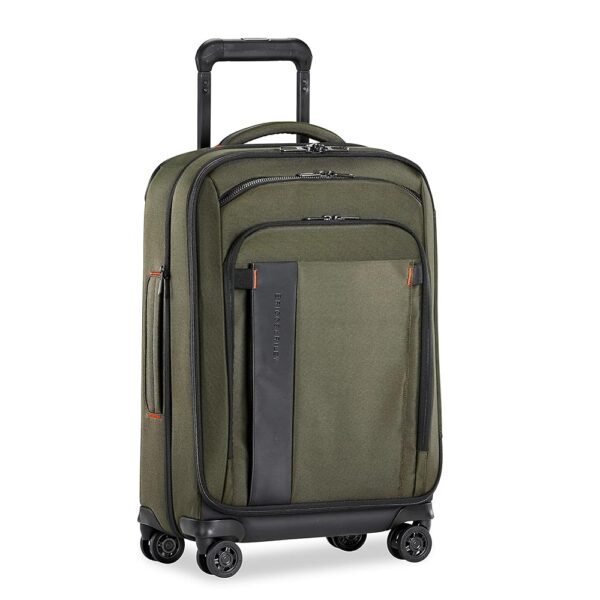
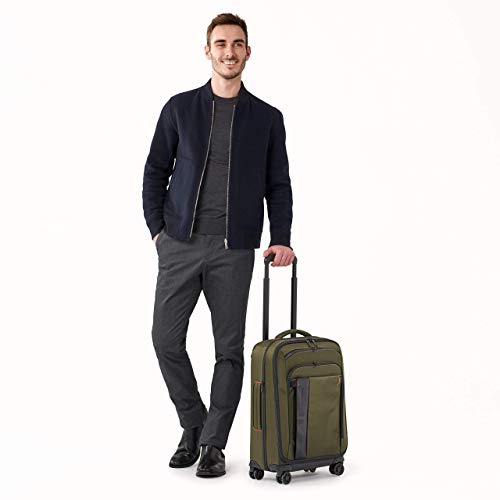
The Briggs and Riley ZDX in hunter, model ZXU122SPX-23, is the domestic 22 inch carry-on. It is a premium cabin bag with two features worth understanding properly, an externally mounted handle and an outside battery pocket, and one claim in its description that needs challenging directly.
The traveler and the trip this suits
This is a frequent flyer’s cabin bag, built for someone who packs garments rather than gear and wants them to arrive wearable. Large cinch down garment panels, two lid zip pockets and a U zip front compartment describe a bag organized around clothing and quick access rather than raw volume.
At 7.4 pounds empty it is mid weight for a premium cabin case. Readers comparing at this tier should read the TUMI 19 Degree expandable carry-on and the Travelpro Platinum Elite carry-on, and the same maker’s smaller bags are covered in the Briggs and Riley Rhapsody underseat spinner and the Briggs and Riley ZDX underseat cabin bag.
The expansion claim, and why we will not repeat it
The description states that the case offers 2.5 inches of expansion depth and still fits in an overhead compartment, making the difference between having to check a bag or not.
Working through the numbers
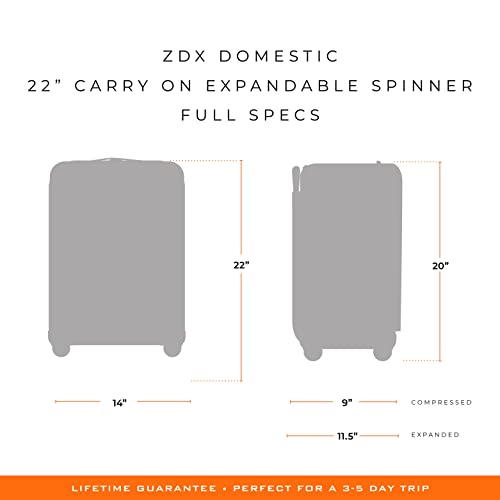
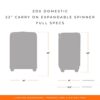
The specification block gives Product Dimensions of 14 by 9 by 22 inches. That matches the commonly cited United States domestic cabin allowance of roughly 22 by 14 by 9 inches exactly on all three axes. There is no margin unexpanded.
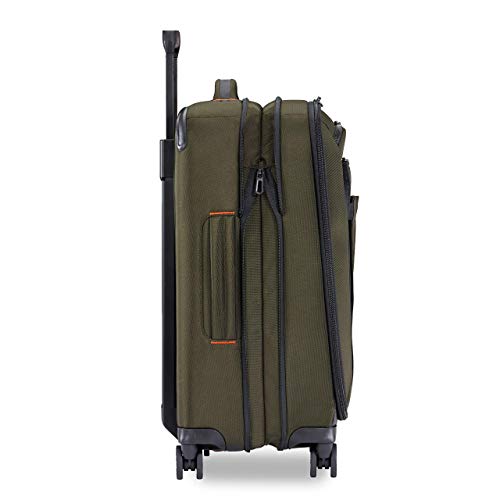
Add 2.5 inches of expansion depth and the case becomes 22 by 14 by 11.5 inches. That is 28 percent over the common depth figure. No airline sizer built to a 9 inch slot accepts an 11.5 inch bag, and depth is the axis a sizer constrains hardest because the bag has to go in flat.
The maker’s claim is about fitting in an overhead compartment rather than fitting a sizer, and those are different tests. An overhead bin on a wide body aircraft will physically swallow a bag considerably larger than the published allowance. But whether a bag boards is decided by a gate agent and a sizer, not by bin geometry, and on a full flight that decision goes against oversized bags first. We will not write that an expanded case still fits, because on the published numbers it does not fit the allowance.
The honest position: unexpanded, this case matches the common figure exactly and has no room for error. Expanded, treat it as a checked bag. Every airline sets its own allowance, budget and regional carriers are stricter, and international carriers frequently enforce a cabin weight limit as well. The word domestic in the product name is the maker telling you it is not built to the tighter overseas standards.
The listing also does not state whether the 22 inch figure includes the wheels and the externally mounted handle. On this bag that omission is unusually important, because the handle is on the outside.
A capacity figure larger than the bag
Capacity is published as 51.9 liters in both capacity fields. The outer envelope of 22 by 14 by 9 inches is 2,772 cubic inches, or about 45.4 liters.
The published capacity exceeds the entire outside of the case by roughly 6.5 liters. Unexpanded that is not possible. The most likely explanation is that 51.9 liters is the expanded capacity, since 2.5 inches of extra depth adds roughly 12 liters of geometric volume, and the listing does not label it as such. Treat 51.9 liters as an expanded figure and expect meaningfully less in a case you intend to take through a gate.
The Outsider handle, and what it buys
The handle tubes are mounted on the exterior of the case rather than running through the packing space. Two consequences follow and both are real.
The interior floor is flat. On a conventional bag the handle tubes create two raised ridges down the packing surface, and folded garments crease along those ridges. A flat floor means clothes pack flat, which is the maker’s stated reason for the design and is the mechanism behind the crisp clothes claim. It reduces creasing rather than eliminating it.
Interior volume also goes up, because the space the tubes would have occupied now sits outside the shell. The cost is that the tubes are exposed on the back of the bag: they take the knocks when the case is set down hard or forced into a bin, and they form part of whatever the real measured depth turns out to be. On a case with zero dimensional margin that last point is not academic.
The battery pocket, and the rule that governs it
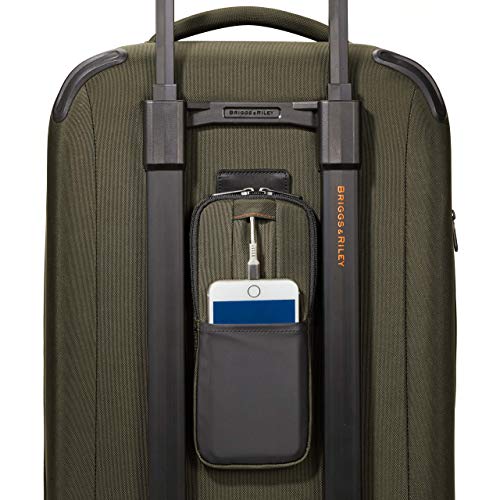
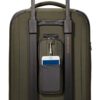
The description specifies an outside battery pocket so you can keep charging your phone. This needs care.
What the listing describes is a pocket, not an installed battery. Nothing here says a battery or power bank ships with the case, and a pocket implies you supply your own, which means it is removable by definition. That is the right arrangement.
The rule still applies to whatever you put in it. Most airlines require lithium batteries and power banks to travel in the cabin and to be removable, and bags with non removable batteries have been refused at the gate. If your cabin bag is gate checked, which on a full flight is a real possibility for any cabin bag, the power bank has to come out and come with you. An externally accessible pocket makes that easy, which is the practical advantage of putting it on the outside.
The rest of the organization is well specified: a U zip front compartment with a wide opening for jackets, books and tablets, an easy access slip pocket with an elastic closure for security checkpoint items, a spacious main compartment, large cinch down garment panels, and two lid zip pockets. A Smartlink strap connects two bags together.
What the listing does not publish
No material is named anywhere. Not a fabric, not a denier, not a polymer, not soft or hard. At this price point that is a striking omission.
No warranty term appears either, which is worth flagging specifically because the same maker’s Rhapsody listing in this catalog does state a lifetime repair commitment that explicitly names airline damage. Its absence here means a buyer working from this product data has no published period, scope or exclusions. Confirm with the seller before treating warranty coverage as part of the value.
The listing shows a 4.6 star average across 379 ratings and ranks 130th in Carry-On Luggage and 81,250th in Clothing, Shoes and Jewelry, which is a strong position for a premium priced bag. Country of origin is China. More options sit across the carry-ons category and the carry-on luggage category.
Who should buy it, and who should not
Buy it if you want a flat packing floor from an externally mounted handle, genuinely good garment organization, an externally accessible power bank pocket and a quick access compartment for security, and you fly domestic carriers that are relaxed about a bag sitting exactly on the common figure.
Skip it if you need margin at a strict gate, because unexpanded there is none and expanded the case is 11.5 inches deep. Skip it too if you want a named material or a published warranty, and read the 51.9 liter capacity as an expanded figure rather than what you can take through a sizer.