

Description
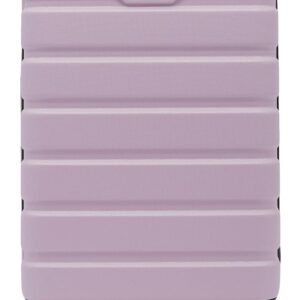
The mixi carry-on is a hard shell case with a side opening panel, a cup holder and a phone holder moulded into the top, and a USB plus Type C charging interface. It is sold at the 20 inch label size in rock gray. Two things on this listing need naming before anything else: the only dimensions published are far too large to be a 20 inch case, and the charging feature is described in a way that leaves the battery question unanswered.
The dimensions do not describe a 20 inch case
The specification block gives 16.53 by 11.02 by 24.01 inches. The product title says 20 inch. A 24 inch tall case is a checked bag, not a cabin bag, and 11 inches of depth is two inches beyond the depth convention most United States carriers apply.
Those three figures also convert to tidy metric values, 42 by 28 by 61 centimetres, which is the signature of a shipping carton rather than a product measurement. A carton is normally an inch or two larger than the case in every direction, which would put the actual bag somewhere near 22 by 14.5 by 9 inches. But that is an inference and the listing never publishes a product dimension anywhere, in any bullet, so a buyer has nothing to check it against.
We are not going to write that this bag is airline approved and the listing does not claim it is, which is to its credit. There is no general approval for luggage in any case: carriers publish their own cabin allowances individually, budget and regional operators are frequently stricter than the roughly 22 by 14 by 9 inch convention, and international carriers commonly enforce a cabin bag weight limit as well.
The charging interface, and the question the listing leaves open
The fourth bullet describes a USB and Type C double interface and says that with it you can charge your electronic devices on the trip, eliminating the need to search for power outlets. Nowhere does the listing say whether a battery is included, whether one is required, or whether any battery fitted can be removed.
That omission matters more than any other on this page. Lithium batteries are not permitted in the hold on the great majority of carriers, and airlines have refused boarding to bags whose batteries could not be taken out. A pass through port, which routes a cable from a power bank you supply, is unproblematic because you can always remove the battery. A built in, non removable battery is a boarding risk. The wording here, particularly the promise of eliminating the need for power outlets, reads more like an integrated power source than a pass through, but it is not stated either way.
Establish this before you fly with it. If the case has a fitted battery, find out whether it is removable and check your carrier rules on portable chargers and watt hour limits. If it is a pass through, supply your own power bank and take it out whenever the bag leaves your hands. Other cases in this catalog handle the disclosure properly, including the KROSER hardside carry-on, which states plainly that the power bank is not included.
Shell, opening, holders and lock
The shell is named as three layer Covestro polycarbonate. That is a more specific claim than most listings offer, since Covestro is an actual polymer producer rather than a marketing word, and a multi layer construction is a real manufacturing approach. Polycarbonate is the better of the two mainstream hard shell plastics: it flexes under load and returns rather than cracking, and it sheds water. Its weaknesses are scuffing, which the maker addresses with a scratch resistant finish, and cracking at a corner after a genuinely hard impact.
The opening is the design feature. Rather than splitting into two clamshell halves, the case opens from one side panel, which the maker says is easier and takes less effort. That is a genuine benefit in a hotel room with no luggage rack, because a panel opening case can be worked while it stands upright instead of needing a bed cleared. The trade is a fixed internal geometry that will not accept the deep single cavity packing a clamshell allows, and additional hinge hardware that is one more thing to fail. The Hanke H9860 takes the same approach if you want to compare.
The cup holder, phone holder and handle hook moulded into the top are unusual and genuinely useful in a queue, where the alternative is putting a drink on the floor. They also sit proud of the shell, which means they form part of whatever a sizer measures, and the listing does not say by how much. A similar cup holder appears on the SwissGear 7366.
Weight and capacity
Capacity is published as 42 liters in both capacity fields, with no internal disagreement. For a case at the 20 inch label size that is a generous working volume, more than the 32 to 38 liters several competitors publish, which is consistent with a bag whose real dimensions may sit at the larger end of the cabin range.
Weight is published consistently at 8.66 pounds in both fields. That is heavy. Most 20 inch polycarbonate cases in this catalog sit between five and seven pounds, and this one is one to three pounds above them. The extra weight is the price of a three layer shell, a side opening mechanism, the moulded holders and the charging hardware. On carriers that enforce a cabin bag weight limit, and many outside the United States do, close to nine pounds of empty case is a meaningful share of the allowance before anything goes in. Note also that if the published dimensions are a shipping carton, the published weight may be the shipped weight rather than the bag.
Warranty, the record, and the alternatives
No warranty is published. No term, no coverage description, no exclusions. The first bullet talks about strict production and quality control standards and the second asks the reader to believe in the brand, but neither is a commitment anyone could act on. On a case with a hinge mechanism, a charging interface, a lock and four casters, there is no stated cover for any of it. Airline handling damage is routinely excluded even where warranties exist, so the realistic fallback is the retailer return window.
Buyer feedback runs to 339 ratings at an average of 4.4 out of 5, with the case ranked 73rd in Carry-On Luggage and 45,446th in Clothing, Shoes and Jewelry. Manufacturer is mixi, country of origin China, and no model number is published. Within the brand, the mixi M9275 carry-on is the close relative. The wider field sits in the carry-on luggage category and the suitcases category.
Who should buy it, and who should not
Buy it if the side opening panel and the cup and phone holders solve real irritations for you, you want a named polycarbonate shell, and weight is not your binding constraint. Do not buy it if you need to know before ordering whether it will clear a gate, because the only published dimensions describe a box far larger than a 20 inch case. Do not buy it for the charging feature without first establishing whether a battery is fitted and whether it can be removed, because a non removable battery is a boarding risk. And do not expect a warranty, because none is published.