Description
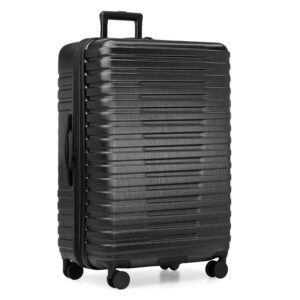
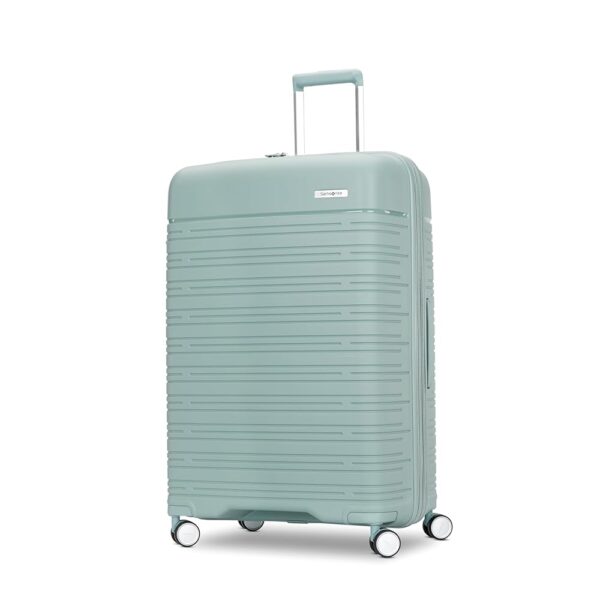
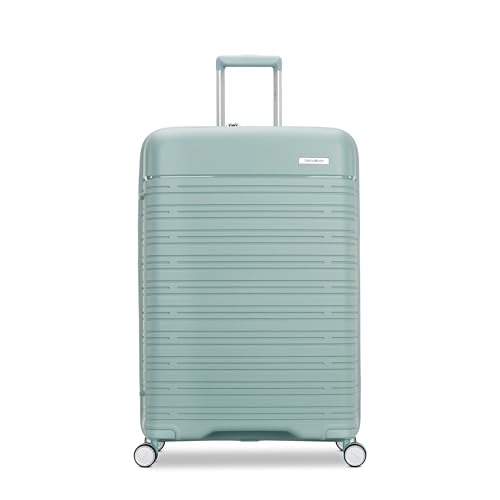
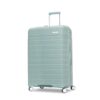
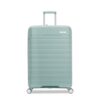
The Samsonite Elevation Plus large hardside spinner in cypress green, model 142911-1244, is one of the most heavily specified listings in this catalog. It names its shell polymer, its zipper brand, its lining material and its warranty period. It also publishes an interior dimension that is the same as its exterior on two axes, and two weights that differ by three pounds.
The traveler and the trip this covers
This is the long stay checked bag: two weeks for one person, a week for two sharing, or a relocation. It is the largest size most travelers should consider, because beyond this point empty weight and handling difficulty rise faster than usable capacity does.
The organizational features point at someone who packs formally: a dedicated garment compartment, a zippered divider and a WetPak pocket describe a bag for clothes rather than gear. Readers comparing large hardside cases should read the Samsonite Omni 2 large checked spinner and the Samsonite Stryde 2 hardside.
Dimensions, and a linear total sitting exactly on the line
The feature bullet gives external dimensions with wheels of 29.5 by 19.5 by 13 inches, and an interior of 27 by 19.5 by 13 inches. The specification block’s Product Dimensions of 19.5 by 13 by 27 inches match the interior figure rather than the exterior.
What a check-in counter would find
Most United States carriers apply a checked bag limit of 62 linear inches, meaning length plus width plus height added together. The exterior figure of 29.5 by 19.5 by 13 inches totals exactly 62 inches. Exactly at the limit.
That is a deliberate design decision and it is worth understanding rather than celebrating. It maximizes capacity for anyone on a 62 inch allowance, and it leaves nothing in reserve. Carriers that publish a lower limit, and some international and regional ones do, would put this bag over. A shopper reading only the specification block would see 27 inches and calculate 59.5 linear inches, which is the interior figure and not what an airline measures.
Samsonite deserves credit for stating that the exterior figure includes the wheels, which is the disclosure most listings omit.
The interior figure that cannot be right
The published interior of 27 by 19.5 by 13 inches is identical to the exterior on width and depth. A hard shell has thickness. A polypropylene case cannot have the same internal and external width, and the same is true of depth. Only the height differs, by 2.5 inches, which is the wheel and handle allowance.
The likeliest reading is that the interior figure describes the packing case body rather than the usable cavity, and that real internal width and depth are each an inch or so less. The listing does not say, and we are not going to invent numbers. Plan conservatively.
Two weights, three pounds apart
The specification block gives an Item Weight of 13.27 pounds. The second feature bullet says the bag weighs only 10.3 pounds.
Those cannot both be right, and the gap is nearly a quarter of the lower figure. On a checked bag that matters: 13.27 pounds consumes 27 percent of a standard 50 pound allowance before anything goes in, while 10.3 pounds consumes 21 percent. There is no way to resolve it from the listing. Plan on the heavier figure and confirm with the seller if you fly a carrier with a tight allowance.
No capacity figure is published in liters or cubic inches anywhere, which on a bag sold on packing performance is a real gap.
Polypropylene, and what it does differently
Samsonite names the shell as polypropylene, describing it as offering exceptional flexural strength and fatigue resistance. That is an accurate description of the material rather than a marketing flourish.
Polypropylene is more flexible than polycarbonate and considerably more flexible than ABS. Under impact it deforms and springs back rather than cracking, and fatigue resistance means it tolerates being flexed repeatedly without developing stress fractures. That is exactly the load case a checked bag sees. The trade is stiffness: a polypropylene shell bows more under a heavy load, so a fully packed case can flex rather than holding a crisp shape. It also takes surface scratches readily, which is what the scratch resistant treatment in the product name is addressing. A similar shell material appears on the Travelhouse three piece hardshell set.
Zippers, wheels, handle and the tracker holder
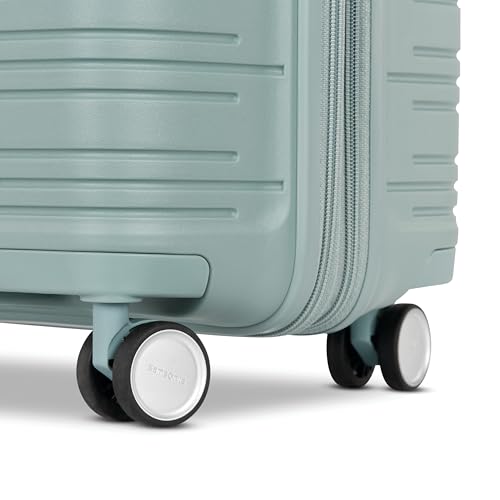
The zippers are named as Fuzion zippers by YKK, and the listing says the design eliminates traditional weak points. Naming the zipper maker is worth real credit because the zipper is the component that ends most cases, and YKK is the industry benchmark. Very few listings in this catalog name one.
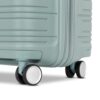
The wheels are nylon spinner castors with hubcaps. No count is given, though four spinner assemblies is the standard arrangement. Exposed castors remain the most common failure point on any wheeled case and are part of that 29.5 inch exterior height.
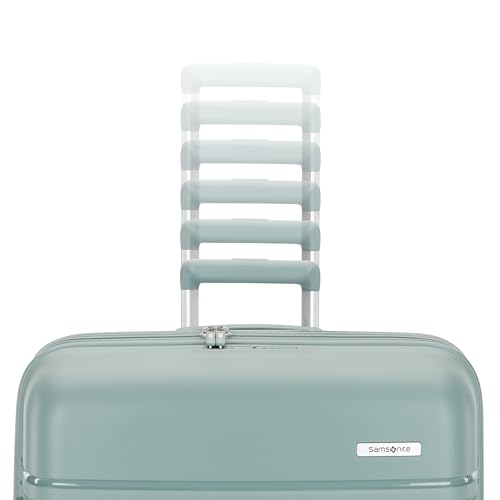
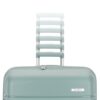
The RightHeight handle system offers multiple one inch adjustments with a TPR comfort grip. Incremental adjustment rather than two fixed stops is a genuine advantage for anyone who is not average height,
An integrated AirTag holder is fitted, with the AirTag not included. Worth understanding: an AirTag is a Bluetooth locator that reports its position through other nearby devices, not a GPS tracker, so it tells you where the bag was last seen rather than where it is going. It uses a replaceable coin cell rather than a lithium ion power bank, so it does not raise the boarding questions that a bag with a built in battery would.
Interior, lock and warranty
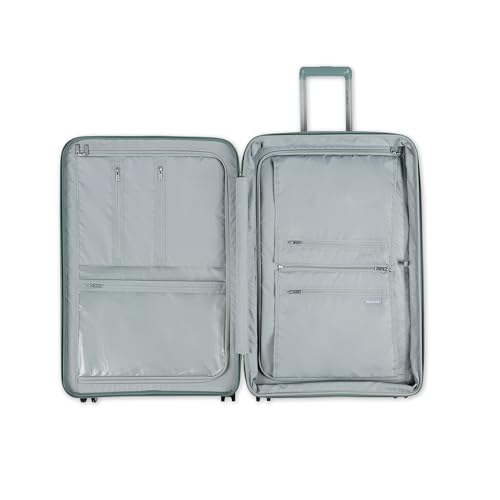
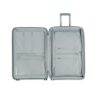
The interior has two oversized packing compartments, a zippered divider with dual accessory pockets, a WetPak pocket and a dedicated garment compartment. A WetPak is a sealed pouch for damp or leaking items, which keeps a wet towel or a shampoo bottle away from clothing. The lining is Recyclex, described as woven from 100 percent post consumer recycled plastic bottles.
A keyless TSA approved lock is fitted, and the listing frames it as added security. That needs the standard correction. A TSA recognized lock opens with a universal key held by screeners, and those key designs have been widely reproduced. It deters casual tampering and keeps a zipper closed in transit. It does not secure valuables.
Samsonite states a ten year warranty backed by rigorous testing, under a heading reading built to last, guaranteed. The ten year figure is a real term. The testing claim names no standard and describes no test, so it is marketing language. And the scope of the warranty is not published here: luggage warranties ordinarily cover defects in materials and workmanship rather than damage caused by airline handling, which is precisely what a checked bag sustains. One bullet also describes the product as hard-shell carry-on luggage, which it is not, since this is the large checked size.
The listing shows a 4.6 star average across 41 ratings, a thin sample, and ranks 124th in Suitcases and 145,976th in Clothing, Shoes and Jewelry. Country of origin is Thailand. A smaller accessory from the same line appears in the Samsonite Virtuosa train case review, and more options sit across the suitcases category and the carry-ons category.
Who should buy it, and who should not
Buy it if you want a large polypropylene checked case with named YKK zippers, an incrementally adjustable handle, a garment compartment and a WetPak, a recycled lining and a stated ten year warranty.
Skip it if your carrier publishes a checked limit below 62 linear inches, because the exterior sits exactly on that figure. And treat both the interior dimensions and the lighter weight figure with caution, since the interior matches the exterior on two axes and the two published weights differ by three pounds.