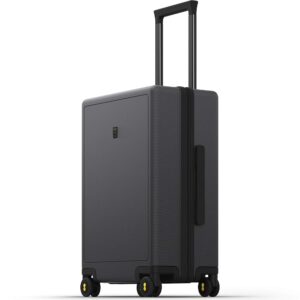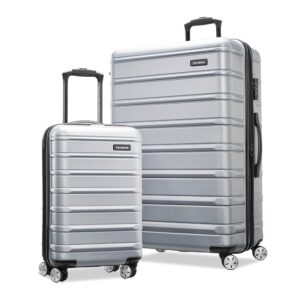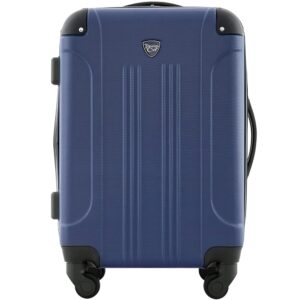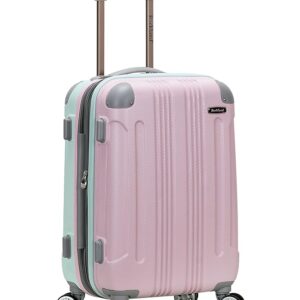


Description
The TPRC Smart underseater is a 15 inch soft sided rolling personal item bag with a side USB port, built in 1680 denier polyester and rolling on inline skate wheels. Those are three good specification choices. What the listing does not contain is a single dimension, a weight or a capacity figure. On a bag whose entire purpose is fitting into a specific space under an airplane seat, publishing no measurements at all is close to publishing nothing.
The traveler and the trip
A 15 inch underseat bag is an overnight or two night bag, or a work bag for someone who flies short haul regularly. The buyer is the basic economy flyer who wants wheels without paying for a carry on, and the person who already owns a cabin case and wants a second bag to move alongside it.
The USB port suggests a traveler who wants to charge a phone in a terminal. The fully lined interior with accessory pockets and an open side pocket suggests someone who wants things reachable rather than packed away. It does not suit trips beyond a long weekend. Full size cabin cases sit in carry on luggage, and the same maker’s cabin sized cases are the obvious step up.
Dimensions, and the total absence of them
There is no length, no width, no depth, no weight and no capacity anywhere in the source data for this product. The only size reference is the phrase 15 inch in the product name, and 15 inch on an underseat bag is a nominal description rather than a measurement.
Why that is disqualifying on this particular product
Personal item allowances in the United States commonly sit around 18 by 14 by 8 inches, and several budget and ultra low cost carriers publish tighter boxes and enforce them with a rigid gauge at the gate. The underseat space itself is not standardized either: it varies with aircraft type, it shrinks at bulkhead and exit rows, and on some aircraft it is partly occupied by an equipment box.
Against all that variation, a buyer needs three numbers: the length, the width and above all the depth, measured with the wheels and any exterior pocket included. This listing gives none of them. The site excerpt previously claimed the bag was a fit for underseat storage on most airlines. Nothing published here supports that, and we are not going to repeat it. Get the exterior dimensions in writing from the seller before you order, and check them against your specific carrier’s personal item box. On an underseat bag that measurement is the whole purchase.
The one thing working in the buyer’s favor is that this is a soft bag. Fabric compresses, and a soft bag that is marginally over a gauge with a half packed main compartment will often go in where a rigid case would not. That is a property of the material and not a substitute for knowing the numbers.
Fabric, wheels and the interior
The fabric is named as 1680 denier polyester, which the maker calls the best fabric to withstand time and travel. That is marketing language on top of a genuinely good specification. Denier measures the weight of the yarn, and 1680D is at the heavy end of what luggage uses: for comparison, most budget softside cases use 300D to 600D polyester and do not publish the figure at all. A 1680D weave resists abrasion at the corners and the bottom edge, which is where soft bags die. Naming the denier is the single most useful thing this listing does.
The wheels are inline skate wheels, and on an underseat bag that is the correct choice rather than a compromise. Inline wheels sit recessed into the body at one end, so the bag is tilted and pulled rather than pushed upright. They do not protrude beneath the bag, which means they do not consume depth that a gate gauge measures and they do not take interior volume. They are also larger than spinner castors, so they clear thresholds, curb cuts and the metal lip of a jet bridge. The trade is that you cannot push the bag beside you, which on a bag this size matters less than it would on a full cabin case. Compare that against the spinner castors on the BAGSMART Underseat-Black, which rolls more easily on flat floors and gives up depth and durability to do it.
The interior is fully lined with accessory pockets, and there is an open side pocket outside for items you want to grab quickly. The listing does not mention a padded laptop compartment, a lock, a stacking strap for riding on a larger case, or a telescoping handle specification. The absence of a stacking strap is the notable one, because that feature is what makes a rolling personal item work as part of a pair.
The USB port and the battery rule
There is a side USB port, and the listing states plainly that the power bank and the USB cord are not included. That clarity is welcome and it matters for boarding.
Most airlines require lithium batteries and power banks to be carried in the cabin rather than in the hold, and they require any battery inside a piece of luggage to be removable. Bags with batteries built permanently into the shell have been refused at check in and at the gate by multiple carriers. Because the power bank here is yours and lifts out of a pocket, the bag is on the right side of that rule. The obligation transfers to you: if this bag ever ends up gate checked, take the power bank out first and carry it on your person. The same applies to every case with a port, including the Traveler’s Choice Pagosa and the Samsonite underseat spinner with a USB port.
A practical note on the port itself. A USB port on a bag is a passthrough: it connects a socket on the outside to a cable inside that you plug into your own power bank. It does not store power. If you forget the power bank, the port does nothing.
Warranty, the maker and the comparison set
No warranty term appears anywhere in the source data. What the listing offers instead is company history: Traveler’s Club began in 1986 and describes a commitment to quality and customer service. That is brand copy, not a warranty, and it commits to nothing after purchase. Get a term and an exclusion list in writing before ordering, and expect airline handling damage to be excluded, as it is across essentially this whole category.
On a bag that stays in the cabin, the failures that matter are the zipper, the wheels and the handle mechanism rather than shell damage, so ask specifically what any term covers on moving parts. The comparison set is other rolling underseat bags, which sit across carry-ons on this site, including the LUGGEX 16 inch underseat case, which publishes its dimensions.
Who should buy it and who should not
Buy it if the 1680 denier fabric and the inline skate wheels are what you want, and you are prepared to get the dimensions from the seller before ordering. Those two specifications are better than most of the field and they are what determines how long the bag lasts.
Skip it if you need to check the bag against a personal item gauge from the listing, because this page publishes no length, no width, no depth, no weight and no capacity. Skip it too if you need a stacking strap or a padded laptop compartment, neither of which is mentioned. And remember the USB port needs your own power bank to do anything at all.