Description
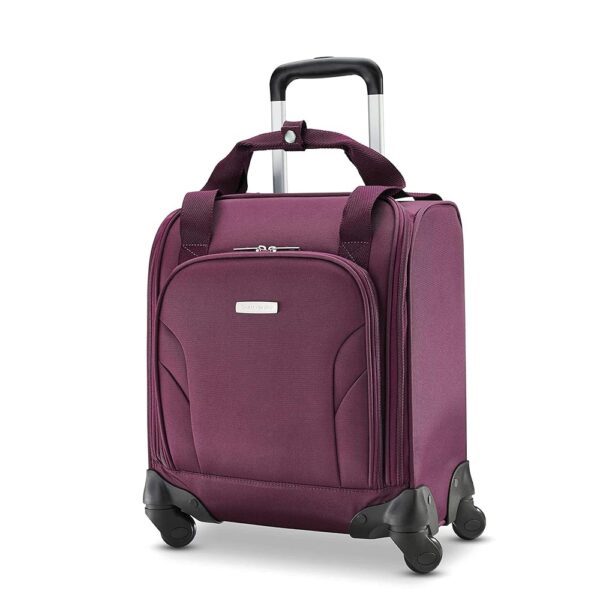
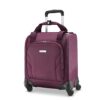
This Samsonite is an underseat spinner with a USB port, a padded 13.3 inch laptop compartment and four multidirectional castors. It is a personal item bag rather than a cabin case, and the listing handles the one thing that matters better than most: it states outright that underseat storage capacity and dimensions vary and tells you to check with your airline. Where it falls apart is the capacity data, which reads 176 cubic inches and 2.89 liters. Those are lunchbox numbers, not luggage numbers.
The traveler and the trip
An underseat spinner is an overnight or two night bag, or a work bag for someone who flies short haul regularly. The buyer is the basic economy flyer who wants wheels without paying for a carry on, and the person who already owns a cabin case and wants a second bag alongside it.
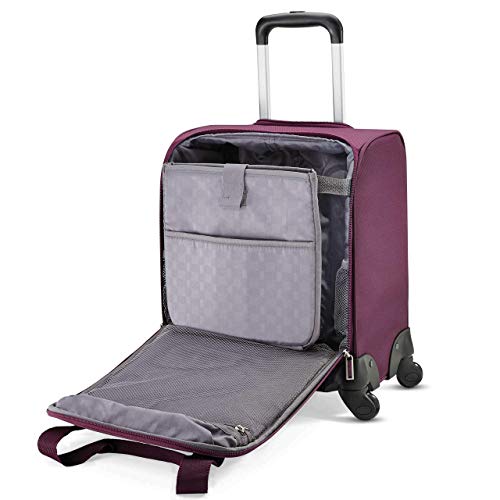
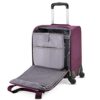
The padded laptop compartment takes a 13.3 inch machine, which is smaller than the 15.6 inch capacity on several competing bags and worth checking against your own laptop before ordering. Quick stash exterior pockets handle a phone, a boarding pass and a bottle. Full size cabin cases sit in carry on luggage, and the closest comparison on this site is the Samsonite underseat spinner in a different color, which is listed separately under a near identical model code.
Dimensions, and what they mean at a gate
The attribute block gives 9 by 13.5 by 16.5 inches. Reordered, that is 16.5 inches on the longest side, 13.5 wide and 9 deep. The manufacturer bullets publish no dimensions at all, so this single figure is the whole disclosure, and it does not state whether the castors, the handle and the exterior pockets are included.
Against a personal item allowance
Personal item allowances in the United States commonly sit around 18 by 14 by 8 inches, with several budget and ultra low cost carriers publishing tighter boxes and enforcing them with a rigid gauge. At 16.5 by 13.5 by 9 inches this bag has an inch and a half of margin on length and half an inch on width, and it is a full inch over on depth. Depth is the axis a personal item gauge is least forgiving about, because the gauge is a shallow slot and the bag has to go in flat.
If the 9 inches excludes the spinner castors, which protrude beneath the body on this format, the real depth is greater still. Samsonite does not say either way. What Samsonite does say, and this is to its credit, is that the bag fits under most airline seats and that you should check with your airline because underseat capacities and dimensions vary. That is the correct framing and it is more honest than the airline approved language on most competing listings. We are not going to improve on it. Measure the bag on arrival, including the castors, and check your carrier’s published personal item box.
The underseat space itself varies with aircraft type, shrinks at bulkhead and exit rows, and on some aircraft is partly occupied by an equipment box. A soft bag helps, because fabric compresses where a rigid case does not.
Wheels, handle and construction
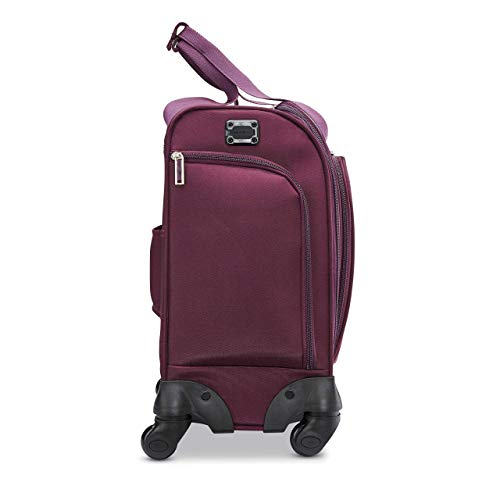
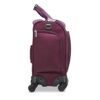
The wheels are four multidirectional spinner castors. On an underseat bag that is a debatable choice. Spinners let you push the bag upright beside you, which is easier through a terminal than tilting and pulling. They also protrude beneath the body, consuming part of the depth budget and exposing themselves to being kicked and dragged. Two recessed inline wheels, as used on the TPRC smart underseater, survive rough ground better and leave more interior volume. Given that this bag is already at 9 inches deep against a typical 8 inch allowance, protruding castors are working against it.
The handle is described as ergonomic with a push button lock, without a stated material or a number of stop heights. The listing does not name the fabric at all, which is the standing gap on soft sided bags: denier is what determines whether a bag frays at the corners in a year or lasts five, and no figure is given.
Item weight is given as 2.5 kilograms, which is about 5.5 pounds. Publishing a weight in kilograms on a listing aimed at a United States audience is an import artifact. At 5.5 pounds the bag is on the heavier side for a personal item, and on carriers that weigh cabin baggage that counts against you before you pack.
The USB port and the battery rule
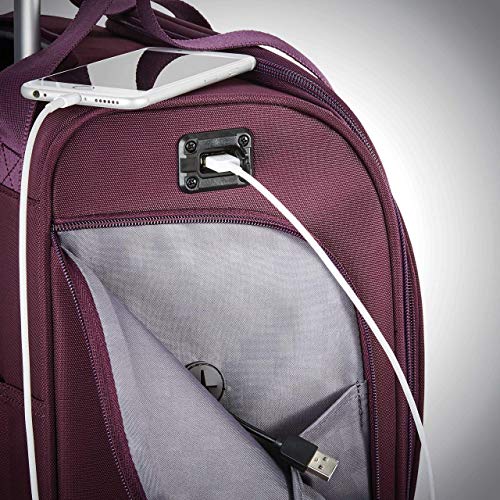
There is a USB port for charging electronics, and the listing states that batteries are not included. That clarity matters more than it might appear.
Most airlines require lithium batteries and power banks to be carried in the cabin rather than in the hold, and they require any battery inside a piece of luggage to be removable. Bags with batteries built permanently into the shell have been refused at check in and at the gate by multiple carriers. Because the power source here is yours and lifts out, this bag is on the right side of that rule. The obligation transfers to you: if the bag is ever gate checked, take the power bank out first and carry it on your person.
A practical note on the port. A USB port on a bag is a passthrough, connecting an external socket to a cable inside that plugs into your own power bank. It stores nothing. If you forget the power bank, the port does nothing at all.
Capacity, organization and the impossible figures
The capacity field gives 176 cubic inches and the total capacity field gives 2.89 liters. Those two are the same figure, since 176 cubic inches is 2.88 liters, so at least they are internally consistent. They are also nowhere near a real capacity for a bag measuring 16.5 by 13.5 by 9 inches, whose bounding box alone is over 2000 cubic inches. Three liters is a large lunchbox. The real figure for a bag this size is somewhere in the region of 25 to 30 liters, but that is an estimate and not a published number. Ask the seller.
Organization is the strong part: quick stash exterior pockets for smaller items, and a main compartment with a padded laptop compartment for machines up to 13.3 inches. Exterior pockets are the everyday advantage of a soft bag, because a boarding pass and a phone stay reachable without opening the main compartment.
There is no lock mentioned, no stacking strap for riding on a larger case, and no divider. The stacking strap is the significant absence, because that feature is what makes a rolling personal item work as part of a pair. Bags such as the LUGGEX 16 inch underseat case publish one.
Warranty, the model codes and what to compare
No warranty term appears anywhere in the source data for this listing, which is unusual for Samsonite, since the brand publishes ten year terms on most of its hard shells. Get the term and the exclusions in writing before ordering, and expect airline handling damage to be excluded, as it is across essentially this whole category. On a bag that stays in the cabin, the failures that matter are the zipper, the castors and the handle mechanism.
The identification data on this listing is muddled. The attribute block gives model number 112934-1717 while the page address for this product is built from a different product identifier entirely, and a near identical Samsonite underseat spinner appears separately in this catalog under model 112934-1041. Those are almost certainly color variants of one product listed as separate items. If you need to identify the exact variant for a warranty claim, use the model code rather than the page. Other options sit across carry-ons.
Who should buy it and who should not
Buy it if you want a Samsonite underseat bag with spinner castors and a USB port, your laptop is 13.3 inches or smaller, and your carrier’s personal item allowance is on the generous side. The maker’s own advice to check with your airline is the most useful sentence on the listing.
Skip it if you fly ultra low cost carriers with rigid personal item gauges, because at 9 inches deep the bag is already over a typical 8 inch allowance before the castors are counted. Skip it too if you need a stacking strap or a 15 inch laptop compartment. And disregard the published capacity entirely, because 2.89 liters is not a measurement of this bag.